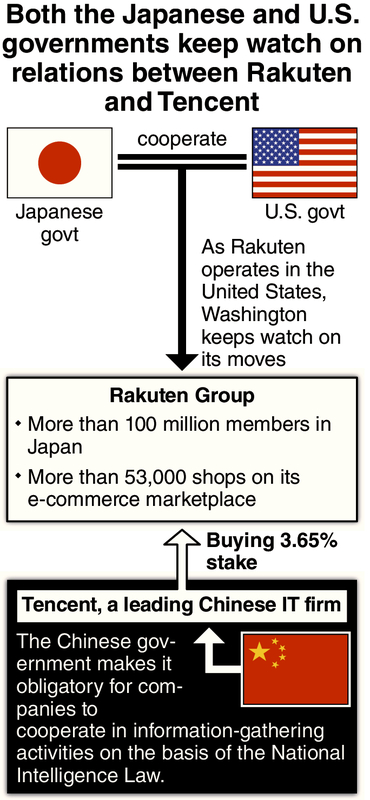
Japanese and U.S. authorities are paying close attention to a recent investment into Rakuten Group Inc. made by leading Chinese IT company Tencent Holdings Ltd. through its subsidiary.
The United States and China have been engaged in fierce competition for supremacy in the digital sector. As concerns cannot be dispelled over possible leakage to China of private information on Rakuten customers, the authorities of Japan and the United States are paying close attention to the companies' movements.
-- Rakuten aims to catch up
Speaking about the Tencent investment, Internal Affairs and Communications Minister Ryota Takeda said at a press conference following an April 23 Cabinet meeting that on the basis of the Foreign Exchange and Foreign Trade Law, "We will make responses appropriately at the ministries concerned, including the Internal Affairs and Communications Ministry." The communications ministry will cooperate with the Finance Ministry and the Economy, Trade and Industry Ministry on the matter.
In March, Rakuten obtained an investment of about 65.7 billion yen from a subsidiary of Tencent, which acquired a 3.65% stake in the Japanese e-commerce firm. It was meant for Rakuten to beef up its mobile phone business, which the company entered on a full-fledged basis last April. Building mobile phone base stations are said to require "trillions of yen" in funds.
Amid the intensifying competition to reduce mobile phone service charges, Rakuten, a late starter in the mobile phone market, had to hurry to establish its communication networks -- dwarfed by those of rivals NTT Docomo Inc., SoftBank Corp. and KDDI Corp. -- seeking funds from external sources to do so. An official related to the matter said that Rakuten President and CEO Hiroshi Mikitani, who enjoys friendship with top officials of Tencent, took the lead in the recent investment.
-- 'Pure investment'
Tencent is one of China's leading IT firms, as powerful as Alibaba Group Holding Ltd. The Chinese government makes it obligatory for companies and other entities to cooperate in information-gathering activities, on the basis of the country's National Intelligence Law. Thus, there are concerns over possible leakage of private information owned by Rakuten to China.
According to Rakuten: "Data has been sealed off, and [the investment] is by no means meant [for Tencent] to get involved in management and [customer] data. It is considered as a pure investment."
At the time of announcing the investment in March, however, Rakuten said, "We will aim at expanding our services through cooperation with the Tencent Group, which has advanced technologies." Rakuten enjoys more than 100 million memberships in Japan, while the number of shops on "Rakuten Ichiba," an e-commerce marketplace, totals over 53,000. As Rakuten also operates its e-commerce business in the United States, the U.S. government is said to be paying attention to the recent investment made by Tencent.
-- Foreign capital control
The government last year put into force the revised Foreign Exchange and Foreign Trade Law, reinforcing its control over investments by overseas investors into Japanese companies with technologies deemed important from the viewpoint of national security.
Before the revision, the government had to be notified when foreign investors planned to acquire "10% or more" of the issued or voting stock of a listed company in one of the important business sectors. After the revision, that threshold has been lowered to "1% or more," and the important business sectors are now designated as "core business sectors."
Rakuten is included in the "core business sectors," but Tencent did not make any prior notification to the government regarding its recent investment. That is because, in the case of a foreign investor's acquiring less than 10% of the stock of such a listed company, it can gain exemption from prior notification if the following conditions are met: 1) foreign investors, including closely related parties, shall not be appointed as officers of a company being invested in; 2) foreign investors shall not propose to the general shareholders' meeting any transfer or disposition of the investee company's business activities in the designated business sectors; and 3) foreign investors shall not access nonpublic information about the investee company's technology which is related to national security. The judgment as to whether such conditions are met is to be made, in principle, by the investors themselves.
Overseas investors who deem themselves exempt from prior notification in their acquisition of such stock still need to make a post-investment report to the government within 45 days. The Tencent side is required to make the report by mid-May.
The government is set to closely watch the moves to be taken by Tencent, on the basis of the concept of the Foreign Exchange and Foreign Trade Law, while also sharing information with Washington.
Read more from The Japan News at https://japannews.yomiuri.co.jp/