Muscled out of their usual profit models by a disease outbreak that has turned the economy on its head for nearly four quarters, the embattled transportation and travel industries are increasingly taking on new challenges to survive.
Some employees in these sectors have shifted to other occupations, such as farming and making soba. And with the coronavirus disaster and its fallout unlikely to abate anytime soon, more companies are trying to reduce or repurpose their surplus workers to help salvage their bottom lines.
--Dispatches to farms, co-ops
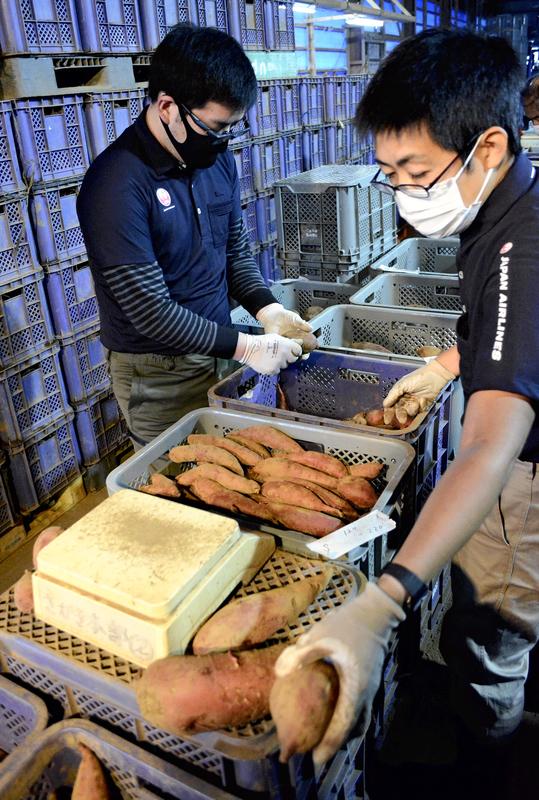
Sakaki, an agricultural corporation in Katori, Chiba Prefecture, produces vegetables on a farm about six kilometers east of Narita Airport. In early October, four men who usually work at the airport were sorting out the harvested sweet potatoes.
Japan Airlines subsidiary JAL Ground Service Co. has dispatched about 1,200 employees to agricultural corporations and farms near the airport since May. The company usually inspects and services planes, but decided to redeploy its employees elsewhere because the number of flights decreased sharply, creating a surplus of personnel. Classifying the work as training, the company pays their salaries. Agricultural corporations also pay a certain amount of compensation.
One of the employees who took part in the training, said, "The practice of talking to each other for on-time airline operations is also useful for selecting vegetables."
--Food instead of passengers
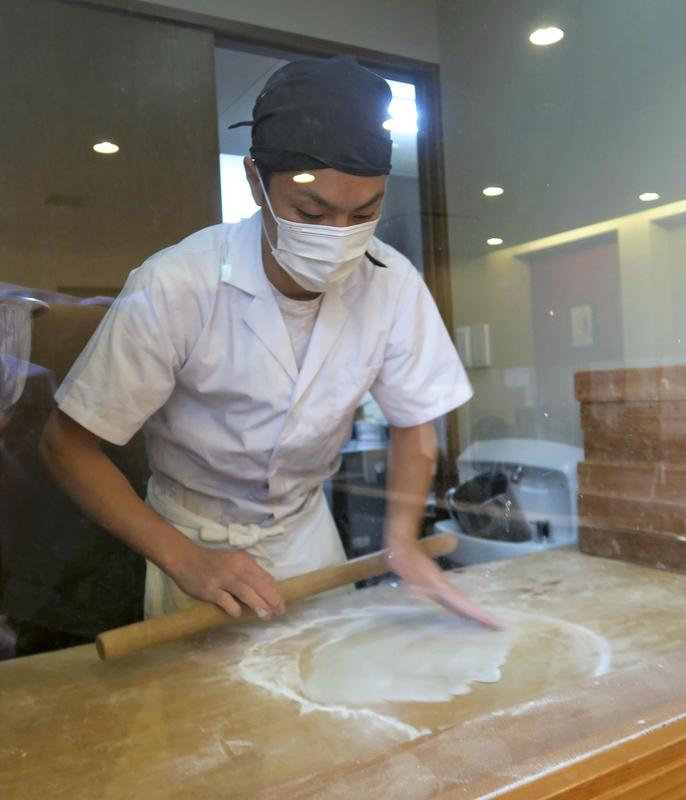
H.I.S. Co., a major travel agency that has been hit hard by a series of cancellations of overseas trips, has entered the restaurant business. On Oct. 2, the company opened a soba restaurant called Manten no Hidesoba in Kawagoe, Saitama Prefecture.
The company invited an owner of a soba restaurant who had decided to retire to become an instructor, and eight amateur employees became apprentices. They have progressed to the point where they can open the soba restaurant for a few months.
The restaurant serves Juwari soba, which is made with 100% buckwheat flour. On Nov. 5, the company opened their second outlet in the Iidabashi district of Chiyoda Ward, Tokyo.
There are also attempts to transport agricultural products in place of the drastically reduced number of passengers.
In late October, Seibu Railway Co. carried Shine Muscat grapes grown in the Chichibu region of Saitama Prefecture to Ikebukuro, Tokyo, on a limited express train in a trial run. They sold the grapes, picked in the morning, at a department store in the city on the same day.
In September, Nishi-Nippon Railroad Co. hauled fruits and vegetables harvested in Miyazaki Prefecture to a commercial facility in its group in Fukuoka by express bus on the same day. Sales of both products were brisk.
--Against backdrop of deficit
The government has tried to support these industries with its Go To Travel tourism campaign to subsidize consumers' travel expenses, but there is a long way to regain the demand the sector once enjoyed.
Facing huge annual net losses this year are: ANA Holdings Inc., 510 billion yen; JAL, 240 billion yen or more; JR East, 418 billion yen; and H.I.S. 31.8 billion yen.
ANA Holdings is also looking to transfer employees to other industries, including KDDI Corp. and Nojima Corp., as part of efforts to reduce labor costs. There are a variety of jobs available at those companies, including telephone counter and customer services, as well as English conversation instruction.
Hideyuki Araki, chief researcher at Resona Research Institute Co., said the companies are repurposing its employees in an effort to avoid possible drawbacks of layoffs. "If a company simply reduces its workforce through restructuring, it could face a labor shortage later when the coronavirus disaster is resolved," he said. "But there is room for good performers at other companies if the secondment path is chosen."
JAL Ground Service employees sort sweet potatoes in Katori, Chiba Prefecture on Oct. 8.
An employee of H.I.S. is seen making soba noodles at a restaurant in Kawagoe, Saitama Prefecture, on Oct. 28.
Read more from The Japan News at https://japannews.yomiuri.co.jp/