An increasing number of Japanese information technology companies are offering numerical data on population flows at major stations, tourist spots, and other locations to help prevent the spread of coronavirus infections. They aim to meet individual needs by including information on retail stores and other nearby commercial facilities, as well as improve the accuracy of information.
Data on population flows is collected by communications companies such as KDDI Corp., known as one of Japan's three largest mobile operators. Communications companies use the Global Positioning System of smartphones to collect information on the number of people and the congestion situation in a specific area and then provide it to outside companies.
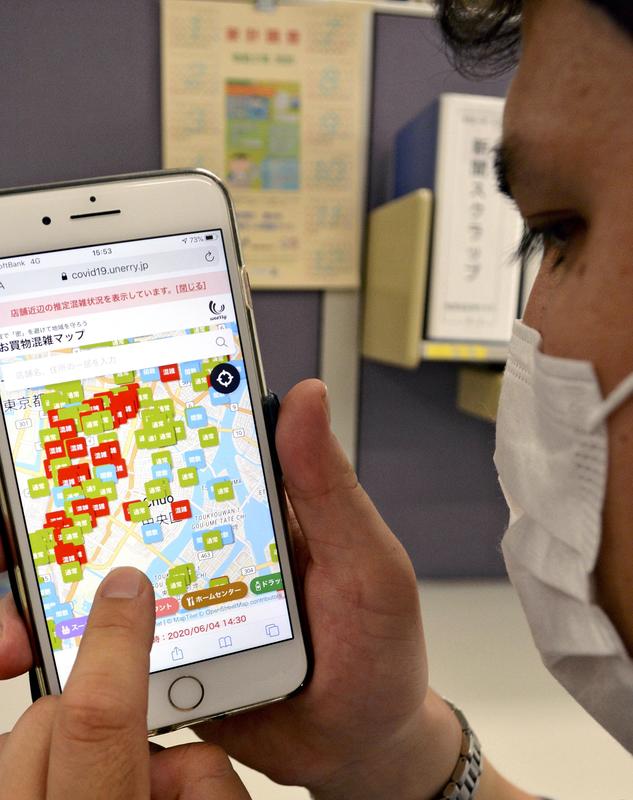
Since May, a Tokyo-based start-up Unerry Inc., that analyzes big data, has been providing data for smartphones that shows congestion information on areas around roughly 28,000 supermarkets and other shops nationwide. It shows the degree of congestion in three levels: crowded, normal and not crowded -- compared to situations in the past four weeks. The data is updated every hour, making it easier for users to shop during off-peak hours.
GPS, which is the most commonly used system today, may have errors of up to several tens of meters compared to the actual location, but it is said that accuracy will be improved to the level of several centimeters in the future, and it will be possible to display more detailed congestion information.
Yahoo Japan Corp., meanwhile, has improved its service called Congestion Radar, which indicates the degree of congestion by color on its map applications. Previously, Yahoo provided data of two hours prior, but since May 25, the lag has shrunk to 20 minutes, bringing the data closer to real-time.
All of such data is provided anonymously, so it is said that there is no concern that a third party will identify an individual. On the other hand, if the government or other entities uses information that can identify individuals, it can be expected to have a great effect in preventing infections. In South Korea and Taiwan, GPS and location data were used to track movement histories of infected people and those who contacted them, but it has become a controversial issue with concern over privacy.
Read more from The Japan News at https://japannews.yomiuri.co.jp/