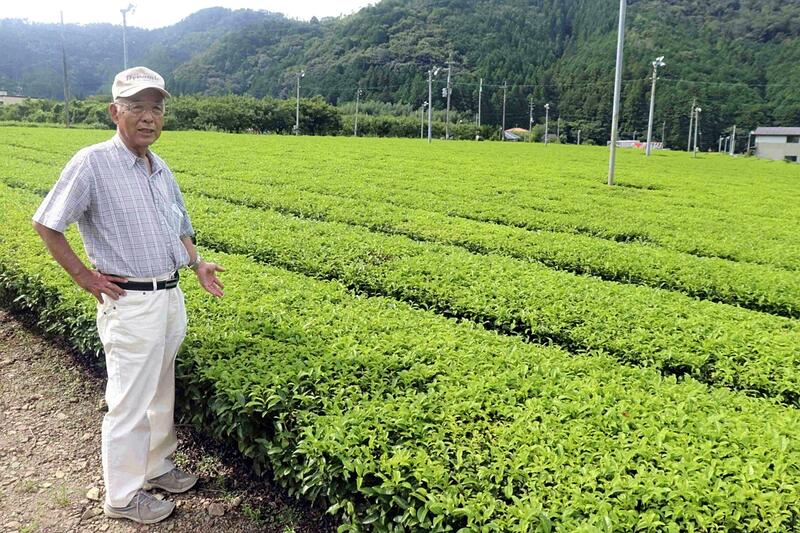
Tea producing regions across Japan have been struggling to stay afloat amid the novel coronavirus pandemic, as restrictions on social gatherings drain demand for the beverage of choice for everything from office board meetings to funerary return gifts. Facing flagging sales, municipalities have begun brewing up initiatives to buoy their local tea industries, in the hopes of finding a glass half-full solution to a challenging situation.
-- Funerals and tourists
"Things have never been this bad before. It's devastating," said Isamu Harada, 77, the head of a local cooperative producing Tanba Sasayama tea, a specialty of Tanba-Sasayama, Hyogo Prefecture.
In ordinary times, half of the tea produced by the 68-member cooperative would end up being used as a ceremonial thank you gift, given out by the bereaved in return for funeral offerings.
But the pandemic has forced funeral services to scale down, and the cooperative's tea sales for such return gifts totaled only about 1.8 million yen in fiscal 2020 -- a paltry one-tenth of the 13.6 million yen peak recorded in fiscal 2015.
"We don't get tourists anymore either, so have also been hit with a loss of souvenir sales," Harada said.
In Iruma, Saitama Prefecture -- an area known for its Sayama tea -- farmers who specialize in the production of funeral gift tea have similarly seen their sales channels dry up. As a relief measure, the Iruma tea industry association has arranged for the city government to purchase tea bags and distribute them to local residents for free.
But as one tea association official said, "Even if the pandemic is brought under control, I doubt funeral services will ever go back to the way they were before."
-- Tea as 'communication tool'
According to the Agriculture, Forestry and Fisheries Ministry, production of unrefined "aracha" tea -- tea leaves that have been steamed and dried but remain unfinished -- declined by 15% nationwide in 2020 from the previous year. Year-on-year sales of pricier first-flush "ichibancha," the coveted first crop of tea harvested between late April and early May, also fell by 20% in Shizuoka Prefecture, the top producer of aracha, and by 17% in Kagoshima Prefecture, which ranks second for aracha production.
Japanese tea is often used as a "communication tool," whether served by companies to lubricate conversation when meeting with guests, or given as a decorous gift that speaks for itself. The loss of such social settings amid the pandemic has quelled demand.
According to statistics compiled by the Tokyo-based Japanese Association of Tea Production, the total production of sencha, a type of Japanese green tea prepared by infusing whole leaves in hot water, declined by about 15% in 2020 from the previous year. The agriculture ministry believes that the spread of teleworking, as well as the closure of department stores and ryokan inns, have also been factors behind the decline.
-- Aging of tea farmers
The pandemic adds to the headaches of a tea industry that was already faced with declining production and the advancing age of its farmers.
In 2000, the percentage of tea farmers aged 65 or older was 49%. By 2020, this figure had grown to 62%.
Over the same 20-year period, tea-growing acreage and production volume both fell by 20%.
Fearing for the future of the tea industry, local governments have been coming up with a range of support measures they hope will help stimulate more demand for tea.
In June last year, the Shizuoka prefectural government set up a subsidy system that offers producers 5 million yen to develop new products and 3 million yen to cultivate further sales channels.
As of Sept. 9, 26 products had been selected for sponsorship under the scheme, ranging from tea aroma items to sparkling beverages made with tea leaves.
Last autumn, the Kyoto prefectural government purchased about 180,000 Uji tea bags with central government subsidies and distributed them for free at shopping malls and other locations in the prefecture. Experts were enlisted to host online seminars on tea-brewing technique, and hands-on teapot-making workshops were held.
"We want to do what we can to help spread the appeal of Japanese tea, so that it can go on to play a familiar role [in people's lives] even after the pandemic ends," said an organizer of the prefectural government initiative.
Read more from The Japan News at https://japannews.yomiuri.co.jp/