Retail and food service industry groups released guidelines Thursday designed to ensure the safety of customers and employees during the coronavirus outbreak.
Steps to help prevent infections include workers and customers maintaining a safe distance between people when packing items and lining up to pay the bill, and using a tray to pay with cash and return change. Many businesses have recently resumed operations after implementing their own steps to combat the virus' spread, and the guidelines are intended to make customers more understanding of in-store services and customer service standards that are being increasingly adapted to fit the times.
The guidelines emphasize frequent handwashing and preventing infections caused by person-to-person contact.
On Thursday, staff stationed at the entrance of the Tamagawa Takashimaya shopping center in Setagaya Ward, Tokyo, wore gloves and face shields as they sprayed disinfectant on customers' hands and checked their temperature with a forehead thermometer, asking customers to understand the reason for these steps. The same day, three Takashimaya stores in the Tokyo metropolitan area that had restricted their operations to selling food expanded the range of items for sale to include clothing and other goods. "We want to strike a balance between continuing our operations and taking steps to prevent infections," a Takashimaya official said.
The guidelines also stressed the importance of maintaining distance between people inside and outside shops. Major distributor and retailer Aeon Co. resumed operations at 42 shopping malls in 19 prefectures -- albeit with infection prevention measures in place -- after local government requests to close businesses were eased Wednesday. The Aeon mall in Natori, Miyagi Prefecture, halved the number of seats in its food court from 1,000 to 500 and widened the spaces between tables. Signs displayed inside the mall urge customers to keep a safe distance from others.
On Thursday, McDonald's Japan Co. revealed a plan to restart in-store dining at outlets in regions where the state of emergency has been lifted. The spaces between chairs and tables at these outlets will be widened.
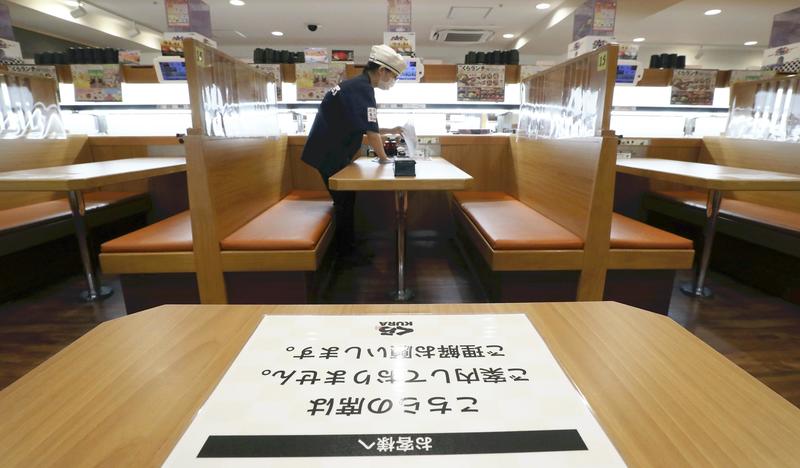
There will also be changes to how customers shop and are served. Kura Sushi, Inc., which operates a chain of conveyor belt sushi restaurants, will launch drive-through services at some restaurants. Customers will order in advance by smartphone, and then pick up their sushi from the restaurant parking lot at a designated time.
"We're also stepping up our takeaway service, but we'll take additional measures to ensure customers can dine at our restaurants with peace of mind," a Kura Sushi official said.
Starbucks Coffee Japan, Ltd. and other companies are likely to expand the use of "mobile orders," in which customers place an order via their smartphone and then pick up their purchase at the store.
Placing the priority on preventing the spread of infections is making it difficult to provide the kind of customer service businesses practiced before the outbreak.
Many supermarkets and department store food sections have stopped in-store food sampling and no longer allow customers to personally measure and select the volume of loose food they want to buy. Summit, Inc., which operates supermarkets in the Tokyo metropolitan area, has halted a service in which employees pack goods into reusable bags brought by customers. Many of Lawson Inc.'s convenience stores no longer let customers use their trash bins or toilets.
The guidelines clearly state that businesses should call for customers' understanding of changes to their services.
Read more from The Japan News at https://japannews.yomiuri.co.jp/