The COVID-19 epidemic is changing the behavior of businesses and consumers in Japan. Departments stores, facing the reality of not being able to serve customers as they had done before the crisis, are grappling with the challenges of providing hospitality in the coronavirus era.
In late May, Daisuke Morinaga of Toshima Ward, Tokyo, visited the Seibu Ikebukuro department store, which had fully opened for the first time in 1-1/2 months.
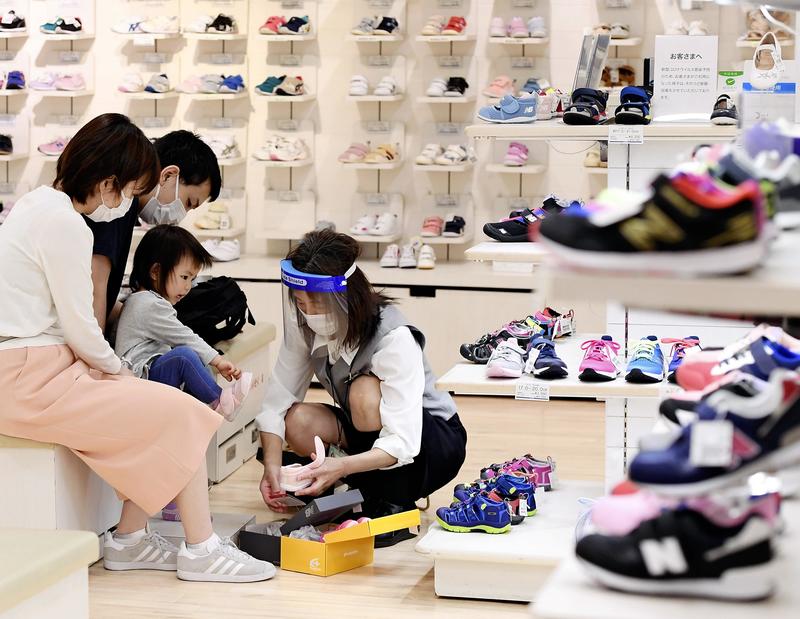
Morinaga was visiting the store to buy shoes for his young child, who had outgrown an old pair during the pandemic-imposed shutdown.
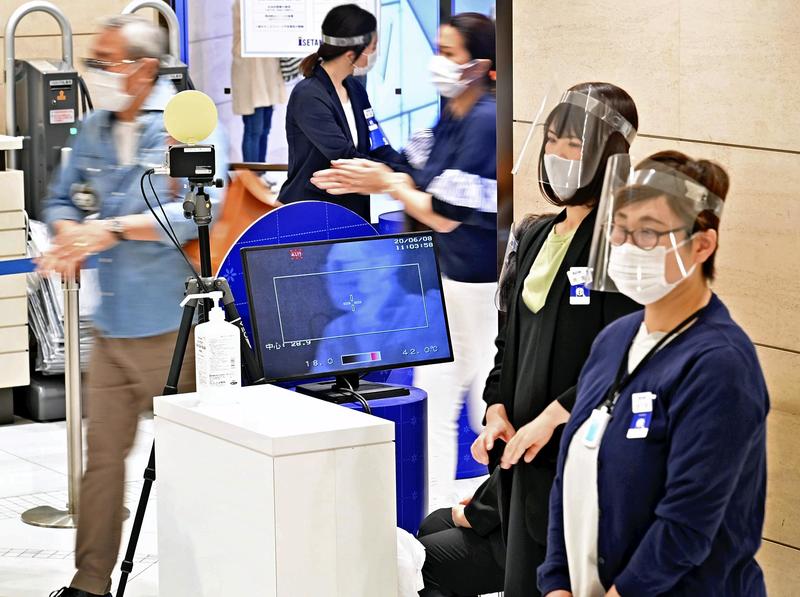
Shop clerks wearing face shields and sanitary masks in the shoe section was an unfamiliar sight. A clerk even asked if it was OK to touch the shoes before checking if they fitted correctly.
The clerk recommended only three pairs of shoes, half the number of pairs as on previous visits, and spent 15 minutes serving them, half the amount of time as usual.
"Customer service is the top priority for department stores. The challenge is how to sustain this principle in the coronavirus era," said Toshiki Kubota, 64, director and general store manager of Seibu Ikebukuro.
-- Safe space
Matsuya Ginza's seasonal sales event "Ginza no Otoko" (Ginza man) began on June 3 at the department store in Chuo Ward, Tokyo. The popular sales event has a history stretching back almost half a century.
Ahead of the event, menswear assistant manager and buyer Sho Awatake, 32, was thinking of ways to avoid the venue from becoming overcrowded.
The sales area space is about 500 square meters. With 50 salespeople on hand, the department store is limiting the number of customers at any one time to 100 to maintain social distancing at the event. Also, the width of the aisles has been doubled and the numbers of products, salespeople and fitting rooms have been halved.
Major promotions such as direct-mail advertising were dropped to lower the risk of infections spreading among crowds of shoppers.
"Of course, we have to sell products, but we also have to avoid the '3 C's' [closed space, crowds, close proximity]. We have to strike a balance," Awatake said.
On the first day of the event, the number of visitors was about 80% of the targeted figure, and there were no queues, which are usually seen at the event.
Annual sales of department stores in Japan totaled 5.8 trillion yen last year, of which apparel accounted for 30% at 1.7 trillion yen. In recent years, clothing sales have fallen 60% from their peak, and the prominence of department store food sections has increased.
However, clothing is an important source of revenue for department stores, with gross margins of 30% to 40%, higher than that of food products. If department stores continue to have difficulty attracting customers, business performances will deteriorate.
-- Profits down
With customers not returning since shops reopened their doors, many department stores are struggling.
The Isetan department store in Shinjuku Ward, Tokyo, resumed full operations on May 30. But the number of visitors to the store on Saturday and Sunday, the second weekend after its reopening, was only half the figure from a year earlier.
Sales on the weekend were down by only 20%. However, such a phenomenon is unlikely to continue as customers may have spent more to relieve stress after the coronavirus shutdown.
The Shinjuku outlet is one of Isetan Mitsukoshi Holdings Ltd.'s flagship stores, drawing more than 25 million visitors a year -- comparable to that for Tokyo Disney Resort, which attracts 29 million people a year.
Annual sales at Isetan Shinjuku totaled 274 billion yen, more than the combined sales of the Mitsukoshi Nihonbashi store and the Mitsukoshi Ginza outlet, both in Chuo Ward, Tokyo.
Department stores sell many products for special occasions, such as jewelry and gift items. A rapid recovery in customer numbers is unlikely amid a situation in which people are being asked to avoid nonessential and nonurgent travel.
A slump in sales at Isetan's flagship store will have a direct impact on the earnings of the entire group.
If people continue to refrain from going out, Isetan Mitsukoshi Holdings estimates that its group sales will fall by 30% to 40% and operating profits will decrease by about 3 billion yen-4 billion yen.
The company posted a record-high profit of 34.6 billion yen for the fiscal year that ended in March 2014. If a sales drop of 30%-40% continues throughout this year, it could put a huge dent in the group's annual profits.
-- Urgent reforms
Department stores are taking measures to avoid overcrowding on sales floors and minimize face-to-face customer service. Meanwhile, customers are wary of visiting crowded places.
How long will this unusual situation continue?
"The impact of the coronavirus has spread to almost all industries around the world," said Toshihiko Sugie, 59, president of Isetan Mitsukoshi Holdings. "A recovery might come after a long period of stagnation."
Asked about what steps should be taken in the current situation, an official of J. Front Retailing Co.'s finance section, said: "The first step is to reduce investment and expenses. The next is accumulating available cash and deposits. We want to secure a year's worth of working capital, including a line of credit."
Department stores are expected to strengthen their defenses first. After that, they likely will need to launch measures to boost earnings, on the assumption that conventional sales cannot be expected.
Department store sales declined 40% over the past 28 years from their peak in 1991. However, store operators have put off reforms partly due to the influx of overseas visitors in recent years. But international customers have disappeared amid the pandemic.
"Places in which people gathered used to be fun places, but they have become dangerous," said Takehiko Furuya, 46, a director and senior executive of Matsuya Co. "In the wake of the coronavirus, consumers will change. Department stores have no option not to change."
Brand power is no longer enough to sustain department stores. Some operators are expanding the leasing of sales areas to gain a stable income, while others are devising digital strategies to sell products without depending on physical stores, working with people who have large followings on social media, dubbed "influencers." Each of the companies is exploring new strategies to survive.
Read more from The Japan News at https://japannews.yomiuri.co.jp/