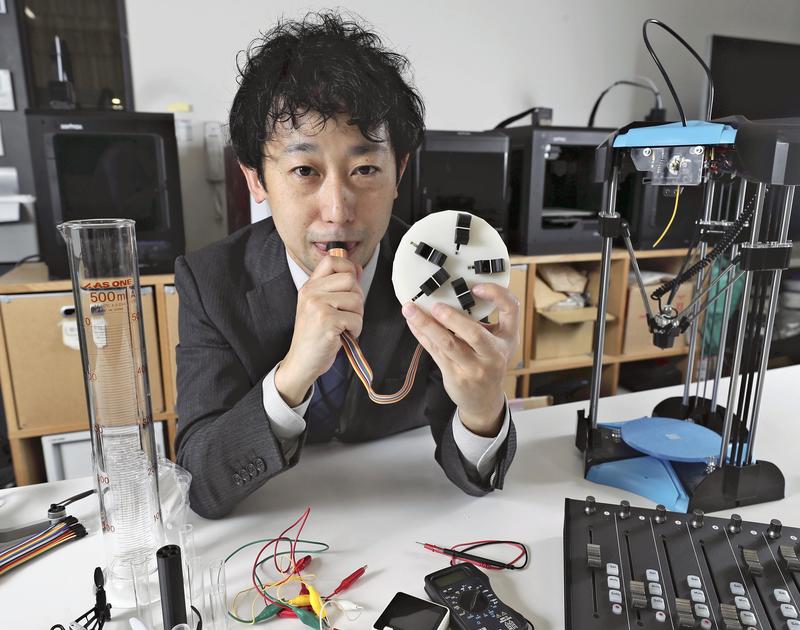
Homei Miyashita, a professor of the School of Interdisciplinary Mathematical Sciences at Meiji University, has been developing a "taste display," a device that can reproduce the taste of food on smartphone.
"Some may think, 'Is such technology really essential?" said the 43-year-old specialist. "The best way to have them understand its value is to bring it to fruition and have them experience it for themselves." Miyashita has produced unprecedented gadgets and systems by examining the power to change human behavior or society, The Yomiuri Shimbun introduces his work as well as his charm.
In the year 20xx, a restaurant by the seaside, which has seen a decline in customers, uploads a video clip online to introduce its unique ramen noodle dish. In the clip, the owner, who is also fisherman, boasts his soup made from the simmering seafood he catches free diving every morning.
"If you think it's delicious, please visit our restaurant," he says as he ladles the soup into a sensor on his smartphone. When viewers place their tongue on a specific device on their own smartphones, the exquisite salty flavor of the stock made from seaweed and seafood spreads in their mouths.
This futuristic image is the ideal use of a device currently under development. Its mechanism is as follows: sensors convert components of taste such as umami into numbers, which are further converted into data. Based on this data, flavors can be reproduced at the terminal.
"Taste is, so to speak, one of the results of a chef's cumulative efforts through training," he said. "I want to make a machine that, as long as the data is there, enables the reproduction of all flavors in the blink of an eye." He aims to reproduce the ultimate eating experience.
Miyashita specializes in human-computer interaction (HCI) studies. Just by swiping the screen of a smartphone with their fingers, anyone can access to the digital world. His research aims to devise methods such as this to allow people to use computers and other tools comfortably.
In his laboratory on the Nakano Campus of the university, a drone, a three-dimension (3-D) printer, a home video game and other gadgets are assembled, creating a space that may attract machine-loving children. In this environment, Miyashita has created devices that beat human imagination while carefully considering the relationship between humans and computers.
Three years ago, Miyashita developed a system to link a 3-D printer with a car navigation system.
When users enter a destination, such as a camping ground, into the car navigation system, it suggests tools that would be convenient to have or a new way of enjoying trips. They can then search for shops where the tools can be purchased along the way or even create them via the car's equipped 3-D printer.
"It is difficult for us to get the things we want immediately while on a trip. But, a 3-D printer is a computer that can physically produce what we want, and this is where I got the idea to link it with a car navigation system," he said. "The time when humans ordered and computers just obeyed has come to an end. Computers can now propose ideas that will influence human activities, which I hope will make people happier."
Three years ago, he became the head of the Department of Frontier Media Science at the age of 40, partly due to his highly-rated research originality.
Miyashita has always been fixated on the constantly evolving information technology devices from the point of view of an expressive person who recognizes the power to change human activities or society.
"People used to be passive consumers, who paid professional artists and only received their work," he pointed out. "Now, they have been transformed into those with creativity, who can freely deliver work of their own and enjoy them mutually. 'Democratization of expression' has made progress."
A similar phenomenon has occurred in the academic world, due to artificial intelligence and programming education having lowered technological barriers and breaking borders among various academic fields and citizens.
"Activities of expression are not only for artists. In the same respect, research is not only for experts," Miyashita said. "Specialists cannot seal themselves off. They must increase their contact with society to expand the range of ideas."
He is convinced that what contemporary specialists should focus on is the "power of ideas" to create new values.
Read more from The Japan News at https://japannews.yomiuri.co.jp/