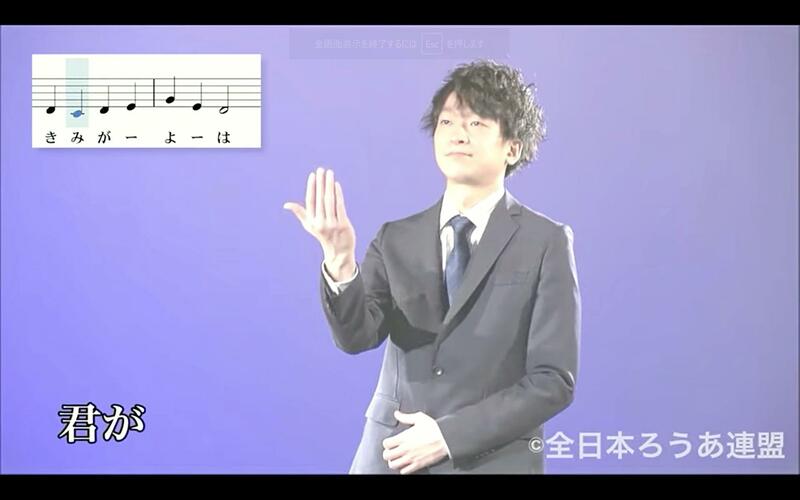
Hearing-impaired athletes competing at next year's Summer Deaflympics will be able to represent Japan not only through sports, but also with a new sign language version of the national anthem.
The new anthem is the handiwork of the Japanese Federation of the Deaf, which has been working with a team of specialists to devise a more natural signed rendition, in the hopes that it could be performed at the international sporting event in Brazil next May.
There is no official sign language translation of Japan's national anthem, "Kimigayo," which can lead to confusion when it comes to time to perform the anthem at sporting events.
Each sign language interpreter tends to put their own spin on the anthem and past translations have not necessarily been a perfect match to the music, making it difficult for deaf athletes to follow along in sync with spectators.
Rather than complete signs for each word, some translations have even relied on fingerspelling to represent each syllable in the slow-paced anthem, which can take the focus away from the meaning of the lyrics.
In November 2020, the federation set out to review approaches to expressing the anthem in sign, with the help of a team of Japanese literature and sign language experts.
The team said they paid particular attention to matching the tempo of the song, using expressions that were easy to remember, and providing a faithful translation of the original lyrics.
The initial result can now be viewed on YouTube as well as the federation's website.
After gaining exposure through performances at venues such as the Deaflympics, the team intends to continue refining their work based on input from the wider deaf community -- possibly even making it the standard version one day.
In February this year, the federation petitioned the government to establish an official sign language translation for the anthem.
The Cabinet Office, which handles the National Flag and Anthem Law, said it was aware of the request and would monitor the situation.
In the meantime, the federation's project remains a work in progress.
"For now, we just hope the prototype version will raise awareness of some of the difficulties faced by the hard of hearing when it comes to participating in society," said a federation official.
Read more from The Japan News at https://japannews.yomiuri.co.jp/