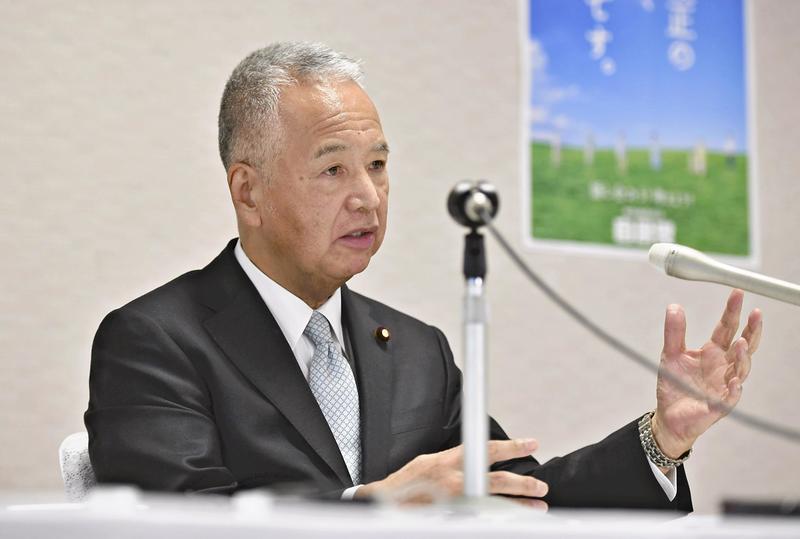
The government and ruling parties plan to discuss preferential measures to make it easier for companies and administrative bodies to integrate and interconnect information technology systems in the fiscal 2021 tax system revision, Akira Amari, chairperson of the LDP's Research Commission on the Tax System, stated in an interview.
With a digital agency set to be established in 2021, the government and ruling parties plan to boost private-sector investment in information technology to allow companies and administrative bodies to quickly respond in an event of an emergency, such as during a pandemic.
"We would like to conduct a thorough examination from the perspective of whether it contributes to 'connected digitalization," Amari told The Yomiuri Shimbun and other media on Wednesday. "We are experiencing a situation in which companies are not connected [to each other's systems]."
Information technology systems are individually developed by many companies and government bodies in Japan, making it difficult to share data and users' information. The government and ruling parties are considering cutting corporate tax that is equivalent to a portion of what is invested in information technology to help solve such problems.
Amari said, the focus of debate in the ruling parties' tax panels is "the proper state of taxes while fighting the coronavirus crisis. As the ability to pay taxes has been substantially declining, we have to be extremely cautious about discussing tax increases."
The government and ruling parties are also considering tax breaks related to automobiles as a key policy to shore up the domestic economy.
One specific option involves the "environmental performance tax," which is imposed based on fuel efficiency when an automobile is purchased. The point of contention will be whether to extend the ongoing 1% reduction beyond the current deadline in March next year.
Amari said: "Currently the Japanese economy is supported mainly by the automobile industry. I don't think we should stand on the sidelines when the industry is suffering serious damage."
Regarding tax cuts for eco-friendly cars that are set to expire next spring, the government and ruling parties are considering not just extending the cuts, but also reviewing which car models are eligible. This comes in response to moves, mainly in Europe, to abandon diesel-powered vehicles.
Another key measure is tax breaks for housing and land. The housing loan tax reduction for people who will move in by the end of 2021 has been extended because the delivery of housing equipment was delayed due to the suspension of factory operations in China. The extension is aimed at stimulating housing demand, which has been declining with the spread of the coronavirus.
In addition, the government and the ruling parties will discuss countermeasures against possible cases in which people struggle to pay back their loans due to reduced bonuses and salaries.
They also intend to avoid increasing the burden from the fixed asset tax on land. Appraisal values are decided mainly based on official land prices as of Jan. 1 this year, but businesses hit by the coronavirus could be faced with too-heavy tax burdens.
Amari expressed his support for narrowing the scope of the tax breaks to commercial land, among others.
"The increase in appraisal values is notable for commercial land, so the basic idea will be to target land whose increase in appraisal value is particularly high," he said.
Read more from The Japan News at https://japannews.yomiuri.co.jp/