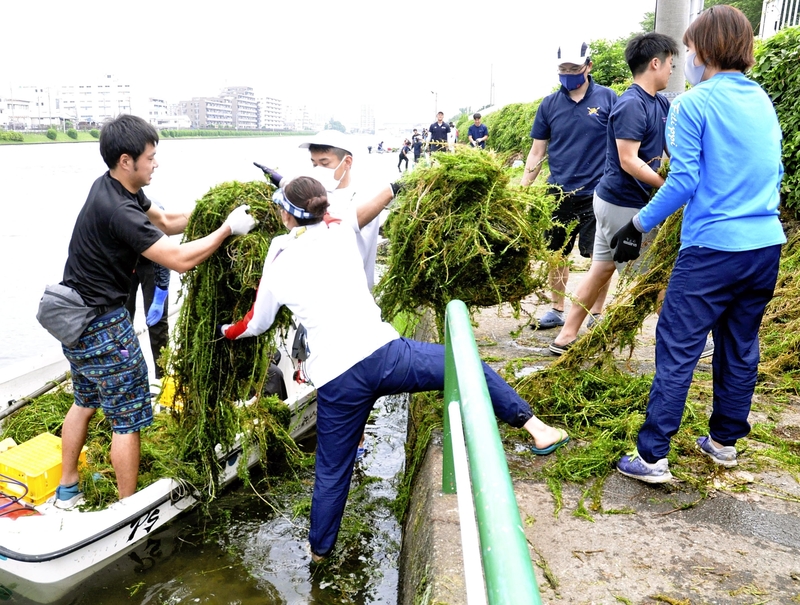
TODA, Saitama -- At the Toda Boat Course, a training base for oarsmen and oarswomen aiming to participate in next year's Tokyo Olympics, a large amount of waterweed has grown, and the athletes have begun removing it together. Because they have not been able to train on the course due to the spread of the new coronavirus, the waterweed proliferated, however, through cooperative efforts the day when the course can be used again will soon arrive.
The boat course in Toda, Saitama Prefecture, the venue for the 1964 Tokyo Olympics, is a stronghold for the national team. Many tournaments are held there every year and it is referred to as the "boating sanctuary."
However, since about 2017, when the course's water quality improved, waterweeds such as curly pondweed began to increase, and were entangled in rudders and oars, interfering with training and racing.
The Saitama prefectural government, which manages the facility, usually sends a boat to remove the weeds in early spring, but this year was unable to due to the state of emergency. The 2.5-meter depth course filled with weed up to the water's surface. Even after the declaration was lifted in late May, athletes could not train on the course.
So the coaches of about 30 groups based at the course decided to remove the waterweeds every weekend. An average of about 100 students and working adults, including members of the Rio de Janeiro Olympic team, participated each day. About 5 tons of waterweed was collected over two days on May 30 and 31, and trawling was also carried out on June 6 and 7.
Full use of the course is expected to resume after the end of June, when the prefectural government will begin extermination work. A prefectural government official said, "The amount of waterweed definitely decreased. Our working time has shortened."
"Removing the waterweed takes a long time and is hard, but I felt an unprecedented bond with the other group members. I'm looking forward to the day when we can train here again," said Rino Hayashi, a senior at Hosei University.
Read more from The Japan News at https://japannews.yomiuri.co.jp/