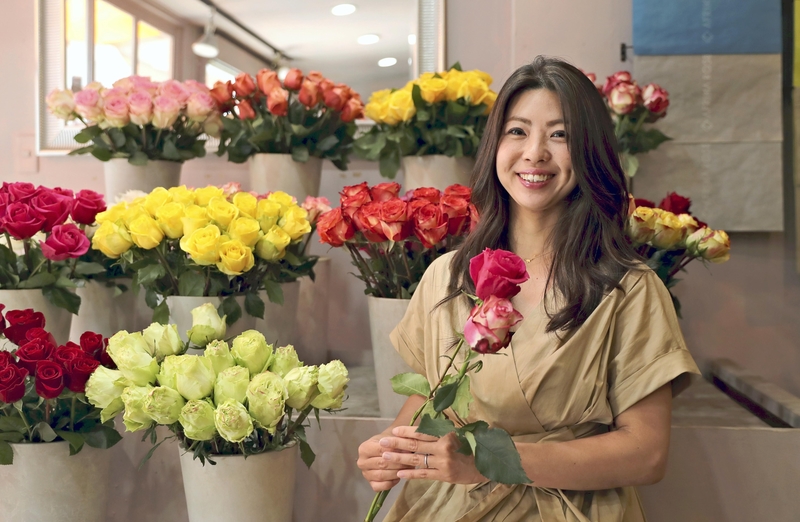
Megumi Hagiuda runs a company importing and selling roses grown in Africa. Now 38, she quit a pharmaceutical company, encountered roses in Africa and opened a store in Tokyo at the age of 34. She says that every time she takes on a new challenge, she tries to make a decision based on her honest feelings.
The following is taken from an interview with Hagiuda.
I run stores called "Afrika Rose" in Tokyo, which handle roses grown in Kenya and Ethiopia. The roses are a little expensive at 800 yen each, but they're large and beautiful, so people buy them for anniversaries and other special occasions.
I majored in international relations at a U.S. university, where I learned the structure of labor exploitation by developed countries, which is behind the poverty in Africa. I was so shocked, I started to hope I could help change the situation in Africa someday.
After graduating from the university, I joined a pharmaceutical company in Japan. But I couldn't give up my passion for Africa. Should I live a stable life as a company employee or choose a career related to my own interests?
After debating the question for a year, I followed my honest feelings and quit the pharmaceutical company when I was 29 years old. I went to Kenya for the first time as a volunteer with a nongovernmental organization and was involved in setting up a school.
I was happy but I also felt something was wrong. Local people were very accustomed to receiving donations and assistance. I wondered how I could help them become genuinely self-reliant.
Six months later, as the day of my return home approached, I came across large roses in a dirty bucket at a commercial facility. Their petals were thick and colorful, and the stalks were thick and strong. They were totally different from roses in Japan. I bought some and they stayed in bloom for two weeks. I was surprised by their strong life force.
At that time, Kenya was one of the world's largest rose exporters. Despite that, Kenyan roses were little known in Japan. I came up with an idea of importing and selling them to help create jobs for local people.
After returning to Japan, I imported 2,500 roses from Kenya and opened a shop at an event held in Tokyo for two days to sell the flowers. More than half of them remained unsold and I suffered a big loss, but some visitors said they hadn't known about African roses and that the flowers were very beautiful.
This convinced me that it would be a good business if I just calculated my stock properly.
So I started an online store. I ordered just the quantities for which I had reservations, to avoid having inventory. It was my dream to have a brick-and-mortar store where I could have more contacts with customers, but I was hesitant considering the inventory risks and labor costs.
I remembered a woman I met in Kenya. She was unfairly fired by her employer, but she opened a bookstore because she loved books. She told me with a smile that she now earns more than she used to in three years. Her cheerful personality and toughness like powerfully blooming Kenyan roses encouraged me a lot.
A sense of responsibility and justice is important for work. But I won't be able to continue my work if it's not enjoyable. Being honest with myself, I always choose the more exciting option when I am not sure. I'm now considering having a farm in Africa.
--Delicious bamboo shoots
My favorite food is bamboo shoots grown at my parent's house in Machida, Tokyo. There's a bamboo forest near the house and bamboo shoots come out of the ground every spring. I cook them in various ways, such as boiling them and eating them with wasabi and soy sauce, as well as cooking them with rice. I also love digging up bamboo shoots with my family.
--A new hobby
I'm into vegetable gardening lately. People tend to think I'd be good at growing plants just because I run a flower shop. But I wasn't very interested in growing vegetables before, and now I'm trying it for the first time. I'm growing green peppers, eggplants, tomatoes, basil and other plants in my kitchen and balcony. The basil has grown enough to harvest, so I'm using it in pasta and other dishes.
When my 2-year-old son grows up a little more, I want to grow vegetables with him and show him the fun of eating.
--Hagiuda was born in 1981 in Tokyo and is the president of a company that imports and sells roses. She has stores in Tokyo's Hiroo district and at the Roppongi Hills commercial facility in Minato Ward, Tokyo. She has also written a book about African roses.
Read more from The Japan News at https://japannews.yomiuri.co.jp/