A team of researchers from Japan will collaborate on a project with universities and research institutes from the United States, South Korea and Taiwan to improve the accuracy of typhoon forecasts.
Researchers from Nagoya University, the University of the Ryukyus and the Japan Meteorological Agency's Research Institute will be involved in the project, in which aerial observations of typhoons in the waters around Okinawa Prefecture will be conducted this summer.
The project will collect data on such parameters as atmospheric pressure and wind speed, and make it available to countries in the region to improve disaster preparedness.
The agency currently estimates the wind speed and central atmospheric pressure of typhoons based mainly on the shape of clouds in satellite images.
For strong typhoons -- of the scale of last year's Typhoon No. 19 -- early forecasts of their paths among other parameters are necessary for implementing disaster countermeasures.
However, there is a lack of accuracy in current forecasting methods.
The Japanese team, which is led by meteorology specialist Prof. Kazuhisa Tsuboki of Nagoya University, will use a small plane to observe typhoons over the East China Sea between Taiwan and the Nansei Islands from May to September.
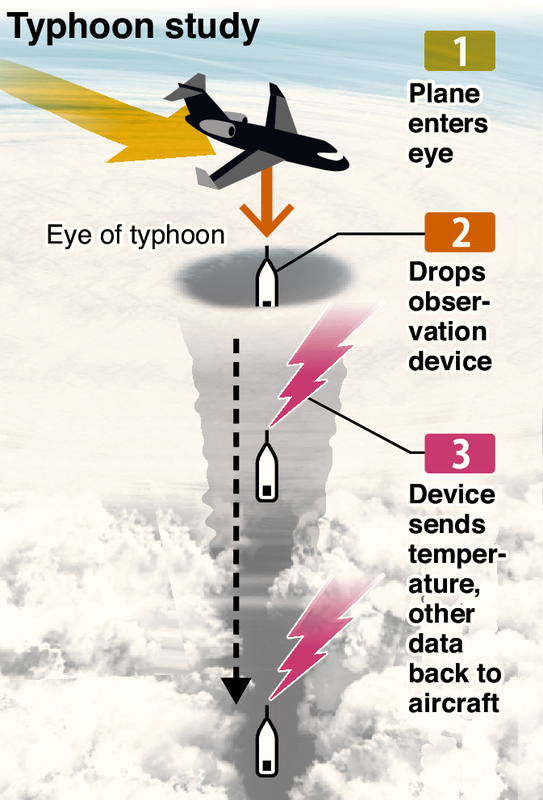
The jet will enter the eye of a typhoon and drop several observation instruments called "dropsondes" from an altitude of about 14 kilometers. The instruments will collect data on temperature, pressure, humidity, wind speed and other parameters, and send it back to the aircraft.
Teams from the United States, South Korea and Taiwan will track the same typhoons but at different altitudes and locations.
Radar equipment to detect the distribution of rain and clouds will be installed at a facility that will be used for ground-based observations on Yonaguni Island in Okinawa Prefecture.
Data collected from aircraft observations by the Japanese team in 2017 that was used to help forecast the path of a typhoon reduced the margin of error by as much as 16 percent.
The upcoming international collaboration will be the first joint observation of its kind and is aimed at further improving accuracy in typhoon forecasts.
In the past, the U.S. military conducted direct observations of typhoons from aircraft in the northwest Pacific. The data collected was provided to the JMA, but these studies were halted in 1987 mainly for financial reasons. Each observation flight costs about 10 million yen.
"We aim to make this collaboration a step toward creating a system for joint observations with neighbors in east Asia that are also hit by typhoons and heavy rains," Tsuboki said.
Hironori Fudeyasu, associate professor of meteorology at Yokohama National University, hopes that having access to data that has never been available before could help researchers analyze the internal structure of a rapidly developing typhoon. "It would be great to create a system through which typhoons could be constantly monitored to establish how they change over time," he said.
Read more from The Japan News at https://japannews.yomiuri.co.jp/