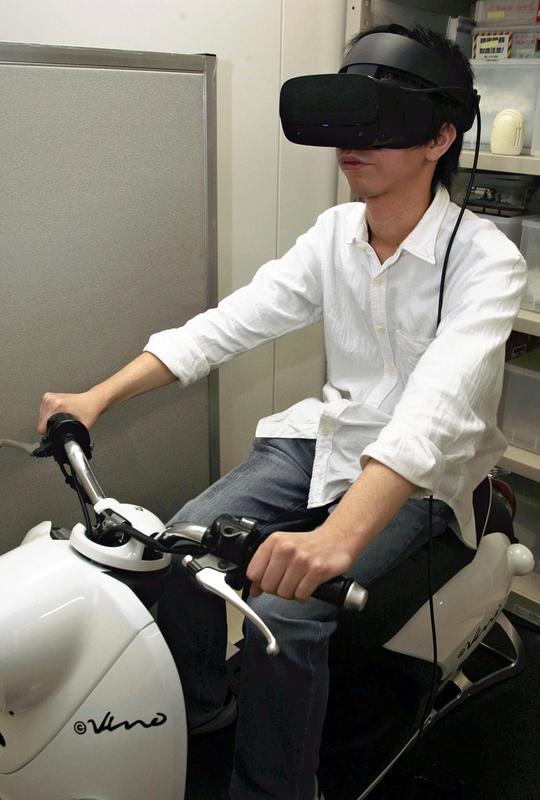
Virtual reality technology, through which users experience immersion in computer-generated worlds, has been put to practical use by businesses and in video games. But the illusion of motion in an imaginary world, often provided via special goggles, can leave some users feeling unwell. They suffer "VR sickness," which is akin to motion sickness.
A team of researchers from Shizuoka University and Yamaha Motor Co. -- a motorcycle maker based in Iwata, Shizuoka Prefecture -- announced that VR sickness was mitigated significantly when users of a motorcycle simulator heard engine sounds and felt vibrations in conjunction with visual images.
The team said the experiment's results will help reduce VR sickness.

The research group had 80 students experience a motorcycle simulator for five minutes to measure their degree of motion sickness. They played a simulation of riding on a meandering road with and without engine noise and vibration. The result showed that the presence of both sound and vibration reduced motion sickness by 55% compared to the absence of both.
The results of the research were published in the May 12 issue of the electronic edition of British scientific journal Scientific Reports.
"We obtained very important knowledge that helps us understand VR sickness. I expect it will be widely applied for VR technology," said Assistant Prof. Yoshihiro Itaguchi of the Faculty of Informatics at Shizuoka University, who specializes in psychology.
Prof. Kazuyoshi Tagawa of Aichi University of Technology, an expert on information science, said, "It's interesting, as it is the first time to find out that the effects of both sound and vibration reduced sickness."
Read more from The Japan News at https://japannews.yomiuri.co.jp/