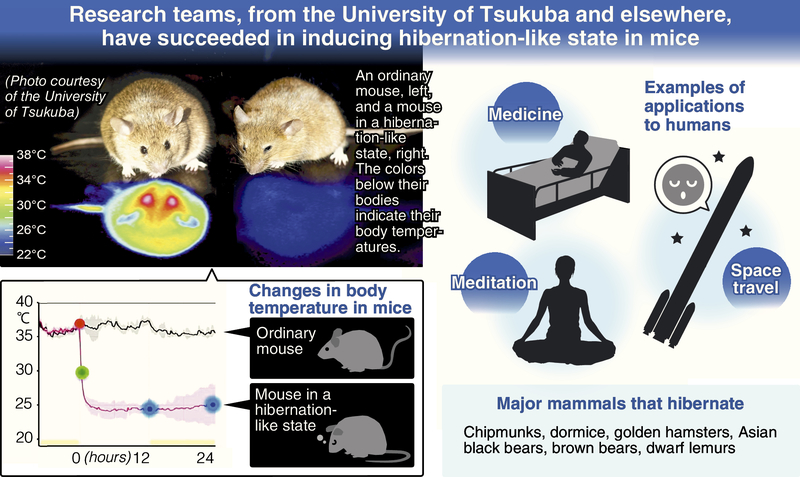
A capsule within a spacecraft opens quietly, and a crew member who has awakened from a long sleep, murmurs, "I will arrive soon," as they gaze at the vista of a new planet outside the ship's window. Artificially induced hibernation of humans, a familiar scene in sci-fi movies, is inching closer to reality, thanks to research originating in Japan. It is a dream technology that could open the door to the future, but it might also transform society and human relationships.
-- 'Brain switch' in mice
Many sleepy people have tried to stay awake through stimulation -- such as pinching their own cheek or hand. And yet, a team of scientists from the University of Tsukuba and elsewhere has succeeded in using stimulation of certain nerve cells to induce a hibernation-like state in mice. Their discovery was published in the British scientific journal Nature in June.
In the study, the mice's body temperature, which is usually over 35 C, was lowered to about 25 C and stabilized, while their heart rate was reduced to about one-quarter of the normal rate, thus artificially inducing a state similar to the one seen in hibernating animals. As the effect of a drug stimulating nerve cells wore off, the mice woke up naturally, with no health abnormalities found, according to the study.
Humans are also said to have nerve cells that could be used as a brain switch to induce a hibernation-like state. University of Tsukuba Prof. Takeshi Sakurai, who led the research, said, "If it [artificial hibernation technology] could be applied to humans, revolutionary progress would be brought about in various fields. The possibility of realizing them 30 years from now is over 50 percent."
-- Medical applications
Hopes for the technology's use are highest in the medical field. A "hypothermia treatment" has already been used in the treatment of patients with serious head injuries or blocked veins that cause oxygen deficiency in the brain. The progress of brain damage can be slowed by lowering the patient's body temperature a few degrees, into the range of 32 C to 34 C. If body temperature and physical functions could be controlled further, it is thought that patient survival rates could be raised markedly.
In the fictional manga series "Black Jack," written and illustrated by Osamu Tezuka in the 1970s and '80s, there is an episode in which the protagonist doctor advises the wife of a young man who is suffering from an incurable disease. He suggests that she try an artificial hibernation device secretly developed in the Soviet Union, keeping her husband in stasis until some future day when a cure for his condition is found.
Another now-imaginary application of artificial hibernation technology is, of course, decades-long voyages into the distant reaches of space. In the United States, such organizations as the National Aeronautics and Space Administration (NASA) have been conducting research on inducing a hibernation-like state in humans, such as by cooling the body by introducing a refrigerant via the nasal cavities.
This research could be applied to meditation, a technique much closer to daily life. With the brain at ease, a person's nerves become stabilized. (There are certainly times when the stress of work makes me feel like hibernating for a while, too.)
-- Tangling human ties
The relevant research is still far from finished. In the case of humans, if a low body temperature continues too long, cells and tissues could be damaged, or the heart could stop beating, leading to death. It remains a mystery why some animals can hibernate safely. Prof. Yoshifumi Yamaguchi of Hokkaido University, who is knowledgeable about hibernation, said, "It is little known why the cells do not die, or how animals switch from a state of hibernation to one of wakefulness."
Besides, hibernation in the natural world usually lasts only a few months. Even if an artificial hibernation were realized, would humans truly be able to live for years without eating?
In this respect, it is interesting to consider the deep-sea crustacean bathynomus giganteus, which drew much attention when it was observed living in an aquarium for more than five years without eating. Also, a kind of newt inhabiting a cavern in Europe is said to live for about 10 years without eating any food. What both creatures have in common is that they live in a cold, dark environment.
If technology advanced to the point at which humans could safely put themselves in cold storage, new challenges would arise: People's chronological age would become inconsistent with their physical age. Among siblings or married couples -- or even between parents and their children -- relative seniority could be flipped. Human relationships would be radically transformed. Systems closely tied to naturally advancing age, such as life insurance, retirement standards, and pensions and welfare programs for the elderly, could be completely upended, possibly transforming our society.
The "Black Jack" episode ended with the wife -- when told that she might live to an old age and die before her husband ever came out of hibernation -- deciding to sleep in the hibernation device together with him. What sort of society will the couple find themselves in, when they awaken in a future world where previously incurable diseases have become curable?
-- Even among primates
For animals such as Asian black bears, chipmunks and dormice, hibernation is a way to conserve enough energy to get through the winter, when food is scarce.
Even among primates, there are species that hibernate, such as dwarf lemurs in Madagascar, an island off the coast of East Africa. They live in dry areas where food is scarce and at high elevations where the temperature falls to nearly 5 C during the winter months.
The ways these animals hibernate differ greatly. Dormice sleep deeply, with their body temperature sometimes falling to as low as around 1 C. As a body temperature below that threshold would be fatal, they wake up and raise their body temperature if the atmospheric temperature falls too much.
Chipmunks, whose body temperature falls into the single digits during hibernation, wake up once a week even during hibernation, eating stored food and excreting waste. Hokkaido squirrels appear to hibernate, but actually don't. By storing nuts and the like in the ground in advance, they are able to get through winter months with a scarcity of food.
Asian black bears, during their hibernation, maintain their body temperature in the 30s C, even giving birth and nursing cubs. But even so, they go for several months without eating, drinking or excreting. Yet, during these months, their muscles weaken little. Research on understanding such excellent bodily functions continues.
Read more from The Japan News at https://japannews.yomiuri.co.jp/