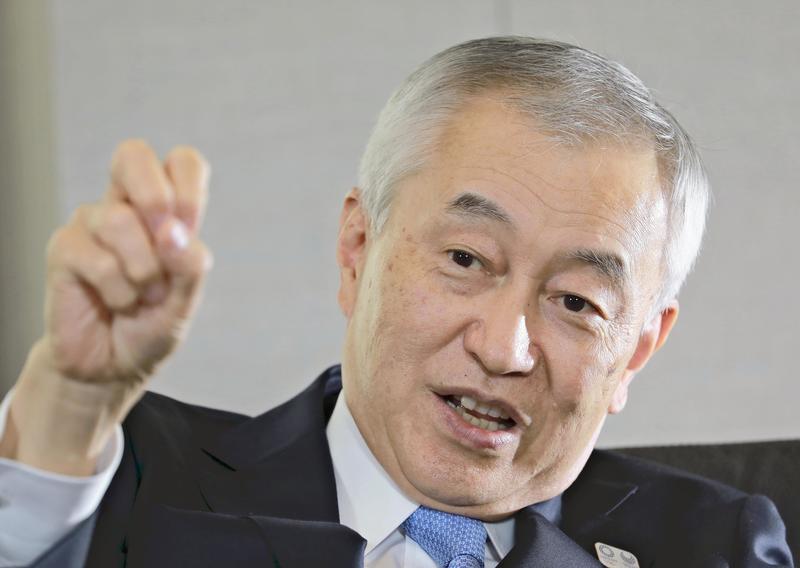
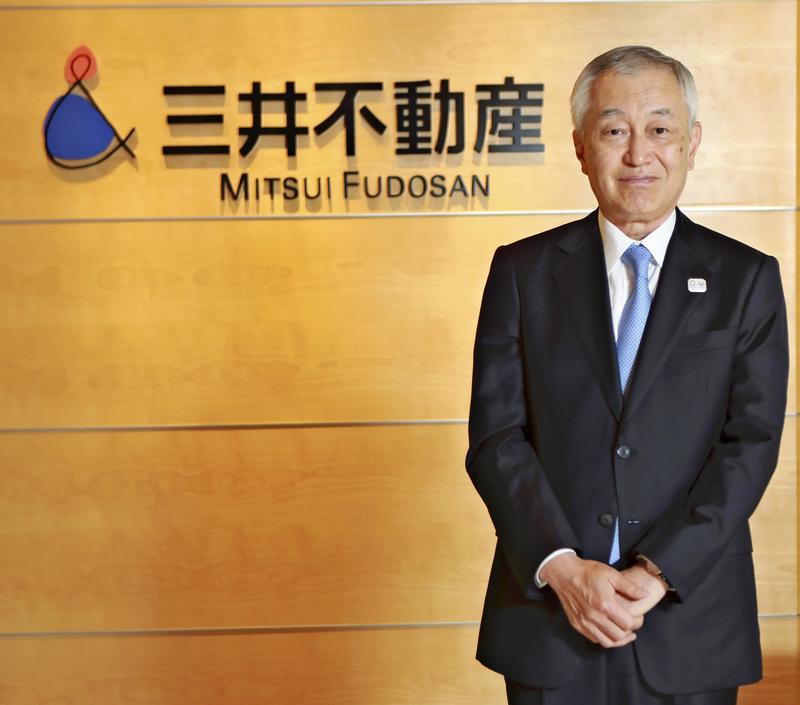
Mitsui Fudosan Co., which is steadily changing the Tokyo cityscape through redevelopment in areas like the Nihonbashi and Hibiya districts, has been seeing very favorable results. In this installment of Leaders, a column featuring corporate management and senior executives, The Yomiuri Shimbun asked President and Chief Executive Officer Masanobu Komoda how the company is going to expand its business in the future.
Somewhere that's comfortable and easy to live, where work efficiency can be improved, and where you can even enjoy a shopping trip -- our mission is to enrich people's personal and business lives through this kind of urban development.
Large-scale redevelopment in central Tokyo marches on, and our company was able to open Tokyo Midtown Hibiya this March.
[In the about two months since Tokyo Midtown Hibiya opened for business, over 4 million people have used its facilities. This number has already exceeded one-third of the company's annual target. Nearly all the office space is filled.]
Hibiya has the potential to become a center for people traffic. It borders a range of different districts, including the business districts of Marunouchi and Otemachi, the shopping districts of Ginza and Yurakucho, and the government district of Kasumigaseki. It has also historically been an area with cinemas and theaters, and a mecca for arts and culture. There are also green spaces such as Hibiya Park and the Kokyogaien National Garden.
However, there have been very few large establishments in the area that a person would visit without any particular aim. I believe that the redevelopment of Hibiya has drastically changed how people flow through the area. As Tokyo goes on to develop as a whole, we want to turn this into a core project.
We've also incorporated features that will contribute to work style reform. We've installed spaces called "third places," which are neither home nor office, in many of our common spaces, such as hanging gardens on middle levels. When you're struggling to develop an idea at your desk, you can come here to reenergize and continue working. There's even a lounge and gym for use by employees of the companies that move in. This is an office building that improves the productivity of the people who work there.
Large buildings will be popping up one by one in Tokyo between 2018 and 2020, and some are saying there are too many offices. However, in a recent report, some data stated that in the 30 years through 2017 and the five years from 2018 to 2022, there will not be any real difference in the average amount of the total floor area of offices. As much of this construction involves rebuilding, and we're losing floor space at the same time, I don't believe there will be any oversupply. There will most likely just be an advancement in the polarization between well-designed buildings that will only increase in popularity and struggling older buildings that are inferior in terms of earthquake-proofing and other elements.
Work that changes the times
I first encountered Mitsui Fudosan by chance when I was looking for work. When I had gone to visit a different company in Shinjuku, Tokyo, I just happened to see that Mitsui Fudosan was taking applications, so I went in.
At the time, the headquarters were in the Shinjuku Mitsui Building. Development of the urban subcenter had just begun and that building, with its black outer walls, left quite an impression on me. I had also heard that it was Mitsui Fudosan that built the Kasumigaseki Building, the first skyscraper in Japan. I started to think, "Urban development that could change the times that we live in so dramatically is work that must be worth doing."
After I joined the company, I had a rough experience through the economic bubble and its bursting. During the bubble, I worked in the personnel department. I was often told, "There aren't enough employees." But the company had a low employee turnover rate, and it's not good to suddenly increase or decrease staff numbers. When I was only able to employ 75 new people, even through mid-career recruitment, during a year in which I was asked to "recruit 100 people," I was often scolded and told, "We're missing business opportunities because we don't have the employee numbers."
After that, the bubble burst and people said, "Maybe we recruited too many people." It turned out that our business plan needed to include long-term thinking.
When I was head of the corporate planning department, I helped reform the residential department. At the time, our company would develop apartment buildings by procuring a site, planning the structure and then selling it through our sales company, Mitsui Real Estate Sales (now Mitsui Fudosan Realty Co.) However, if the developers and the sellers are different companies, they tend to lose sight of the needs of the customers.
At one point, sales were mostly driven by families of two adults and two children, but at that time we were already seeing a dramatic shift, with around half of our sales being for one to two occupants. I proposed to then President Hiromichi Iwasa (now chairman of the board and CEO) that "it might be better if we integrate building and sales and structure our business closer to our customers."
[In 2006, the Mitsui Fudosan housing development department and the residential sales department of Mitsui Real Estate Sales were integrated and started to operate as Mitsui Fudosan Residential Co.]
"Leave it to me," I said, and I was then involved from the preparation stage. Both the housing development department and the real estate sales company had long histories. We had to bring together these two companies, which had two different working styles and environments, and two sets of employees with very different ideas. Even the foundations of the company, including contracts and systems, changed. It was an enormous task, but I was very happy when the company was able to launch without problems.
Tokyo Games a good chance
In the future we're planning to also pour our efforts into overseas projects. For the past five years, this company has seen annual growth in operating profits of approximately 13 percent. As the domestic market matures, we want to continue to grow by increasing the proportion of our overseas projects.
[A 51-story building will be completed in Manhattan this autumn. Mitsui Fudosan is also involved in planning for the construction of a 58-story building there due to be completed in 2022. The company has embarked on the mixed-use development of residences and buildings in London, too.]
Integrated developers like us who are involved in all aspects of urban development are few and far between overseas. In developed countries, offices, commercial establishments and residences are split by type, and developers concentrate on what they're good at. The development and management companies are also separate. In this environment you cannot control large-scale urban development in its entirety.
Buildings are not the main actors in urban development. The main actors are the people who go there, the people who work there and the people who live there. It's not just about buildings and spaces, but also about supporting and managing the community. Once these are handled as a set, then the area really becomes a location of high value. The strengths of integrated developers are also effective abroad.
The Tokyo Olympic and Paralympic Games are a big opportunity. We can show off Japan's real estate development to all the people coming from overseas. If we can have them experience how high the level of urban development is in places like Nihonbashi, Hibiya and Roppongi and the amount of consideration paid to visitors who go there, then this will form the ideal PR package.
One challenge is how we deal with foreign languages. We've established an information center in Nihonbashi, where we can explain about the area to overseas visitors in their native languages. If we can promote the charm of Tokyo, this will most likely be a plus to Japanese international competitiveness.
Real estate is no exception when it comes to the ICT-driven digital revolution. We loan out office space and provide a shared office service called "Workstyling," where you can manage labor as if it was your own office in facilities capable of even videoconferencing. This is all made possible by ICT. In commercial establishments we've launched the website "&mall," which allows you to shop by checking which stores stock the product that you are looking for, combining real-life shopping with e-commerce.
In addition, much like how smartphones and cars collect huge amounts of data, we accumulate data on what people do in our office buildings, malls, residences, or in the town itself. How will we use this data to enrich people's lives? In the future we want to bring innovation to the real estate industry itself.
-- Masanobu Komoda / President and CEO of Mitsui Fudosan Co.
Born in 1954 and raised in Tokyo. Graduated from the University of Tokyo Faculty of Law in 1978 and joined Mitsui Fudosan. Gained much experience in the residential department, including the Yokohama branch, where he spent seven years taking care of tasks such as acquiring land for apartment block development. Became a company executive in 2005 and the managing director of Mitsui Fudosan Residential in 2006. After serving as executive managing director and then senior executive managing director of Mitsui Fudosan, he has been in his current post since June 2011.
-- Key Numbers: 30%
In the company's long-term management policies presented in May, there was a policy to increase the proportion of overseas projects to 30 percent of total operating profits by around 2025. By March 2018 this figure stood at 7.2 percent. Sales on the March 2018 consolidated balance sheet reached 1.75 trillion yen, the highest in the real estate industry. Net profits were a record 155.8 billion yen. The company had 1,526 employees as of March 2018.
Read more from The Japan News at https://japannews.yomiuri.co.jp/