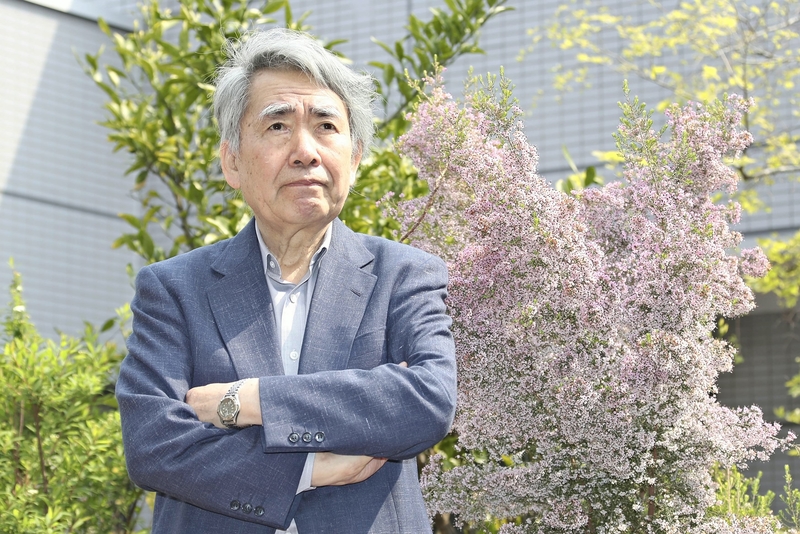
OSAKA ― Poet and cytologist Kazuhiro Nagata, 72, has spent his career probing the mysteries of life from both literary and scientific perspectives. With no end in sight to the spread of novel coronavirus infections, The Yomiuri Shimbun asked the prize-winning polymath for his views on how the virus crisis should be tackled and what we could learn from history. The following are excerpts from the interview.
Yomiuri: Lifestyles and the way we work are changing.
Nagata: A poem I wrote recently about an encounter with former students of mine reads:
A drinking party online
At such mysterious encounters
Raising a glass to each other
The sense of distance between people and ways of interacting with others at workplaces and schools have considerably changed. The freedom of the individual and the irreplaceability of human relationships. It's time to take a fundamental look from a perspective somewhere between these two poles at our relationships with each other.
It isn't all doom and gloom. For children who have suffered bullying at schools, some time off [due to the closure of schools] may provide a chance for them to realize school is not the only place in the world.
Until recently, I had been extremely busy attending meetings at work, but I've realized many of those meetings didn't need to take place.
Q: What are your thoughts on the nature of the virus?
A: My specialty is cell research, such as studying the functions of proteins, not virology, but there are three conditions for the existence of life as I see it. First, separation from the outside world by a membrane; second, gene replication and the production of offspring; and lastly, metabolic functions such as synthesis and decomposition.
Viruses meet the first two conditions but do not carry out metabolic processes. In order to carry out functions such as gene replication, virus have to use proteins from hosts. They are things that exist but cannot multiply without other organisms, such as humans and animals.
I myself don't think viruses are living organisms, but recently a virus has been discovered that straddles the border of life and non-life. Given this, an increasing number of people have come to consider viruses as living organisms.
Q: What are the characteristics of the new coronavirus?
A: When many people get infected with a virus like the flu and then go on to develop immunity, it acts as a bulwark that reduces the spread.
In the case of severe acute respiratory syndrome (SARS), people infected with the virus develop serious symptoms immediately so it is easy to quarantine patients. The new coronavirus is particularly problematic because it can be spread unwittingly by infected individuals who transmit the virus to others before developing symptoms. The spread of coronavirus infections is a phenomenon that has occurred because the world has become one community. The virus is not spreading: Humans are spreading the virus.
SUBHEAD: Lessons from the past
Q: What can we learn from history?
A: In the case of the Spanish flu pandemic that occurred a century ago, the cover-up of information is said to have exasperated the spread of infections. The flu spread on the battlefields of World War I, but the warring countries hid what was actually going on for fear of putting the war at a disadvantage, thus accelerating the spread of the virus.
Only Spain, which was then a neutral country, disclosed the information. Thus, the flu came to be called the Spanish flu. In the case of the novel coronavirus, a doctor in Wuhan of China sounded the alarm at the end of last year, but the municipal authorities dismissed his claim as a hoax and punished him. This is something that should have never happened. The Wuhan case highlights the importance of public disclosure.
Q: Is there any possibility that the new coronavirus will become more virulent?
A: The new coronavirus is an RNA virus with a single-strand RNA gene. DNA consists of two strands, arranged in a double helix. Because of this structure, even if a mutation occurs in one part, it is easily reversed under the influence of another strand. In contrast, mutation tends to occur easily in RNA viruses that have only a single strand. In other words, the novel coronavirus has the possibility of becoming more virulent or less virulent. If it becomes less virulent, it will stay in our bodies.
Q: Can humans overcome the virus?
A: Some of our genes are also of viral origin. One such example is a protein called syncytin, which is essential for the placenta to function. This means humans give birth with the help of a virus. We tend to think of viruses as our enemies, but humans store virus information in our genes. Humans have always coexisted with viruses. Viruses can't be eradicated, we have to find a way to coexist. Humanity's symbiosis with viruses may already be halfway there.
Profile
Born in 1947 in Shiga Prefecture, Kazuhiro Nagata serves as the director general of the JT Biohistory Research Hall, and professor emeritus at Kyoto University and Kyoto Sangyo University. He won the Yomiuri Literature Prize for poetry and haiku in 1999 for a collection titled "Aeba."
Read more from The Japan News at https://japannews.yomiuri.co.jp/