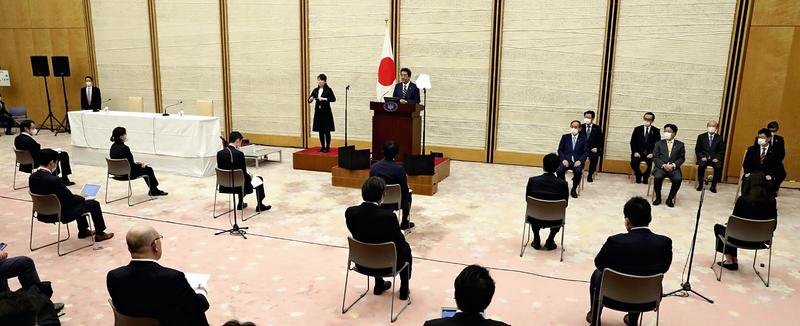
Prime Minister Shinzo Abe officially declared a month-long state of emergency Tuesday for Tokyo, Osaka and five other prefectures to curb the spread of infections with the new coronavirus.
So that the state of emergency can be lifted after one month, Abe also called on people to "reduce person-to-person contact by at least 70% and preferably 80%."
He said by reducing contact across society, an explosive spread of infections can be averted as the number of newly infected patients would peak then start declining in two weeks time, thus making it possible to get mass infections under control.
How can person-to-person contact -- which includes conversations in close proximity and bodily contact -- be reduced by 70% to 80%? Foreign countries are trying to reduce contact to an equivalent degree through forceful measures such as lockdowns, which involve closing off cities and shutting businesses. But Japan is aiming to bring the spread under control without resorting to lockdowns.
First, those engaged in operating public transportation and offering medical care will keep working as usual. It is among people in other types of work that person-to-person contact is to be drastically reduced. For instance, office work is to be managed from home in principle, and if it is absolutely necessary for employees to be in the office, companies are to take such measures as cutting the number of days in the workplace to only one day per week, instead of the usual five.
In addition to these steps, people in their everyday lives are to 1) stay at home except for outings necessary to maintain their daily lives, 2) not hold drinking parties or large dining parties, and 3) refrain from going to live music clubs or nightclubs, both of which are likely to cause mass infections. Through these steps, person-to-person contact could be cut by 70% to 80% across society.
As long as these steps are followed properly, people are expected to be able to continue leading normal lives, such as taking walks in their neighborhood, going shopping for daily necessities, and visiting hospitals or commuting to work the minimum amount required.
Hiroshi Nishiura, a professor at Hokkaido University and a member of a team operating under the Health, Labor and Welfare Ministry to address clusters of coronavirus infections, has calculated that in order to get infections under control in about a month, it is necessary to reduce person-to-person contact by 80%.
Nishiura, assuming a major city where the number of infections surges, has projected the number of cases based on reductions in person-to-person contact. He found that as long as such contact is reduced by only 20% through more moderate self-restraint, the number of cases may fall temporarily but will soon turn upward again. However, by reducing contact between people by 80% across society as a whole, the number of infected patients was found to fall sharply, bringing infections under control. A 70% reduction in contact is also projected to bring the number of cases down, but it would take longer.
"It is necessary for people to bolster themselves to take a fresh look at their lifestyle," Nishiura, a scholar in theoretical epidemiology, said emphatically.
Koji Wada, a professor of public health at the International University of Health and Welfare who is knowledgeable about countermeasures for infectious diseases, said: "Staying at home as much as possible will help save people's lives. The current situation will disperse communities, but by being ever more considerate of others, we can weather this difficult time together."
Concerned about the coronavirus? Look for information and contact numbers here if you suspect you have contracted the virus and are exhibiting symptoms.
PLEASE NOTEThe Japan News is providing this story for free to help all readers keep informed about the coronavirus.
Read more from The Japan News at https://japannews.yomiuri.co.jp/


.png?w=600)