Europeans are generally said to desire a country life, while people in Asia have a liking for city life. When we look at the excessive concentration of people in Tokyo, we can see that Japan certainly fits that pattern. When did Japanese people start to have such a preference for cities?
When urban areas came into being, the words "inaka" and "hina," meaning countryside away from urban areas, started to be used. This occurred when two capital cities -- Fujiwarakyo (694-710) and Heijokyo (710-784) -- were successively constructed in Yamato, present-day Nara Prefecture.
The word hina appears in a poem by the revered Kakinomoto no Hitomaro. The piece is included in the "Manyoshu," Japan's oldest poetry anthology, which was compiled at that time.
The poet wrote:
Amazakaru Hinano Nagajiyu Koikureba Akashi no Toyori Yamatoshima Miyu
(Coming a long way from the countryside to Yamato with a longing heart, I'm now at the Straits of Akashi and can see the land of Yamato)
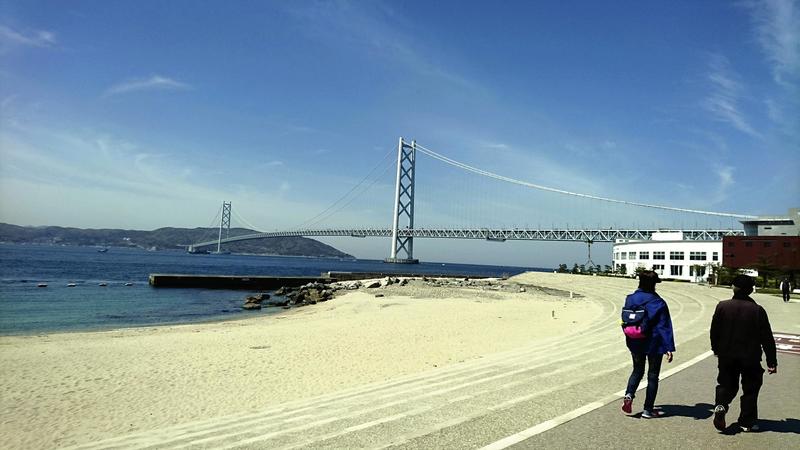
He wrote this poem in what is now Akashi, Hyogo Prefecture, while traveling to Yamato. As a low-ranking government official, he was transferred from one place to another in regional areas, but he was longing for Yamato. The poem shows he had already come to prefer city life.
Those familiar with Japanese classic literature will have seen the term "Akashi" many times. Akashi is a key location, for example, in the "Tale of Genji" written in the early 11th century in Kyoto and said to be one of the world's oldest long novels.
Hikaru Genji -- the novel's protagonist, who falls in love with many noble women -- leaves Kyoto for Suma, present-day Suma Ward, Kobe, after his affair with the daughter of a rival at court is exposed. Going to live in the countryside was meant as punishment at that time. Today, Suma is an urban area, but at that time it was sparsely populated.
Genji laments his life in the desolate land of Suma. At the invitation of an influential local person living in Akashi, west of Suma, Genji later moves to Akashi, where he becomes involved with that person's daughter and is rejuvenated. He eventually escapes his country life, returning to Kyoto.
In the "Tale of Genji," Akashi is also a place from which to aim for a job in the capital.
Why was the local influential person able to gather strength in Akashi, which was located farther away than Suma from the capital? The answer can be found by looking at the background of the story from the perspective of historical geography.
Under the ritsuryo basic laws at that time, five areas -- Yamashiro (current Kyoto Prefecture), Yamato, Kawachi (current eastern Osaka Prefecture), Izumi (southern Osaka Prefecture) and Settsu (northern Osaka Prefecture and part of Hyogo Prefecture) -- were designated as the Kinai region. They are five provinces surrounding the ancient capitals of Nara and Kyoto.
Suma was located on the western edge of the region, as if it was confined to a more remote place.
As Akashi was situated further outside Suma, it can be judged that Akashi was able to evade the pressure and strong influence of the central authorities. The local influential person in Akashi who protected Genji is described as a man who had retired from politics in Kyoto, and established influence in Akashi.
What were the boundaries between urban and rural areas in Kyoto?
A reference work would put the urban areas in Rakuchu (inner Kyoto) and Rakugai (outskirts of Rakuchu), while rural areas encompassed the areas outside these locations. They are arranged in a concentric ring.
But what was the clear line that separated Rakuchu and Rakugai?
According to Minoru Senda, a professor emeritus of historical geography at the International Research Center for Japanese Studies, the boundaries can only be called vague. As a result, the unfortunate practice developed of people who live a little closer to the capital looking down on those further out. This is why people in Kyoto have kept a distance from people living outside it.
I am well aware of this, as I'm now living in central Kyoto.
* * *
This column, which appears once a month, is about various aspects of the culture of Kyoto.
Mori was born and raised in Kyoto. He has 30 years of experience in reporting about Kyoto culture. He has extensively covered scholars of the New Kyoto school, the heads of tea ceremony and flower arrangement schools, as well as maiko in the Gion area of the city.
Read more from The Japan News at https://japannews.yomiuri.co.jp/