The National Police Agency (NPA) is planning to begin experimenting with the use of artificial intelligence in anti-terrorism and criminal investigations next fiscal year, according to sources.
The experiments would involve using the characteristics of past attacks in Europe to train AI to identify terrorists in crowded areas, and introducing AI systems to analyze surveillance videos in criminal investigations.
If the methods prove effective, they could be deployed during the 2020 Olympics and Paralympics in Tokyo.
The NPA plans to conduct experiments in three areas: identifying suspicious people and objects targeting large events; determining the model of automobiles; and analyzing suspicious financial transactions.
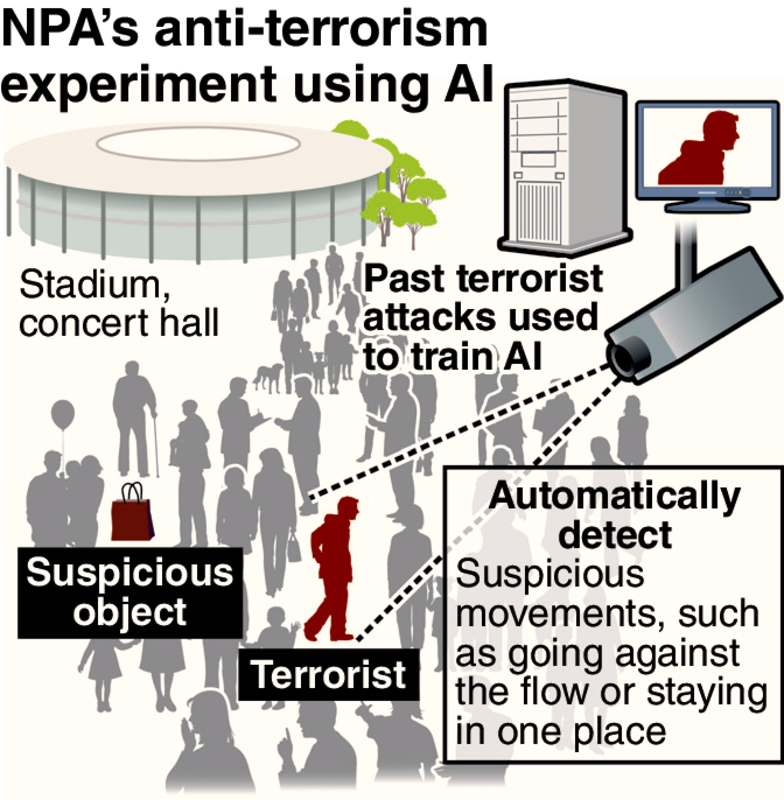
At large sports competitions, events and international conferences, surveillance cameras and other equipment would be installed temporarily to prevent terrorist attacks. The experiment would involve testing a system that uses AI to automatically detect suspicious people and objects from surveillance videos and other data.
In Europe, terrorists have set their sights on so-called soft targets -- events where large numbers of people gather. In the 2015 Paris attacks, the terrorists targeted a soccer match involving the French national team, while a pop concert in Britain was attacked in 2017.
The new system would use past attacks to teach AI the signs of an impending attack and the characteristics of terrorist behavior.
In the midst of large crowds, the system would need to automatically detect people exhibiting unusual behavior, such as repeatedly visiting a certain location or staying in one place, and suspicious objects that are abandoned for long periods.
After detecting something, the system would issue a warning so police officers could assess the situation, such as to determine whether the person in question is armed.
Attempts to analyze videos of crowds are already being made.
In July, the Metropolitan Police Department partnered with major electronics maker Panasonic Corp. in an experiment at the Sumida River Fireworks Festival.
In the experiment, a police car parked at an intersection recorded spectators and others on video, which was used to count the number of people in a specific area and predict the direction in which people move, among other tasks.
"Video technology has improved, making it possible to analyze videos of crowds. The key to success is how well AI can learn from the examples of suspicious people," a senior police official said.
The NPA will also introduce a system next fiscal year that will use land-based cameras to automatically detect suspicious North Korean ships, as many such vessels have washed ashore on the coast of the Sea of Japan.
In criminal investigations, AI will also be used to determine the model of automobiles.
While progress has been made in analyzing surveillance camera videos from murders, robberies and other crimes, often only a part of the vehicle is visible or the image is indistinct.
In a new system, an AI will be trained on data on foreign and domestic automobiles to enable it to identify a vehicle model even when the image is incomplete.
In money laundering investigations, an AI will be trained on the characteristics of illegal money transfers to automatically detect certain situations, such as when a long-dormant account suddenly receives a large deposit or when large overseas transfers are made repeatedly in a short period.
When financial institutions flag a suspicious transaction, the NPA is notified as per the law on the prevention of the transfer of illegally obtained earnings. About 400,000 such transactions occur each year, which are currently investigated manually.
"Much is unclear about how useful AI will be, but we are aggressively searching for ways to make our work more advanced and more efficient," a senior NPA official said.
Read more from The Japan News at https://japannews.yomiuri.co.jp/