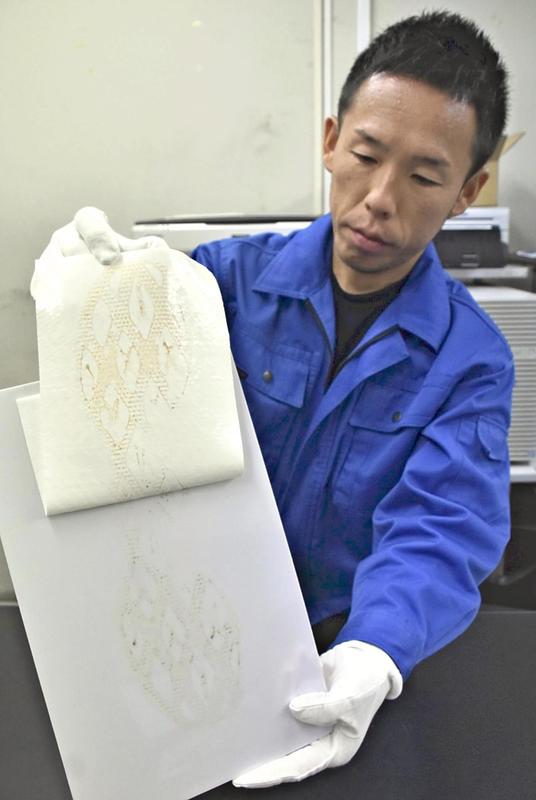
TOKUSHIMA -- Members of the criminal identification section of the Tokushima prefectural police have developed a new evidence sheet they believe will make it easier to collect fingerprints and footprints using blood adhered to surfaces at crime scenes.
Investigators use such sheets by sticking them onto fingerprints and footprints, but the existing types are so strongly adhesive they can damage the pattern of the print.
The new sheet could help even inexperienced investigators obtain clear impressions of detailed patterns.
It has been decided to turn the sheet into a product.
"If we can consistently collect stable samples, it will make accurate authentications possible," said Kozo Watanabe, 44, a subsection chief who was involved in the sheet's development.
The sheet can be used to make impressions of patterns with adhered blood, including fingerprints, footprints and tire tracks.
Existing sheets are highly adhesive and when stuck to materials such as paper there is a risk of tearing when they are removed. It is also difficult to make impressions of dried blood with them. Therefore, these sheets are seen as requiring skill to use.
At a criminal identification training session held at Tokushima police headquarters this spring, younger officers had trouble using the existing sheets. Many could not take good impressions of prints.
Watanabe and the others started their research on the understanding that these sheets were not an easy-to-use tool for evidence collection. "We wanted to create a sheet that would collect identical samples no matter where it's used or who uses it," Watanabe said.
A surfactant with good affinity for the fatty components in blood was added so the sheet could even be used with dried blood. The adhesiveness of the sheet was adjusted by modifying the amount of water.
With advice from the Tokushima prefectural police criminal investigation laboratory, it took about six months of adjusting the components to create the finished product.
In October, test sheets were used at the scene of a murder in Tokushima. Police were able to obtain a clear impression of footprints left on tatami mats and bedding.
These were only test products, so the samples were not used as evidence, but the experience gave the team confidence their type of sheet could be actually used in investigations.
They met with a manufacturer and decided to sell the sheets commercially. When the sheets will appear on the market and for what price has yet to be determined.
If the sheet is developed into a product, it could be used by prefectural police departments nationwide.
The team plans to make a presentation at a meeting of the Japanese Association of Forensic Science and Technology in Tokyo in November.
Kazuo Nakai, deputy director of the criminal identification section, said: "Authentication failures are unacceptable. More advanced technology will improve the quality of our work. I hope these valuable research results will be useful in investigations."
Read more from The Japan News at https://japannews.yomiuri.co.jp/