The Metropolitan Police Department is considering the introduction of a crime prevention system that uses artificial intelligence and big data to predict when and where crimes might occur.
The Kyoto prefectural police have already launched crime prevention measures that harness big data, steps that have resulted in the apprehension of people for crimes including theft and secretly taking photos with a hidden camera.
The MPD plans to combine this system with AI technology to improve its accuracy. In the private sector, the development of new technologies, such as equipment with AI to prevent shoplifting, is also being promoted.
In March 2017, the MPD established a full-time team to examine the practical applications of big data and using AI as part of a crime prevention system. On April 20 this year, experts at a research workshop proposed to the MPD that such a system "could prevent crimes from happening and improve public safety." In response, the MPD began to earnestly consider introducing the system.
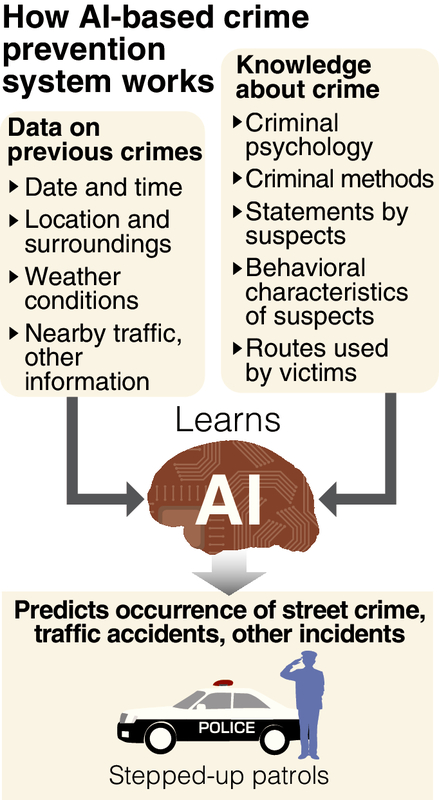
Based on big data including the date, time, location and weather conditions when previous criminal incidents occurred, the envisioned system can predict when and where crimes have a high probability of taking place.
If the system uses AI to learn about criminal psychology, the statements and behavior of suspects in previous cases and other information, its accuracy will increase noticeably. It is said that the system also will enable police to pinpoint the characteristics of people likely to be victimized by crime.
Police will step up patrols in areas deemed prospective crime scenes by the AI system, helping to prevent incidents before they happen. The MPD expects this to have a major impact in stopping traffic accidents and sex crimes, and in combating street crimes such as bag-snatching.
The MPD will discuss the system with the private sector and examine technical issues to be ironed out as well as concrete details on how the system would be implemented.
"We'll be able to efficiently station officers in the right place, which will lead to the quick apprehension of offenders," a senior MPD official said.
Since October 2016, the Kyoto prefectural police have utilized big data accrued from information on past criminal cases. The police narrow down the locations of likely crime scenes to 100 to 200 square meters, before intensifying patrols in those areas.
In April 2017, a man was arrested for secretly filming people on a riverbed in an area where the system had predicted a sex crime could happen. In another case, a man was apprehended for stealing a motorcycle in a district that big data predicted could be struck by vehicle thieves.
A senior official at the National Police Agency said the Kyoto system "had been confirmed" to have produced certain results. Other prefectural police forces, such as the Kanagawa prefectural police, are also moving toward introducing a similar crime prevention system.
National Institute of Informatics Prof. Seiji Yamada, an expert on AI, said: "If the police can use AI to learn details about crimes and the experiences of detectives, they could predict accidents and crimes that previously couldn't be anticipated. If these AI predictions are skillfully combined with the judgment of humans, it could be a powerful tool in the future."
Shoplifters in AI crosshairs
The private sector is spearheading the development of new security devices that use AI.
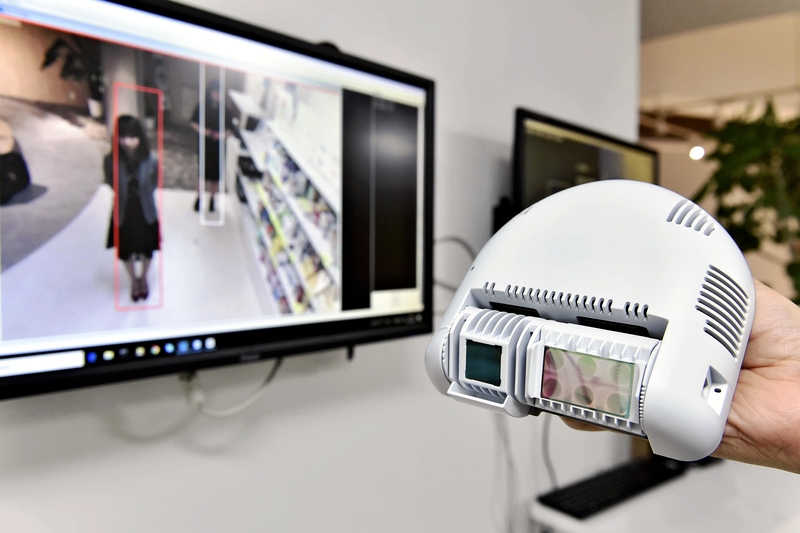
In January 2017, Tokyo-based Earth Eyes started selling shoplifting prevention equipment that taps the power of AI. When a security camera detects movements typical of a shoplifter, such as pacing back and forth along product shelves or a person stopping and then checking left and right several times, built-in AI technology kicks into gear. In addition to sending a message and visual images to the smartphones of store employees and security guards, a speaker attached to the camera broadcasts a warning such as "a store employee is coming" to the person acting suspiciously.
Earth Eyes has sold about 1,500 such products. Major hardware stores and drugstores that installed these cameras last year reduced losses attributed to shoplifting by 30 percent to 60 percent, according to the company. An Earth Eyes spokesperson said the company plans to integrate AI into home intercoms and other devices to help deter stalkers.
Since April 2017, Kawasaki-based Fujitsu Laboratories Ltd. has been developing AI to combat cyber-attacks.
AI that has learned the distinctive features of malware can automatically detect if a virus has infected a computer network. The malware can then be neutralized before any information is stolen by an outside party or leaked.
The AI program is currently 97 percent accurate, and Fujitsu Laboratories plans to conduct demonstrations this fiscal year with an eye toward its practical implementation.
Read more from The Japan News at https://japannews.yomiuri.co.jp/