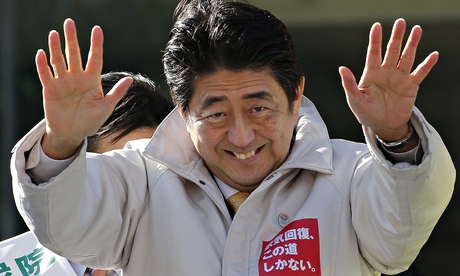
Japan’s prime minister, Shinzo Abe, seems likely to tighten his grip on power after exit polls forecast that his Liberal Democratic party would win a comfortable majority in the country’s general election – albeit on a very low turnout.
Abe had called a snap election in search of a fresh mandate for his growth-centred economic policy, known as “Abenomics”, after data showed the world’s third-biggest economy recently slipped back into recession following an April rise in the tax on consumer goods.
Exit polls from public broadcaster NHK forecast that Abe’s LDP would win a majority of about 300 seats in the 475-seat lower house.
The party currently has 295 seats and could register its biggest victory since it was formed six decades ago. The LDP’s junior coalition partner, Komeito, was expected to add to its tally of 31 seats.
Japanese media said the ruling parties together were expected to retain their two-thirds majority, enabling them to push legislation through both houses with ease.
Winning at least 317 seats – their joint strength going into the election was 326 seats – would give the ruling coalition the power to override bills rejected by the upper house and pass them into law.
While the low turnout – as of 6pm local time it was just under 35%, down almost seven points on the last election two years ago – hardly amounted to an endorsement of Abe’s policies, Sunday’s expected result underlined the precarious state of the main opposition Democratic party of Japan (DPJ) and confirmed its failure to rebuild its support base after its trouncing by Abe’s LDP two years ago.
“This is not so much a vote of confidence in Abe and the LDP as a vote of no-confidence in the political opposition,” Professor Gerry Curtis of Columbia University told Reuters.
Many voters had questioned the need for an election midway through Abe’s first term.
The prime minister had described the snap election, held halfway through his first term, as a referendum on “Abenomics” – his three-pronged strategy of cheap credit, public investment, and structural reforms that include raising the number of women in the workforce and opening up the country’s highly protected agricultural sector.
The finance minister, Taro Aso, said the expected result proved that voters were behind Abe’s economic policies. “That was the people’s verdict, so we will continue with Abenomics until the very end,” he told NHK shortly after polls closed.
Abe’s mission hit a snag in November when Japan slipped back into recession in the third quarter, amid weak consumer and corporate spending. Analysts blamed that on April’s rise in the consumption (sales) tax from 5% to 8%, which battered consumer spending.
On the same day he announced the snap election, Abe said he would delay a two-percentage point rise in the same tax originally planned for next October until April 2017.
Abe is expected to use Sunday’s victory to silence critics inside his own party who believe the tax rise should have gone ahead as scheduled so Japan could begin addressing its huge public debt, now more than twice the size of its economy.
After almost a decade in which prime ministers have come and gone in quick succession, Abe is set to dramatically extend his longevity as leader.
Abe’s first stint as prime minister, from late 2006, lasted just a year when he was forced to resign by a string of ministerial scandals and a chronic bowel problem he now treats with new drugs. Five years later, he mounted a dramatic comeback, sweeping into office by a landslide with promises of reviving the economy and restoring the country’s pride.
He is widely expected to win next September’s LDP leadership election and will not have to face voters again until upper house elections in 2016.
Doubts exist, however, over his appetite to push through structural reforms, including labour market deregulation that would make it easier for companies to sack workers. He will also come up against strong opposition from farmers to plans to join the Trans-Pacific Partnership free-trade pact.
“We are likely to see more of what we’ve seen … piecemeal reforms moving more or less in the right direction, but at a fairly slow clip and no bold breakthroughs because of this election,” Curtis said.
Sunday’s victory also gives Abe breathing room to proceed with two controversial policies: the restart of nuclear reactors, three years after the Fukushima meltdown, and expanding the military’s global reach by lifting the postwar ban on collective self-defence .