The stationery industry has been especially hard hit by the nation's declining birthrate, due to fewer children using its products in schools. With increasingly less paper also being used in offices, manufacturers are working hard to develop distinctive products in a bid for survival.
Unlike overseas markets, where cheap ballpoint pens are often sold by the dozen, Japanese makers release unique new products one after another. For example, notebook pages with dots on the guidelines make it easier for the user to draw figures and charts, while a mechanical pencil sharpens itself. An eraser is designed with many corners, to make it easier to rub out very small sections.
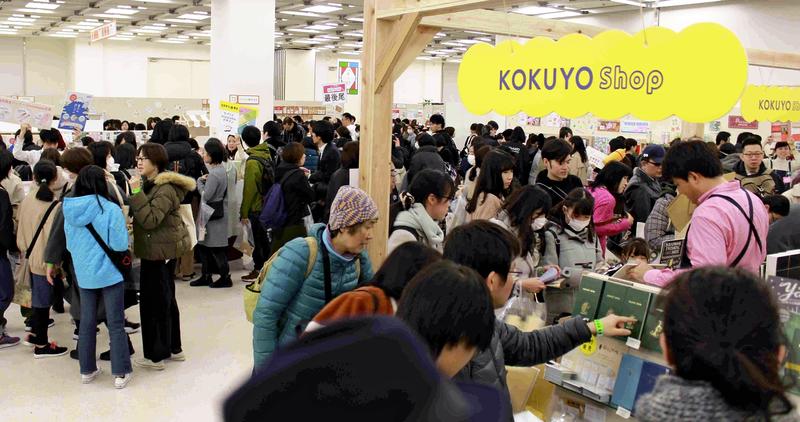
Users are also strongly interested in various stationery products. Social networking sites contain photos of diaries and notebooks in which people wrote with colorful instruments. Female stationery enthusiasts are called "bungu joshi," or stationery girls, and there is an annual fair aimed at such fans.
The 2019 edition of Bungu Joshi Haku, held in December in Tokyo, attracted about 38,000 visitors. More than 100 companies set up booths at the venue, and fans lined up to buy limited items and vote for their favorite products.
Makers have put out high-function, high-end products one after another, partly in an earnest attempt to survive. Data from a cooperative association for pencil companies indicates the structural predicament facing the stationery industry -- the number of pencils produced in Japan was 207.64 million in 2018, or less than a third of the figure 30 years before. This is primarily because the number of elementary school students, who are heavy users of this product, has decreased by nearly 40% over the period.
There is also the fact that companies and government offices are using less and less paper.
According to the Yano Research Institute, which conducts market research, the domestic market for stationery and office supplies stood at 457.6 billion yen in fiscal 2018 in terms of prices at the time of manufacturers' shipments. This was down 1.4% from the previous year, marking negative growth for the second year in a row.
An increasing number of manufacturers are turning to overseas markets to find a way out of this difficult domestic environment, including Pentel Co.
In the 1960s, Pentel distributed a sample marker at a trade fair in the United States, and it happened to fall into the hands of then President Lyndon Johnson. He loved how the marker wrote smoothly. Winning the president's favor paved the way for the marker to become a worldwide hit.
It was later adopted by the U.S. National Aeronautics and Space Administration (NASA) because it could be used in zero gravity.
Overseas sales currently account for 60% of Pentel's total sales.
Pilot Corp.'s Frixion Ball ballpoint pen series is a recent example of an overseas success. Writing done with a Frixion Ball can be erased using the rubber eraser on the other end. The pen uses a special ink that changes color according to temperature, an achievement representing 30 years of research by the company.
In Europe, students usually use a fountain pen or a ballpoint pen during class. They used to need three implements for writing, erasing and overwriting, but Frixion Ball can do all three and became a runaway hit when it first went on sale in Europe. It was even described as "having changed the landscape of classes in Europe."
Mitsubishi Pencil Co.'s Jetstream ballpoint pen provides a smooth writing feel even through it uses an oil-based ink. It makes it easy to write kanji characters that have many strokes, and is a massive success with sales of more than 100 million units a year, mainly in East Asia.
Creative, high-value-added products like these have been developed as manufacturers compete with each other over technology and ideas in the shrinking domestic market.
Domestic mobile phones and home appliances once succumbed to international competition as they fell into the so-called Galapagos syndrome. This refers to by pursing advanced functions to meet the needs of the domestic market, and therefore becoming isolated from global standards.
In this sense, the stationery industry seems to be a rare example of a business that has benefited from Galapagos syndrome.
Writing tools took the lead
In the biggest recent headline for the stationery industry, leading manufacturer Kokuyo Co. attempted a hostile takeover of Pentel.
Plus Corp., the No. 2 player in the industry, joined in the battle for Pentel shares as a friendly white knight, eventually preventing Kokuyo from buying a majority of Pentel shares and thus making it a subsidiary.
Kokuyo provides more than 8,000 kinds of stationery, including its signature Campus Notebooks series, and also sells office furniture. However, the industry giant relies largely on the domestic market for its sales.
Through its hostile takeover attempt, Kokuyo is believed to have been aiming at boosting sales of writing instruments in overseas markets.
It's difficult for notebooks and other paper products to stand out among various rivals, and their heavy weight makes them unsuitable for exports. In contrast, it's easy for writing utensils to be made more sophisticated, and they've sold fairly steadily overseas.
In addition to Pilot and Mitsubishi, Sakura Color Products Corp. and Zebra Co. also export their writing tools.
Major manufacturers overseas include Newell Brands Inc., a U.S. company that owns the luxury Parker brand, and BIC, a French maker known for its affordable ballpoint pens.
In the global market, U.S. and European makers, which boast sophisticated designs, compete against Japanese rivals that stand out for their products' superior functionality. They also view for market share with manufacturers from China and India that sell cheaper products.
Read more from The Japan News at https://japannews.yomiuri.co.jp/