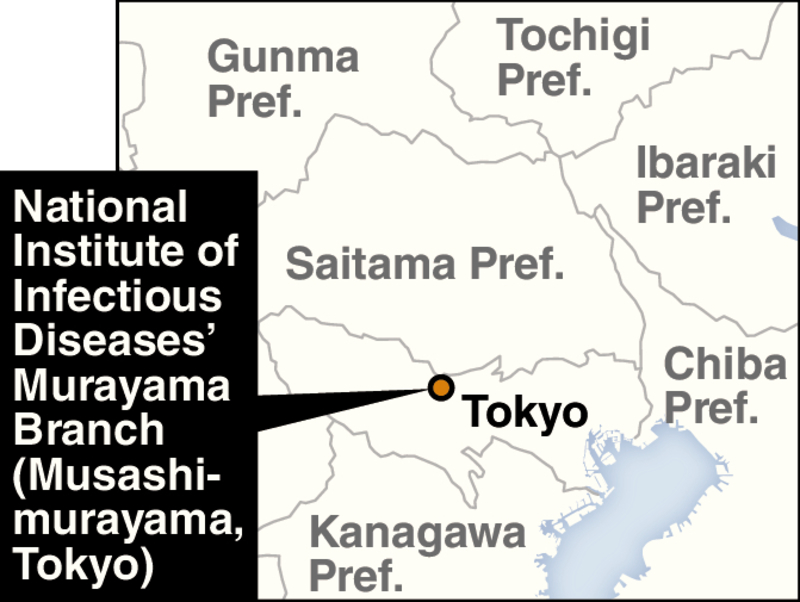
A national institute in Tokyo plans to use and research live strains of the Ebola virus and other infectious diseases imported from overseas, a move that would see the institute utilize its biosafety level 4 facility (see below) for the first time.
The Health, Labor and Welfare Ministry said Thursday that the National Institute of Infectious Diseases' Murayama Branch aims to use live viruses to strengthen detection methods for infectious diseases ahead of the 2020 Tokyo Olympics and Paralympics. The branch is located in Musashimurayama, Tokyo.
Several types of viral hemorrhagic fever that have a high mortality rate, including Ebola and Lassa fever, are spreading overseas. The government has set a goal of 40 million foreign visitors in 2020, and there are concerns people carrying these diseases could enter the country.
Essential steps for combating infectious diseases include an accurate, quick diagnosis, tracing the infection route and providing appropriate treatment. However, current testing methods used in the country at times struggle to provide a diagnosis, even if a patient is infected with a virus. Using live viruses will enable new tests that will make sure a treatment is effective.
On Thursday, health ministry officials met with related people including Musashimurayama resident representatives at a facility operation liaison council at the Murayama Branch. The ministry asked the attendees to accept the plan to import viruses acquired from overseas research institutes, but did not specify which kinds of viruses would be used or when.
In August 2015, when the ministry designated a laboratory inside the branch as a BSL-4 facility, the Musashimurayama city government agreed to allow tests to be done at the branch if a patient was identified. However, no tests using live viruses have been conducted so far.
According to the ministry, at least 59 BSL-4 facilities operate in 24 nations including the United States, Germany and China, and it is standard for these facilities to use highly accurate testing methods based on live viruses.
-- Biosafety level 4 facility
A facility equipped to safely handle the most dangerous types of viruses. The World Health Organization designated the four-level BSL system for pathogens based on their level of risk to human health. Viruses including Ebola and Lassa can be handled only at designated facilities based on the infectious diseases control law. Nagasaki University plans to build a BSL-4 facility in Nagasaki.
Read more from The Japan News at https://japannews.yomiuri.co.jp/