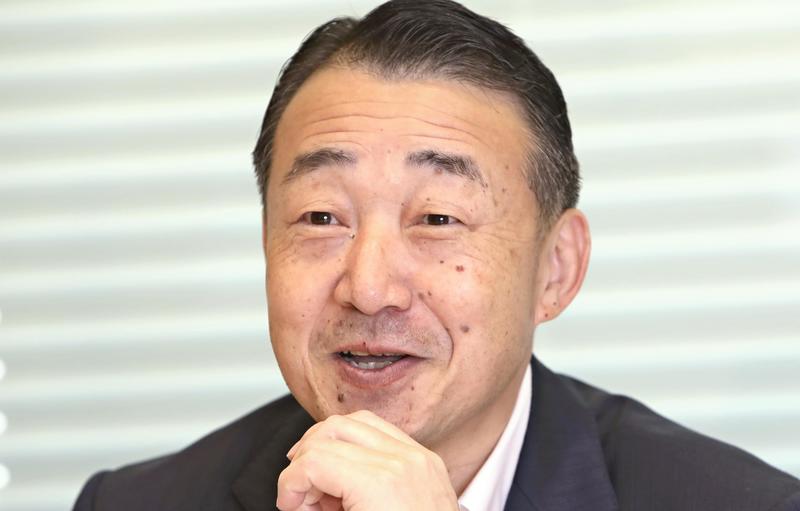
Kewpie Corporation is known as Japan's largest manufacturer of mayonnaise and dressings. For this installment of Leaders, a column featuring corporate management and senior executives, Kewpie President Osamu Chonan discusses the company's corporate philosophy, which he calls the backbone of its operations since its founding in 1919.
When it comes to how to diversify our business, Kewpie has maintained a basic principle -- never shamelessly barge into other companies' core areas.
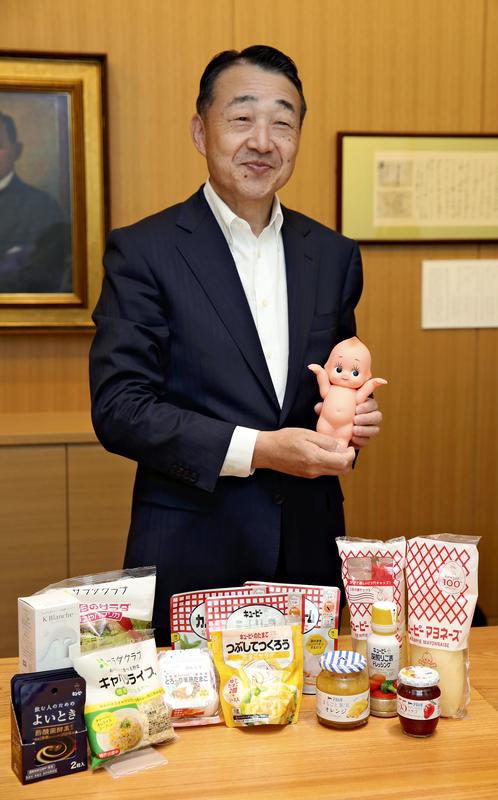
Since the company's founding, we have manufactured and sold mayonnaise, dressings, meat sauce and nursing care food. We were the first to introduce these products to the domestic market. All of the new businesses we've launched can be traced to these pioneer items. We don't enter a new field simply because it's the latest trend.
To be honest, this isn't easy. That's because we can't always raise sales by making adjustments to our existing popular products. One of the golden rules we've observed since our founding is: "Act on moral principles." We apply this rule when considering whether to start a new business as well. We abide by it at all times -- it is like our constitution.
[In the 1910s, company founder Toichiro Nakashima worked as an "overseas intern" in London and New York as part of a government program. He tasted mayonnaise for the first time during this trip.]
Nakashima noticed that well-built Americans were eating potato salad with mayonnaise. The observation was apparently behind his decision to make delicious and nutritious mayonnaise to help the Japanese improve their physiques.
After his return, Nakashima created his own mayonnaise and began selling it in 1925. The ingredients were eggs, vinegar and cooking oil. He decided to use only the yolk of the egg for Kewpie's mayonnaise.
If he used egg whites, the mayonnaise would be easier to manufacture and also have a milder taste. However, Japanese prefer foods with a rich taste like miso and soy sauce. He likely thought that the rich taste of egg yolks alone would go better with rice. He also believed that the highly nutritious yolks would help improve the physical stature of the Japanese.
[Most domestic and overseas mayonnaise makers use both yolks and whites, but Kewpie uses only the yolk for its mayonnaise.]
In the old days, we would put the leftover egg whites in 1.8-liter sake bottles and go around selling them to pastry shops and other places. Sales of leftover whites have gradually grown, and today we sell them to a wide range of customers, from fish paste manufacturers to confectionery companies.
[The company has diversified its lineup, going from mayonnaise to egg-related foods and processed foods like jams, pasta sauce, baby food and nursing care food. Its condiments business, which includes mayonnaise and dressings, accounts for only 32 percent of Kewpie's total sales, followed by its salad and delicatessen business at 21 percent, and its egg-related business at 18 percent.]
We have been offering a variety of salad items using mayonnaise to supermarket chains and the restaurant industry. We have also been working to strengthen our manufacturing and sales of salads and delicatessen. We will aim to further refine our business and become a leader in the field of salad and eggs, while keeping mayonnaise and dressings as our core products.
You're not your job title
Kewpie's president and top executives do not have special offices and work on the same floor as regular employees. This has been common practice at the company since its foundation.
Our employees don't have to address their bosses by their job title. They can simply add "san" to their name. For instance, all the employees call me, "Chonan-san." Up until around 1990, our business cards only listed the company's name and the name of the cardholder -- but not the job title.
This practice is based on the company's motto: "Raku gyo kai etsu." Nakashima took this expression from the Analects of Confucius. It relates to the idea that people who have the same ambitions enjoy working together, endure struggles together and rejoice together. It reflects Nakashima's belief that employees should perform their work as one single individual and not from the perspective of their job title.
Since early in my career, senior coworkers have often told me: "When something is right, it's right even if said by a newcomer. When something is wrong, it's wrong even if said by a boss. We must always adhere to this principle." I believe that the driving force behind our business is the fact that we've managed to preserve the same motto and principles we had at our foundation.
[Kewpie's largest shareholder is Nakashimato Co. Ltd., a company owned by the family of founder Nakashima. It holds a 16.22 percent share. Nakashimato is in charge of advertising and brand management for Kewpie, with most of its advertising geared toward cultivating corporate brand image and food culture rather than promoting products.]
Sales staff have requested that we do more advertising directly related to Kewpie's products. However, I think that our dedication to building a consistent branding strategy instead of pursuing more sales has enabled us to win our customers' trust.
From the customer's perspective
I am not good at speaking in public. When I joined the company, I asked to be assigned to a factory because I was more confident in my physical strength. The company decided to assign me to Kewpie's Sengawa Factory in Chofu, Tokyo.
In my eighth year at the company, I was transferred to a sales department and took charge of sales to a major supermarket chain in Osaka Prefecture. At the time, it was rather uncommon for someone to be transferred from a factory to a sales section. Honestly speaking, I did not view it as a positive step in my career.
My knowledge of sales lingo and business terminology was limited. My sales results were not good, so I really had a tough time. For almost half a year I would have nightmares and wake up in the middle of the night covered in sweat. I thought that I would have no choice but to quit my job if things went on that way.
Even during this time of hardship, I woke up early in the morning to help stock shelves at a supermarket. Eventually, a manager at a key store ended up entrusting me with the role of preparing an event space and introduced me to other store managers, saying, "Chonan-san is going to visit you soon, so please listen to him." My sales performance began to significantly improve thanks to these experiences.
Looking back on that time, I believe that people at the store were noticing my work. Even though I was inexperienced, I devoted myself to working for the sake of the store. I have been telling younger employees these days, "Although you may find yourself in a tough situation, there's always someone who will take care of you and extend a helping hand."
[One of the company's future challenges is how to meet the diversifying needs of consumers.]
We need to conduct research on customers' daily lives in order to understand their changing preferences. We have been conducting consumer research to find out such things as what type of refrigerator they use, what kind of food is stored inside it and the needs of the elderly.
Through our research, various findings have emerged that have caught our attention. For example, the way that people eat eggs has changed. Eggs have long been a standard breakfast item, either fried, boiled or as an omelet. In recent years, however, more people have been relying on easy-to-eat foods like bananas and yogurt in the morning. As the number of double-income households increases, more people lack the time to prepare eggs, which requires cooking and clearing away the dishes.
Based on our research, we have developed a new product series called "Tsubushite Tsukuro," meaning crush to cook. Customers simply squeeze a boiled egg inside a package to enjoy freshly made egg salad. We would like to create products from the customer's perspective to make people happy.
This year marks the 100th anniversary of the company's founding. Corporate management is similar to an ekiden road relay race, but without the goal. Just like an ekiden runner carries the sash to the next in line, I will carry Kewpie's principles to the next generation without getting dragged down by the desire to make a short-term profit.
-- Osamu Chonan / President of Kewpie Corporation
Born in Yamagata Prefecture in 1956, Chonan joined the company after graduating from Kagoshima University's Faculty of Fisheries in 1980. He has held various positions at the company, including manager of the Sendai, Osaka and Tokyo branches and executive corporate officer, before taking up his current post in February 2017.
-- Key Numbers: 4.2 billion
The company handles about 4.2 billion eggs a year, or about 10 percent of total egg production in the country. Its main product, Kewpie mayonnaise, was named after a doll popular when the product first hit shelves. According to its consolidated financial statement for the fiscal year ended November 2018, net sales were 573.5 billion yen and ordinary income was 34.3 billion yen. The consolidated number of employees was 14,808 as of November last year.
Read more from The Japan News at https://japannews.yomiuri.co.jp/