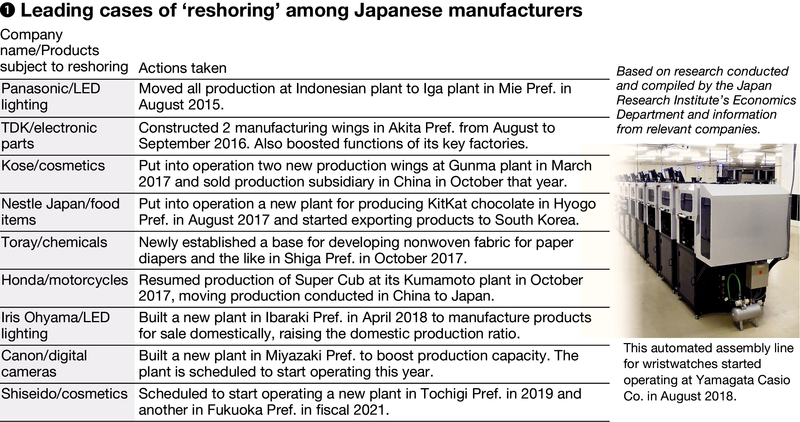
There have been conspicuous moves among Japanese manufacturers to beef up their domestic production.
Increased demand abroad for high-quality "made in Japan" products is believed to have contributed to this trend, along with diminishing benefits of overseas production, due to rising wages in the emerging economies of Asia.
However, it is difficult to foresee how far this "reshoring" phenomenon will spread.
At Yamagata Casio Co., which is based in Higashine, Yamagata Prefecture, and a domestic base for Casio Computer Co., the assembly of watches in a popular price range that used to be done manually has been automated since last August.
Production capacity is now 100,000 units a month, and per-worker production efficiency has tripled. Popularly called "cheap Casios," the wristwatches, to be sold at around 20 dollars each, are being exported to such destinations as the Middle East, where the "Made in Japan" brand enjoys a good reputation.
There are also plans to transfer a portion of Yamagata Casio's production base from countries like China and Thailand to Yamagata Prefecture in a few years.
The trend of Japanese manufacturers shifting their production bases back to Japan from overseas, or boosting their production at home, can be seen in a wide range of industries.
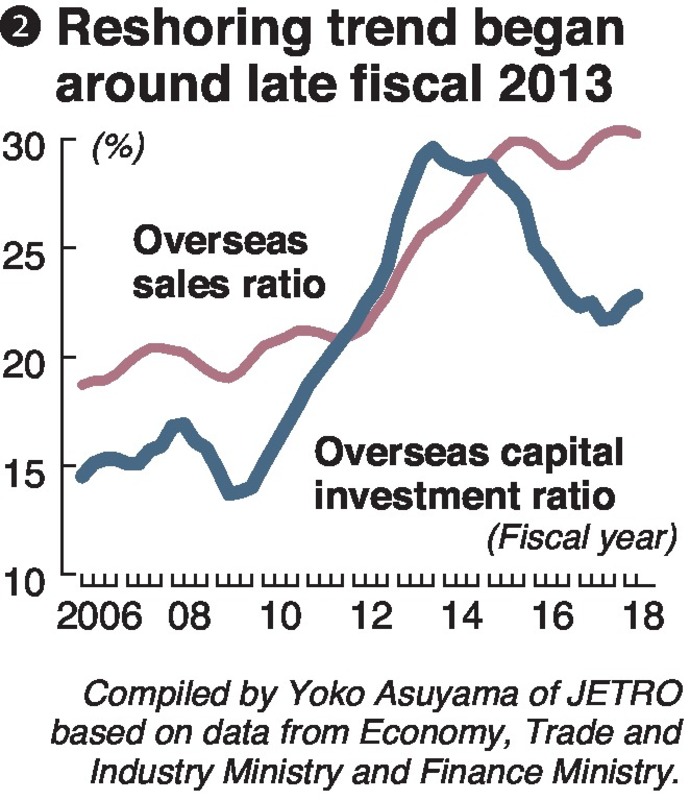
In the aftermath of the collapse of Lehman Brothers in 2008, Japanese manufacturers accelerated their transfer of production bases overseas, as they were beset with the so-called sextuple burdens, (see below) which included the yen's sharp appreciation. In the years that followed, a depreciation of the yen took hold, thanks to monetary easing by the Bank of Japan, while the corporate tax rate was lowered and the power shortages after the 2011 Great East Japan Earthquake were alleviated.
This led to a decline in overseas capital investment ratios and increased reshoring, trends that are intimately connected.
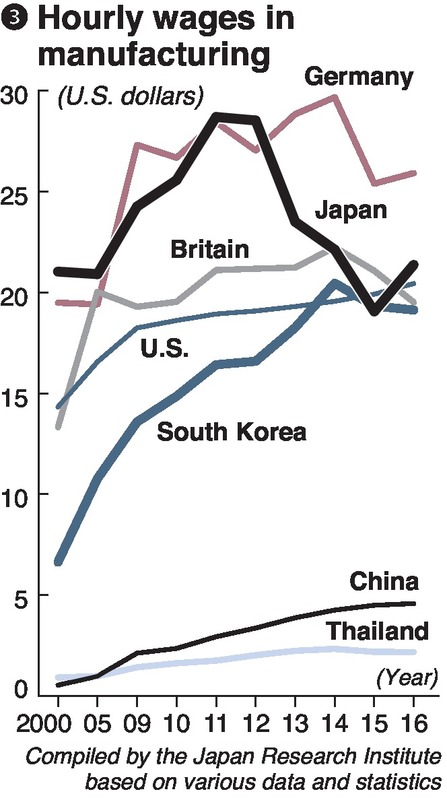
Another factor is wage increases in China and countries in Southeast Asia, shrinking the gap between domestic and overseas production costs.
In the fields of daily necessities and cosmetics, the increase in cross-border e-commerce has led to the expansion of sales channels via exports. Growth in inbound demand for Japanese products also appears to be promoting capital investment at home and supporting the reshoring trend.
Manufacturers' reshoring is not limited to Japan. Yoko Asuyama of the Japan External Trade Organization (JETRO) said that in the United States following the Lehman shock in 2008, the administration of U.S. President Barack Obama announced it would bolster the country's manufacturing sector. To that end, it pledged the strengthening of research and development.
Moves by Apple Inc. and General Electric Co. to bring part of their production bases back to the United States drew attention.
However, there are also signs that the trend is slowing down in the United States.
According to a survey by leading U.S. consulting firm A.T. Kearney, Inc., imports in 2017 from 14 major nations and regions -- including China and countries in Southeast Asia -- to which U.S. manufacturers have moved some of their production bases grew by 8 percent over the previous year, the largest year-on-year growth since 2011.
Increased demand for Chinese goods, which have markedly improved in design and quality, was also a contributing factor.
Manufacturing is a key industry for Japan's economy even today, accounting for roughly 20 percent of its gross domestic product. Yosuke Yasui, a senior researcher at the Japan Research Institute, said that if the reshoring trend continues, Japan can expect to see such effects as a higher economic growth rate stemming from increased exports, decreased imports and expanded capital investment.
However, it is difficult to determine whether this trend will continue. As Yasui said, there is the obstacle of whether Japan can successfully reduce production costs by increasing productivity while overcoming the contraction of domestic demand due to population decline.
According to a JETRO survey for fiscal 2016, the reason most cited by Japanese manufacturers for expanding domestic operations was an increase in domestic demand, at 55.6 percent. Those who cited evading currency fluctuations stood at 6.6 percent, and the percentage that cited such overseas cost factors as labor costs and tax burdens was unexpectedly low at 3.9 percent. Whether wages rise domestically, boosting consumers' purchasing power, will hold the key to the advance of the reshoring trend.
Manufacturers will also be tested over whether they can offer products and services that help them acquire new markets.
Following the collapse of the bubble economy, Japanese companies, overly eager to put their finances on a sound footing and streamline their business operations, "adopted a strictly defensive management style," said Prof. Akio Makabe at Hosei University Graduate School.
In other words, he pointed out that the aggressive approach to corporate management among Japanese companies receded, causing them to lag behind in product development that could sweep through markets, as represented by smartphones, and also in the digitization of production processes, which Germany spearheaded with its fourth industrial revolution.
Japan, with its declining birthrate and graying population, will be tested as to whether it can streamline production processes to make up for labor shortages, and whether it can succeed in innovation that could lead to the development of groundbreaking products.
Disposable diapers for adults can be cited as a successful example of generating new demand in response to an aging population and a declining birthrate.
"There's no guarantee of success in the promotion of reshoring by Japanese manufacturers, against the backdrop of the U.S. protectionist policies and R&D investments that focus solely on improving existing businesses rather than creating new businesses," said Yasui.
The important thing is whether the reshoring of "wisdom" can lead to innovation.
--The sextuple burdens
Six factors that have put pressure on corporate management in Japan following the Great East Japan Earthquake. A 2015 investigative report by Keidanren (Japan Business Federation) lists them as:
1. Strong yen; 2. Heavy corporate taxes and social insurance premiums; 3. Delays in concluding economic partnership agreements; 4. Inflexible labor market; 5. Unreasonable environmental regulations; 6. Power supply shortages and high costs
Read more from The Japan News at https://japannews.yomiuri.co.jp/