Even after recovering from an infection with the new coronavirus, some people still live in secrecy, fearing discrimination for having been infected.
No cure for this unknown pathogen has been established, and anyone can be infected. In the midst of society's fear, a man who was infected is confronting such prejudice by daring to reveal his experiences.
-- 'Don't visit'
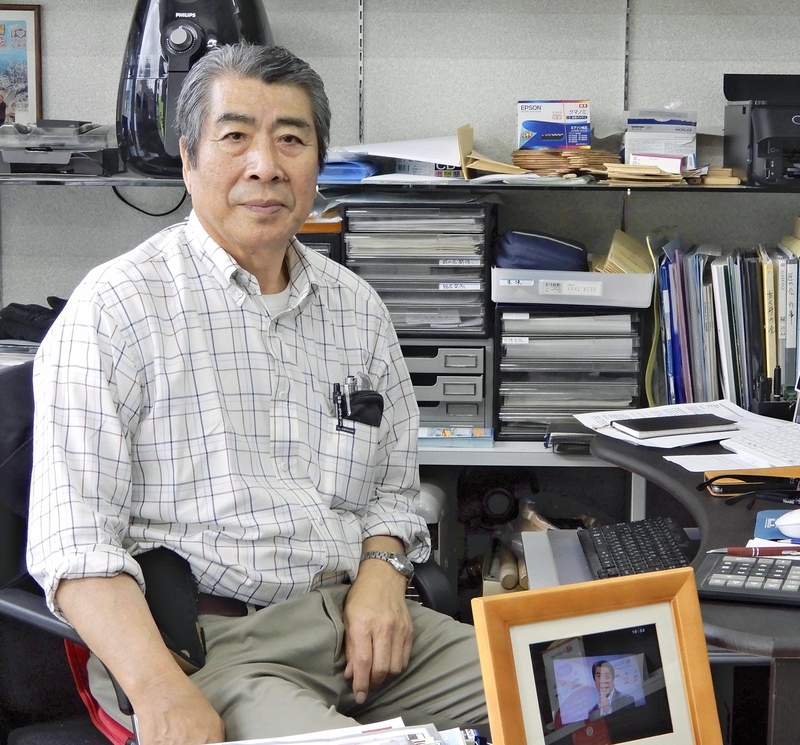
"By disclosing the name and face of an ordinary man like me, I wanted to convey the fact that 'Anybody can get infected at any time,'" said Mitsumasa Okumura, 67, who runs an electronics store in Kitami, Hokkaido, explaining his reason for agreeing to be interviewed by The Yomiuri Shimbun without requesting anonymity.
On Feb. 14 and 15, Okumura participated as an exhibitor in a commodity fair held at the city's commercial facility. He held business meetings with dozens of people in a "close-contact setting," so close that their shoulders were almost touching. A week later, on Feb. 22, he developed a fever of around 38C. He found out on Feb. 29 that he was suffering pneumonia caused by the coronavius and was hospitalized.
Eleven people, including participants at the fair, were found to have caught the virus, and the central government recognized the case as an infection cluster.
Okumura said he did not have any respiratory symptoms, such as a cough or sputum. On March 15, he was discharged after testing negative in PCR tests twice in a row. After that, however, he became known in his community as a coronavirus carrier.
Okumura said his clients told him "Don't visit us as you may transmit the virus." Some people hurled insults at him, such as saying that Okumura had made their family member sick. One long-time client even told him with a puzzled expression, "I was told, 'You'll be left out if you hang out with Okumura-san.'"
-- Nipping it in the bud
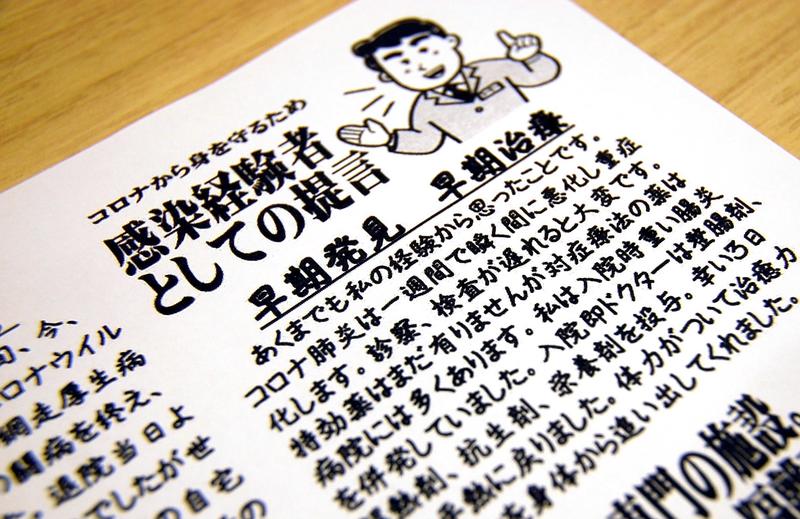
"If I don't take any action, the rumor will be embellished and spread further." With this philosophy in mind, Okumura distributed 500 flyers to his business partners on the occasion of resuming his business in April, explaining how he recovered from the disease, along with a public health center's approval for him to resume business.
In the flyer, he described his notion that the coronavirus was not a particularly scary disease: "There are many medicines for symptomatic treatment in hospital," and "My temperature returned to normal three days after admission to hospital."
He also added something to keep his clients from being scared off: "I was able to move about freely from the day I left the hospital, but I took care of myself at home for another two weeks, considering possible rumors."
Those who saw the flyer encouraged Okumura saying, "You must've had a really tough time." Some of his clients began placing orders with jokes like, "This is a condolence gift for suffering from the coronavirus."
His store's sales are picking up again, and things are returning to normal, Okumura said.
-- Accurate information necessary
More than 16,000 people have recovered from coronavirus infections nationwide. However, some of them are still hesitant to return to work or resume business even after recovering.
To prevent discrimination and prejudice against former coronavirus patients, it is essential to provide accurate information about medical findings and the state of infections so as not to stir up fear. The Yomiuri Shimbun on Monday announced a proposal to prevent discrimination triggered by the coronavirus.
Okumura said, "I think all the harsh words directed at me came from fear.
"Infected patients are being treated with fear and anxiety, too. I hope that society can welcome those who were once infected and came back after fighting against the coronavirus."
Okumura said he is determined to continue sharing his experience of fighting the virus.
Read more from The Japan News at https://japannews.yomiuri.co.jp/



.jpg?w=600)