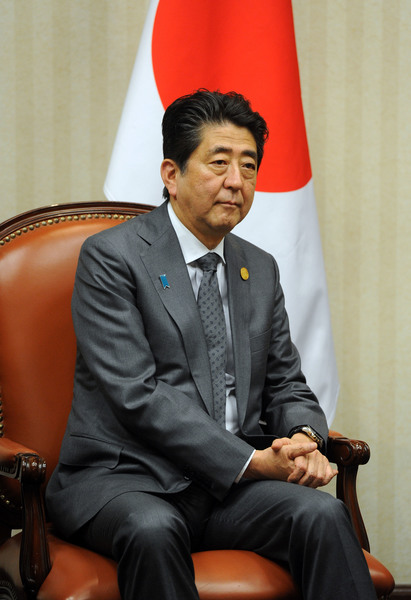
BEIJING _ Japanese Prime Minister Shinzo Abe announced Monday that he would accompany President Barack Obama to Pearl Harbor, making him the first sitting Japanese leader to visit the Hawaiian naval base since the end of World War II.
Abe told reporters that he will visit a memorial at the site on Dec. 26 and 27. The surprise announcement came two days before the 75th anniversary of Japan's attack on the base, which killed 2,400 U.S. servicemen and civilians and drew the U.S. into the war.
"This will be a visit to console the souls of the victims," he said. "I would like to show to the world the resolve that horrors of war should never be repeated."
The trip will reciprocate Obama's visit to Hiroshima in May, the first by a sitting U.S. president. Alongside Abe, Obama visited the site of the U.S. atomic bombing on Aug. 6, 1945, which killed an estimated 140,000 people. He expressed his aspiration to "ultimately eliminate the existence of nuclear weapons," but stopped short of apologizing for the U.S. attack.
The White House welcomed Abe's trip to Obama's home state of Hawaii, and confirmed that Obama will accompany him to the battleship Arizona memorial at the harbor.
"The two leaders' visit will showcase the power of reconciliation that has turned former adversaries into the closest of allies, united by common interests and shared values," Josh Earnest, the White House press secretary, said in a statement.
"The meeting will be an opportunity for the two leaders to review our joint efforts over the past four years to strengthen the U.S.-Japan alliance, including our close cooperation on a number of security, economic and global challenges."
Japan attacked the U.S. naval base at Pearl Harbor on the morning of Dec. 7, 1941, aiming to diminish Washington's Pacific Fleet. About 200 Japanese aircraft bombed the site, destroying 164 aircraft and several naval vessels, including the Arizona, a 600-foot-long battleship whose wreckage still lies at the bottom of the harbor.
The following day, President Franklin D. Roosevelt addressed Congress to ask for a declaration of war; he described the day as "a date which will live in infamy."
About three years later, in August 1945, the U.S. dropped atomic bombs on Hiroshima and Nagasaki, and Japan surrendered. Since the end of the war, Japan and the U.S. have become close allies _ trade between the two countries totaled an estimated $290 billion in 2012, according to the United States trade representative. More than 50,000 U.S. troops are stationed in Japan.
Abe's wife, Akie Abe, visited the Arizona memorial in August. She posted to Facebook that she had offered flowers and prayers.
In August 2015, on the 70th anniversary of Japan's surrender, Abe expressed "remorse" for his country's actions during the war, but did not formally apologize. "I express my feelings of profound grief and my eternal, sincere condolences," Abe said.