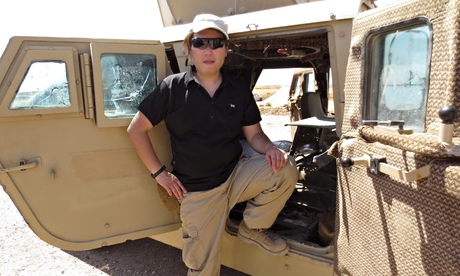
There were fears on Saturday night for Haruna Yukawa, one of two Japanese men taken hostage by Islamic State, after the release of a recording claiming he had been beheaded and a photograph purporting to show his body.
In the brief tape a man claiming to be the surviving hostage, 47-year-old journalist Kenji Goto, says his “cellmate” is dead and pleads for his own life. Speaking in English with a Japanese accent, he says Isis has dropped its demand for a $100m ransom and, instead, now wants to organise a prisoner exchange for a woman held in Jordan. The still image released with the tape shows Goto apparently holding a picture of Yukawa’s body.
Although Barack Obama issued a statement condemning what he called “the brutal murder”, the Japanese government said it was investigating the recording, which is quite different in format from the string of videos Isis produced to show the murders of other foreign hostages. Chief cabinet secretary Yoshihide Suga told the Associated Press that cabinet ministers were holding an emergency meeting.
Prime minister Shinzo Abe told reporters that the release of the new message was “an unforgivable act” and called for the “immediate release” of Goto. Abe said: “We are using every diplomatic channel … to work toward a release.”
The prisoner whom Isis wants released is Sajida al-Rishawi, an Iraqi woman who was sent on an al-Qaida bombing mission to Jordan in 2005 with her husband. They targeted a wedding in a hotel, and he killed at least 57 people, but she was caught after her suicide belt failed to detonate.
Japan’s deputy foreign minister, Yasuhide Nakayama, is in Jordan to try to coordinate rescue efforts. He was sent soon after the first video of the hostages surfaced, but in the hours before an arbitrary deadline for the ransom payment, Japanese officials admitted they had not been able to reach Isis representatives to start a dialogue.
Yukawa, 42, from Chiba prefecture near Tokyo, went to Syria last year after a series of personal misfortunes. Goto is a respected author and freelance journalist who ran a small media company, and went to cover the Syrian conflict.
On Tuesday, the two men appeared together in a video released by Isis’s al-Furqan media outlet entitled “A message to the government at the people of Japan” that set a 72-hour deadline for the Japanese government to pay a $200m ransom, $100m for each hostage. It had a format similar to previous hostage videos, with the men in orange jumpsuits kneeling on a hillside in a rocky desert, while a British-sounding militant standing between them issued demands.
Yukawa was originally detained in April in northern Syria by anti-government militant group the Free Syrian Army, and Goto, who was in the area, was brought in as an interpreter for the group to interrogate him. He was captured again some time after 21 July, when his blog entries stopped. In August, Isis released a YouTube video showing him with a bleeding face and lying on the ground, identifying himself as Japanese and not a spy.
In early October, Goto is understood to have travelled between Japan and Syria, arriving there again around 22 October. There has been speculation that he may have travelled to come to the aid of Yukawa.
This is not the first time Japan has faced a hostage crises from Islamic militants. In 2004, followers of Jordanian militant Abu Musab al-Zarqawi in Iraq beheaded a 24-year-old backpacker Shosei Koda. A video by Zarqawi’s group, which later became the Islamic State group, showed Koda begging Japan’s then-prime minister to save him.
At the time prime minister Junichiro Koizumi told reporters: “I cannot allow terrorism and cannot bow to terrorism.” Koda’s body was found a few days later dumped in Baghdad.