The coronavirus crisis has greatly impacted people's everyday life, and the "new normal" is starting to emerge in various areas, including housing, food and transportation.
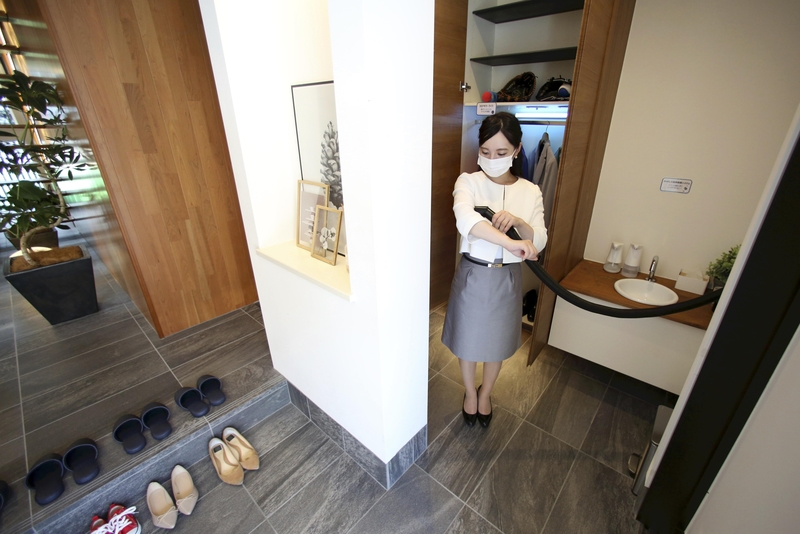
As soon as you walk into a model home constructed by Aqurahome Co., a company that builds custom houses, you will see a sink where you can immediately wash your hands after returning home. There is also a vacuum-like apparatus that will suck pollen and dust from your clothes and body near the sink. The house has been designed in such a way that a clear path is created between the entrance and the bathroom, to allow easy access for those who want to immediately shower after coming home.
A 29-year-old company employee visiting the model home at the housing exhibition grounds in Kuki, Saitama Prefecture, said a house designed to make it easier to prevent the virus from spreading is attractive and reassuring since she has two daughters. She said she is thinking of building a house on her parents' property in Konosu, which is also in Saitama Prefecture.
Aqurahome only started selling these types of homes in July, but a company official said there has been good feedback regarding the product.
"The house is designed in a way to make it difficult for the virus to contaminate the entire house and residents can comfortably work from home," the official said. "There is a lot of interest in these houses among visitors."
The spread of the coronavirus has created many changes in housing design trends, and besides virus prevention designs, teleworking-related changes are important factors as well.
Space was an important factor for 52% of respondents when looking for a home, according to a survey conducted by Recruit Sumai Company Ltd. in May. This was up 10 percentage points from a survey conducted in December last year, far exceeding the 30% who place importance on the proximity to train stations. When asked about what kind of qualities they need in a house, 25%, the largest group, said they required a dedicated workspace.
Polus Group, a Saitama Prefecture-based home building company, is benefiting from this design trend. Polus group began developing houses that had a space of about 100 square meters in Nerima Ward, Tokyo, and were sold under the name of "Tokyo 5LDK@Nerima Hikarigaoka" project. The homes are about a 24-minute walk from the nearest station, but they allow each family member to have their own space. Twenty of the 23 houses have already been sold.
"I only commute to work every once in a while, so I don't mind the distance to the station," said Koji Ishibashi, a 35-year-old company employee who moved into the house with his family of three in May. "I'm glad I went with this house because I can have a quiet place to think when I work from home."
His wife also works, and he used to work on his computer in bed or at the dining table when they lived in a 1LDK, a one-bedroom with a living, dining and kitchen.
"We were able to get a head start on new lifestyle [trends] for the post-coronavirus era," a Polus official said.
The concept of Japanese houses has drastically changed because of repeated disasters and other factors.
Takamitsu Wada, president of Aki-katsu Co. that provides information about vacant houses in urban areas to real estate agents, said, houses in the suburbs that are surrounding by greenery and far from train station used to be avoided, but they are becoming more popular in the wake of the pandemic.
"There are companies that don't mind having their offices outside of the city center," Wada said. "Property in the suburbs or countryside will likely become popular in the future."
Read more from The Japan News at https://japannews.yomiuri.co.jp/