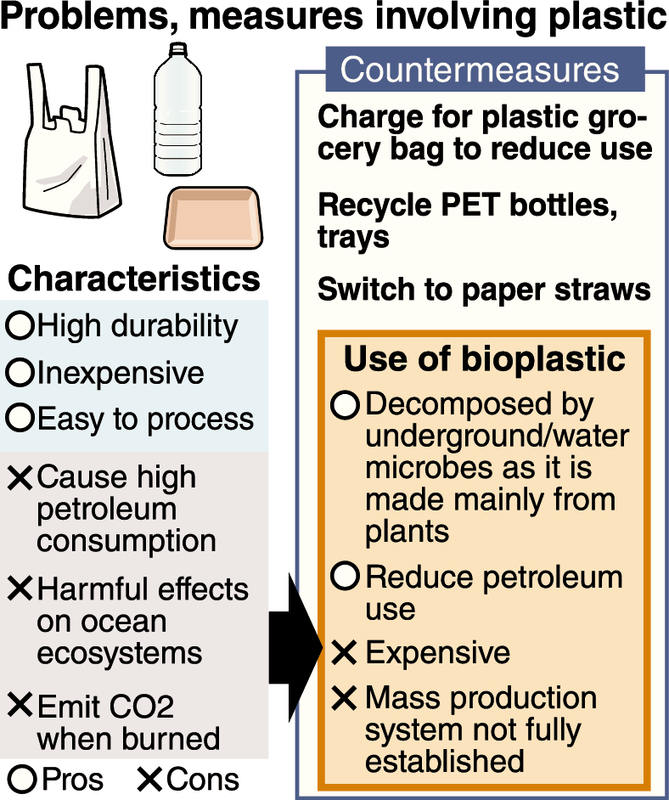
The Environment Ministry plans to encourage the spread of bioplastics (see below) from next fiscal year by subsidizing commodity manufacturers and groups that are making efforts to replace petroleum-based plastic products with plant-based ones.
Amid the global trend to stop using disposable goods made of petroleum-derived plastic -- which is considered a cause of environmental pollution -- the ministry is trying to disseminate domestic bioplastic products.
The movement to stop using disposable plastics has been spreading both inside and outside Japan. U.S. coffee giant Starbucks has decided that it will eliminate plastic straws from its stores worldwide by 2020. Family restaurant chain Gusto has announced it will do the same within the year.
Petroleum-based plastic products do not decompose naturally when they are disposed of in the ocean or rivers, and thus have a negative impact on the ecosystem. When incinerated, they also add to carbon dioxide emissions, which accelerate global warming.
Bioplastics are easily broken down by microorganisms underground, so their use would help reduce petroleum consumption as well as the volume of garbage to be incinerated.
Although it is technologically possible to replace petroleum-based plastics with bioplastics, they are costly and a mass production system has not yet been fully implemented, so it is difficult to make people familiar with them.
To solve these problems, the ministry plans to subsidize companies and universities that make efforts to develop technologies to replace plastic packaging with that made of bioplastics, and to expand and improve facilities in order to increase production of bioplastic items. The ministry will also study methods to collect and dispose of used bioplastic products. It has included 5 billion yen (45 million dollars) in its budgetary request for next fiscal year for these projects.
The government's global warming prevention plan estimates that the country can cut 2.09 million tons of CO2 emissions by increasing the amount of domestic bioplastic shipments to 1.97 million tons by fiscal 2030. According to the ministry, however, the volume of domestic bioplastic shipments in fiscal 2015 was 40,000 tons, hovering at around the same level as the base year of fiscal 2013. The government is being urged to drastically increase production volume in order to achieve its interim goal of producing 790,000 tons in fiscal 2020.
-- Bioplastics
A collective term for biomass plastic, which is made from corn, sugarcane and other organic substances, and biodegradable plastic, which can be decomposed by microorganisms. Some products are made from a mix of bioplastic and ordinary plastic for reasons of cost and durability.
Read more from The Japan News at https://japannews.yomiuri.co.jp/