The Environment Ministry plans to step up efforts to recycle disposable plastic products, as China's introduction of import restrictions on plastic waste at the end of last year has led to a rapid accumulation of such waste in Japan.
To address the situation, the ministry will provide subsidies to recycling companies to cover half the costs of building new recycling facilities.
Waste piled 5 meters high
"We can't take any more," the president of a waste disposal company in the Kanto region lamented. Plastic waste such as PET bottles, food containers and clothes hangers was piled up about 5 meters high at a site managed by his company, surpassing the height limit set by storage standards under the Waste Management Law.
The company used to buy PET bottles and other plastic waste from waste-collecting agents that was discarded by convenience stores and companies. It previously sold about 3,000 tons of plastic waste a month to a Chinese exporter, but China introduced limits on the import of plastic waste at the end of last year, and now the material has nowhere to go.
The Kanto company has stopped buying such waste and charges a fee for taking it in, in a bid to curb the accumulation.
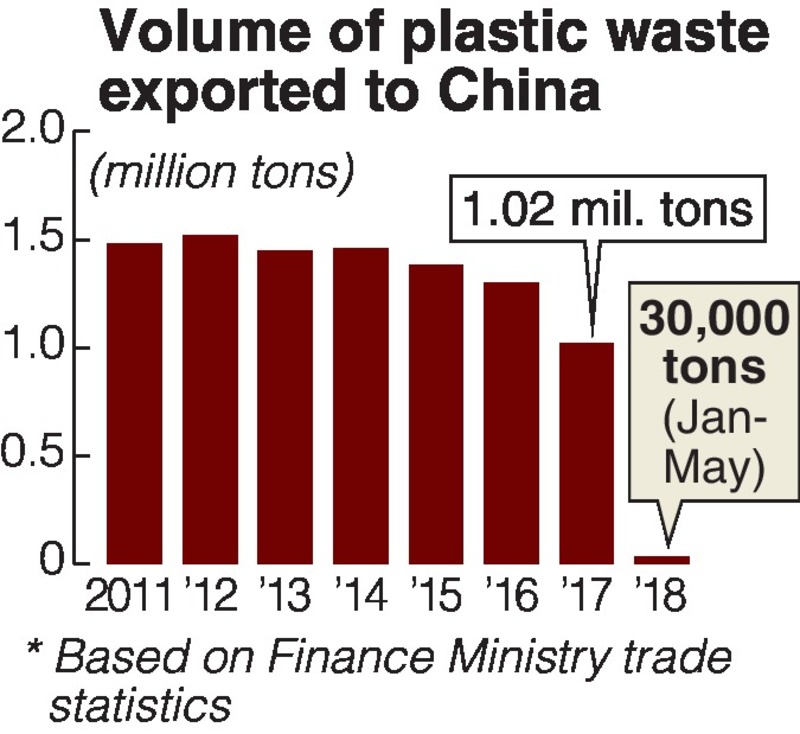
Exports of plastic waste to China have nosedived. According to Finance Ministry trade statistics, 30,000 tons of plastic waste were exported to China from January through May this year, only about 6 percent of the 510,000 tons exported a year earlier. According to industry sources, more and more waste disposal operators are overseeing storage facilities that are filled to capacity with plastic waste, and more than half of such operators in the Kanto region are refusing to accept new orders.
Collecting agents have successively raised their fees for taking plastic waste, leading to increased costs for companies that generate the waste.
Policy change
From the 1980s, China imported a huge amount of recyclable waste, such as plastics from all over the world, to address a shortage of resources. China recycled the waste into new plastic products or raw materials for chemical fibers, as using recycled material is much cheaper than producing new products from oil. For plastic waste exporters such as Japan and Western countries, China had been a convenient "dumping site."
However, some of the imported plastic waste contained toxic substances, worsening environmental pollution in China, partly due to its lack of wastewater treatment or insufficient measures against air pollution. To address the situation, China stopped the import of plastic waste from products used in everyday life, such as shopping bags and PET bottles.
In December, China is expected to halt the import of plastic waste generated through manufacturing at factories and other places.
Hard to increase facilities
For Japan, the only quick solutions are incineration or exporting the waste to other countries. The export of plastic waste to countries other than China, such as Thailand and Vietnam, has increased since the beginning of this year, but the export volume is lower than that of past shipments to China.
Furthermore, the Thai government has announced it will ban the import of plastic waste in the near future, citing a series of cases involving the illegal processing of recyclable waste imported from Japan. The Thai government's move was also triggered by an incident in which a large number of plastic bags were found in the stomach of a dead whale on a Thailand coast.
The incineration of plastic waste poses problems as well. If separately collected plastic waste is simply burned without being recycled or burned to produce heat at power plants and other places, the purpose of the separate collection of waste will be questioned.
Plastic generates high temperatures when burned, so it can damage incinerators. Moreover, carbon dioxide is released through the process of burning plastic waste, which also affects measures against global warming. As about 70 percent of plastic waste in Japan is burned, it is desirable to avoid burning greater amounts.
"In the long term, we need to reduce the amount of plastic waste generated while simultaneously increasing the number of recycling facilities," said Michikazu Kojima, senior economist at the Economic Research Institute for ASEAN and East Asia and an expert on recycling issues.
Read more from The Japan News at https://japannews.yomiuri.co.jp/