Cashless payments are rapidly becoming more commonplace, raising hopes for innovations linked to various new services. Japan, however, has lagged behind other nations in this field, and the government is taking steps to help it catch up.
A sign in front of a Gathering Table Pantry restaurant in Chuo Ward, Tokyo, notifies customers that the eatery accepts credit cards and electronic money, but not cash. Royal Holdings Co., a major food service company that runs the chain, opened the branch in November last year as a trial run for a cashless restaurant.
"My friends and I don't use cash very often," said one regular patron, a 27-year-old advertising designer, saying that he did not find it particularly inconvenient.
Royal Holdings decided to open the trial branch as an urgent labor-saving measure prompted by a shortage of workers. Counting up the cash after closing a regular store takes an average of 40 minutes, but at the trial branch it can be done in two or three minutes, a company official said.
Cashless payments have gradually increased along with the spread of smartphones. Purchases can be made easily by installing an app linked to a credit card or a form of electronic cash, such as East Japan Railway Co.'s Suica.
One factor delaying the spread of cashless payments is the cost of credit card terminals, which can run from tens of thousands of yen to several hundreds of thousands. However, there are services that do not require such terminals. The Mizuno restaurant in Na-kagawa, Tochigi Prefecture, uses Coiney, which allows cashless payments to be made on a tablet.
The 66-year-old owner said he started using the system to "meet the demand of customers from other prefectures who make larger purchases."
Lagging behind
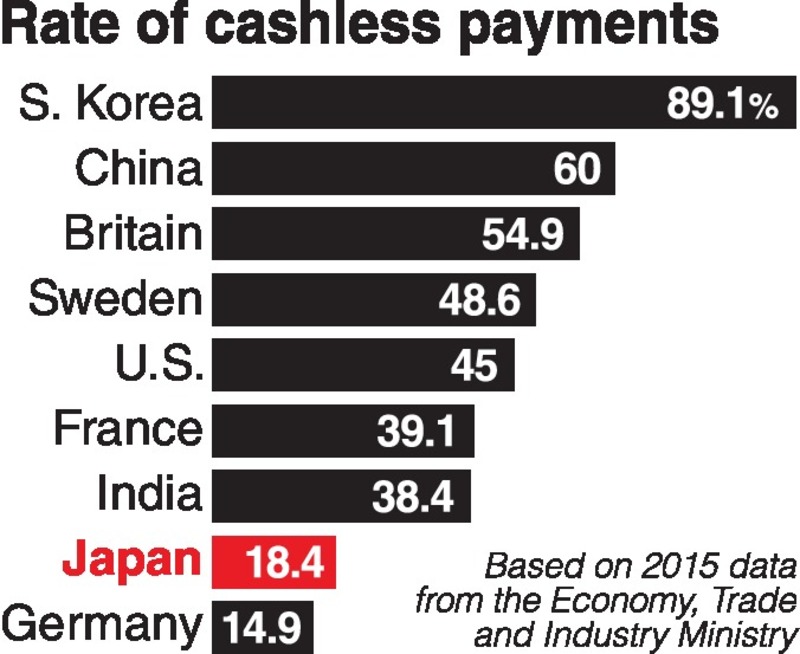
Japan has fallen behind the cashless wave that is sweeping the world. Compared to South Korea and China, where cashless payment rates were 90 percent for South Korea in 2015 and 60 percent in China, Japan's rate was less than 20 percent.
Japan's predilection for cash is said to be partly due to the fact that counterfeit bills are rare, which makes people feel comfortable using cash. ATMs that are open 24 hours are also readily available.
The government is seriously concerned about the situation, as cashless payments could hold the key to all kinds of innovations. In China, consumers use smartphone apps not only for purchases, but also such tasks as managing assets, making hotel and hospital reservations, and paying for public services.
Records of these transactions can be accumulated as big data, possibly leading to new services.
As the 2020 Tokyo Olympics and Paralympics will bring many foreign visitors with a strong need to use cashless services, it is necessary to increase convenience for tourists. Cashless payments are also expected to help businesses resolve labor shortages and raise productivity.
In April, the government moved up its target for raising the cashless payment rate to 40 percent by two years to 2025.
The Economy, Trade and Industry Ministry is planning to create a panel on the matter as early as June, made up of representatives from industry, academia and the government.
The panel is expected to study measures such as providing businesses with preferential tax treatment or subsidies.
The most common reason for opposing it was a fear of possible overspending.
"One way to encourage consumers is to make them feel they are gaining something, such as by providing points," said Yuki Fukumoto, associate chief researcher at NLI Research Institute.
Read more from The Japan News at https://japannews.yomiuri.co.jp/