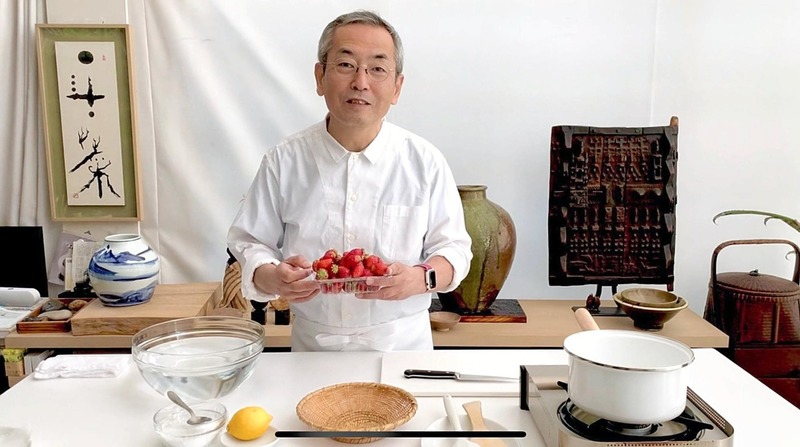
The coronavirus pandemic has changed the way people eat, with people dining at home becoming the norm. However, it has become a problem for those who cook at home as they suddenly have to cook more often than usual. The stereotype that binds many people is the idea of "This is what home cooking should be." Culinary researcher Yoshiharu Doi, who has looked at food culture and suggests foods suitable to Japan, advocates "food initialization," aiming to make life easier for the Japanese people. The idea is for people to have a simpler meal -- called "ichiju-issai," or a bowl of rice, soup, and a side dish. Yomiuri Shimbun Senior Writer Izumi Miyachi interviewed Doi about changes and the diversity of Japanese society through the world of home cooking.
Yoshiharu Doi: The spread of the coronavirus has had a major impact on diet. The amount of time people spend at home has risen dramatically, especially for women, who generally prepare meals for their families. There are many posts on social media of people saying "This is all too hard" and "I don't want to cook."
Women here are suffering. Even so, they still think they have to cook.
Now that Japanese society is no longer troubled by food shortages, luxury has become a matter of course, and that is the case even at home. Even seasonings and perfecting dishes to a restaurant level have become the standard of home cooking.
In 2016, I wrote a book that suggested a soup and side dish along with rice would be enough.
It all started with a study session on the theme of food education for adults. Many people gathered, and many of them were mothers with kids who did not know what to make for dinner.
I thought, off-handedly at that time, "It's great they worry for the sake of their family," but I didn't realize they were really suffering. They had lost confidence in the kitchen.
In Japan, there are customs that folklorist Kunio Yanagita came up with, such as the concepts of "hare" and "ke." Hare is a special situation such as a festival to pray and thank the gods, while ke is daily life. Many people think food meant for hare is actually everyday home cooking. Home cooking is actually an ordinary situation, or ke. Everyday home cooking doesn't have to be decadent.
Cooking and eating is the basic act of living. It's hard to be forced or obliged to cook. It could make life, itself, hard.
So I proposed a sustainable style of cooking. Cook rice and make miso soup with plenty of ingredients. Any ingredients will do. And tsukemono pickled vegetable. It doesn't matter whether you're a good cook or not, or whether you're a man or woman. You can do it alone. It's easy, but not lazy.
If there is a basic form of ichiju-issai, each person or family can create their own new style around it. If it's not compulsory, you can have more time, enjoy life and be more creative.
The taste of miso and rice was not created by humans. Miso is modified by microorganisms, meaning some days it is very tasty, and other days it is mediocre. I think you can enjoy what season it is depending on the ingredients and enjoy the sense of power found in nature. Doing this means not buying too many processed foods with a long shelf life that you end up throwing out anyway, meaning less food waste.
If you look at magazines and the internet, there are many beautiful food pictures, but real life is different. I post pictures of miso soup on my Twitter account. They could be something I should probably not post about, but I have no problem with it.
My Twitter photo caused a stir in 2018.
I posted pictures of the bean paste cake "akafuku" -- a specialty of Ise, Mie Prefecture -- and miso soup with the comment: "Akafuku for breakfast that someone gave me. It's good enough." There were replies such as "You're being malnourished," "That's unhealthy" and "That's not right for a Japanese breakfast."
I wrote: "What on earth are you talking about? You stubborn people (laugh). Sometimes I want to write stuff like that anyway. Please accept diversity in my house."
Nutritional balance cannot be determined with one meal. I counter-argued, with a bit of amusement, that you can't judge a diet by one meal, but each of the posters insisted on "justice."
Although it is said to be an era of diversity, diversity does not actually prevail in Japan.
There is a terminology in archaeology: personal tableware. Like in Japan, rice bowls and chopsticks are set for each individual. Even family members don't use other people's belongings. This is the personality that exists in your house.
In Japan, however, this cannot be realized within organizations or groups. Japanese people are only recognized as individuals at home. For the Japanese, the only place they can assert themselves and rely on others is at home.
I think a society with diversity is where people have diverse values in their minds that people are ready to accept, rather than a situation in which various things randomly exist. To realize such a society, you need to have the ability to empathize and to imagine and understand people's feelings.
The purpose of cooking and eating is not only for nutrition: The five senses are mobilized; it deepens your relationships with family and friends; it accumulates endless experiences including failures; and it sharpens your sensitivity. These are the basis of imagination.
To eat is to live, and to cook and eat is to live as a human being.
I think that diversity and independence will change Japanese society a little from here on out.
Read more from The Japan News at https://japannews.yomiuri.co.jp/