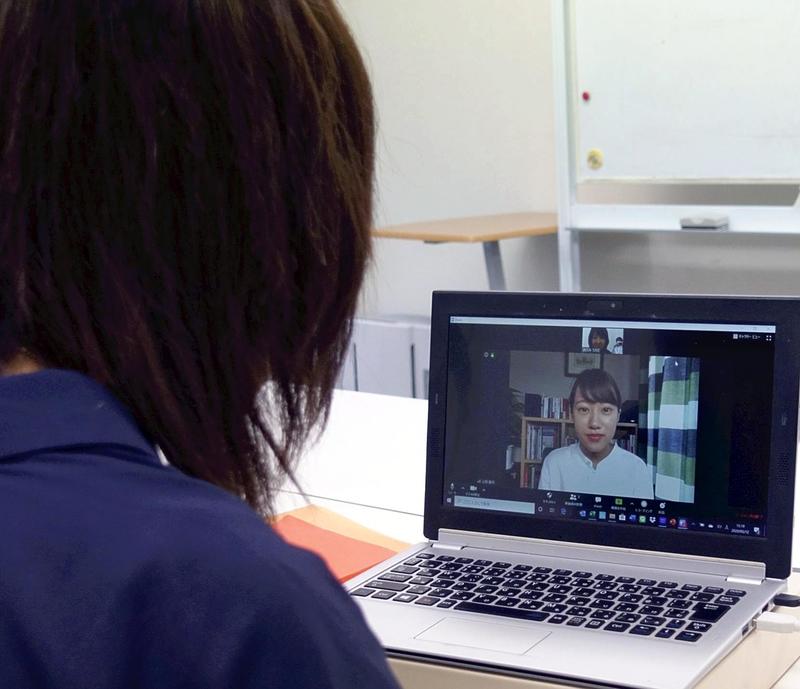
Puzzlement prevails among company officials in charge of the recruitment of job-hunting students for online job interviews that have been adopted in the aftermath of the outbreak of novel coronavirus infections.
While online interviews are designed to avoid crowded areas, they also make comprehending the personality and intentions of the conversation partner more difficult than it would be in the case of a face-to-face interview.
There are strong concerns that if such a screening method is promoted without a deepening of understanding between the interviewer and interviewee, it will lead to an increase in the number of students that declining job offers or retiring from the recruiting process in the early stages.
An information technology company in Tokyo has begun holding online interviews for the first time this year due to the difficulty of having job-seeking students come into its office due to the coronavirus outbreak.
The firm switched to the online method for all three stages of its interview process. This method, however, was found to make reading the facial expressions and demeanor of interviewees and speculation on their personalities through such details as appearance and hand gestures difficult. "The amount of information that can be obtained [via online interviews] is limited, but we must become accustomed to it," said the company personnel affairs official.
A Tokyo construction materials company has also adopted online interviews for its first-round applicant screening. It was discovered that while there were students who were able to articulate themselves well online, they could not do so as smoothly when they spoke with interviewers face to face. There were also cases of interviewees lacking in hygiene and being rude in greetings. The company's personnel affairs official confessed that "the conventional method of getting a glimpse into the real personality of interviewees via the ambiance felt during interviews doesn't work."
Employment information company Disco Inc. conducted an online survey of about 860 companies around the country in late March that showed that 24% of the firms surveyed began holding online interviews for the first time. The combined percentage of these companies and those that had already introduced this method made up more than one-third of the total. Since then, more and more companies are believed to have conducted job interviews online.
In response to an inquiry about the problem of "difficulty with grasping actual impressions," Ryuichiro Maezawa, manager of the marketing department for Tokyo-based Stadium Co., which provides online system to conduct job interviews, said, "It is effective to train interviewers using prerecorded data."
Students also have difficulty adapting to online job interviews.
A senior at a private university in Chiba Prefecture has undertaken online interviews from several companies. He said: "The interviews' beginning and end were so sudden. I didn't have a chance to adapt to it. It was stifling because I felt like every nook and cranny was being observed via the screen display."
A senior coed of a Tokyo private university said that she could not understand her interviewer's reactions that well, adding, "I felt uneasy about whether what I said got across to the interviewer or not." She said there was also difficulty communicating due to interruption midway.
Job information company Recruit Career Co. conducted in late March a survey of 327 students expected to graduate next spring, asking them "what makes them feel uneasy" about online job interviews (multiple choices acceptable). Of all responses, "whether what I say comes across to (interviewers)" topped the list, followed by "the communication environment" and "in which direction should I look."
Masanao Tanide, a recruitment consultant, said that "if job offers are made online only and no efforts are being made to make corporate culture known to the applicants, there is a fear that both companies and students will eventually wind up disappointed." After warning of such a consequence, he added: "To quell their nerves, students should sufficiently prepare how they would speak just as they would in the case of face-to-face interviews. Interviewers, on the other hand, are urged to speak slowly, using short phrases, to help ease the tension of the interviewees.
Read more from The Japan News at https://japannews.yomiuri.co.jp/