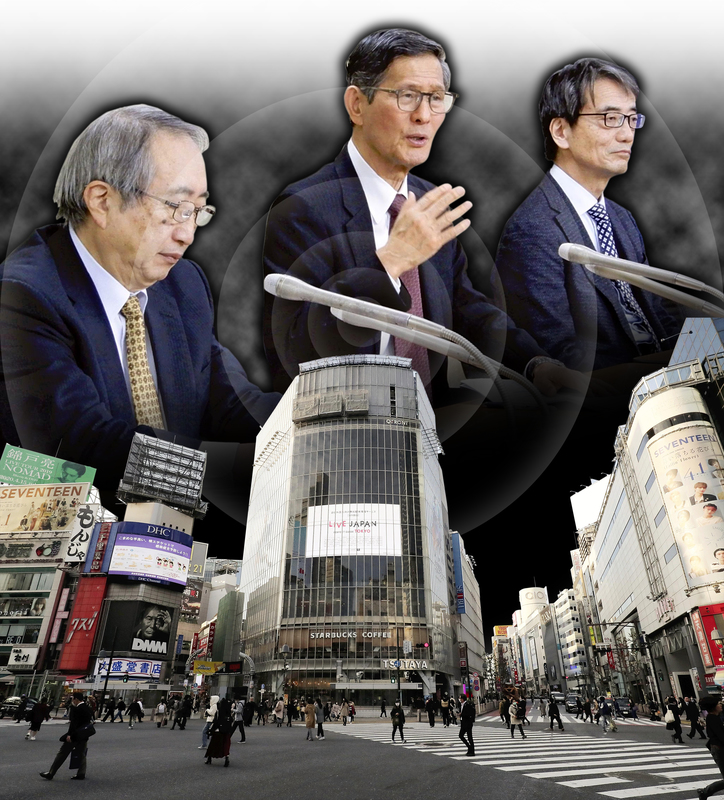
Shigeru Omi, who served as vice-chair of the government's expert panel on the new coronavirus, turned his gaze aside and folded his arms.
He averted his eyes at the precise moment during the panel's Tokyo press conference on June 24 when Takaji Wakita, chair of the panel, seated next to him, said "We've stumbled too far forward."
The expert panel, using its own initiative, had held press conferences separately from the government and issued public warnings. Wakita's remark was one that summed up the panel's position.
The origin of its stance dates back four months prior to Feb. 24, when members of the panel were becoming impatient. Cases at the time surfaced sporadically and links between clusters, which occurred one after another, could not be traced. It was presumed that community-acquired infections were spreading, but the government was preoccupied with the high number of infections on the Diamond Princess cruise ship docked in Yokohama Port.
"If it continues like this, something terrible will happen."
Shortly after 9 p.m. that day, Omi appealed in front of hastily convened reporters, saying, "The next one or two weeks will be a crucial juncture at whether infections will spread rapidly, or be brought under control."
It was the first time the expert panel sent society a message by itself.
-- 'Refrain from drinking parties'
"Please refrain from going to drinking parties as much as possible." This message issued by the expert panel, during an emergency press conference on Feb. 24, was a strong warning, which even called on people to practice self-restraint in daily life. But back then when people had a weak sense of vigilance, it sounded unusual.
Omi had the experience of bringing SARS (severe acute respiratory syndrome) under control at the World Health Organization (WHO). People with the SARS virus are seldom contagious within a few days of the appearance of symptoms, but those with the new coronavirus are contagious before symptoms appear. He believed that the new coronavirus could spread secretly.
Officials at the Prime Minister's Office gave cold looks to the panel, whose movements were even viewed as "runaway acts" by an advisory panel with no responsibility nor authority.
At a government study meeting, held in the afternoon on the following day, Feb. 25, at the Prime Minister's Office, with Prime Minister Shinzo Abe in attendance, an irritated voice was raised. "If 'Self-restraints are called for,' even after the crucial juncture has passed, it will be the government that is battered, by people screaming, 'That's a change in policy.'"
Thereafter, the government and the panel's opinions gradually fell out of sync.
The government, with economic impact in mind, wanted to relax restrictions, while the expert panel wanted to contain the spread of infections. Their opinions have sometimes clashed.
In mid-March, in connection with the expert panel's proposal, which was to be announced shortly, there was a behind-the-scenes exchange of words between the government and the panel. It was about whether to request that large-scale events be canceled.
The expert panel, which wanted to have the proposal stipulate that such events "should be canceled for the time being," shelved their idea, and instead included: "Any large-scale events would raise the risk of an explosive spread of infections." Even so, the panel could not reach accord with the government, and, in the end, accepted, "Organizers [of large-scale events] will be required to make a careful decision by assessing risks."
-- Difference on economic activities
In issuing "the declaration of a state of emergency" in April, Abe's messages to the people ended up amplifying criticism at the expert panel later.
"Please reduce person-to-person contact by at least 70%, where possible 80%."
This request was based on a tentative calculation made by Hiroshi Nishiura, a professor at Hokkaido University and the brains behind the panel. This request was even considered as the main factor that damaged the economy, with the brunt of the criticism directed at the panel. "I have received defamatory messages via social media," said one of the panel members.
"What experts explained made the public believe that relevant policies are based on objective grounds," a government source said. But the same source added that the panel "asks too much in regards to reducing the risk of the infectious disease, while not taking the economy into account." Such a viewpoint has spread to the extent of affecting the continuation of the panel.
"Even if there was another request made to reduce person-to-person contact by 70 to 80%, it is impossible for us to cooperate," said an organization that operates small- and mid-sized businesses.
The government has established a subcommittee for the novel coronavirus, comprised of members from the expert panel, together with economists and others. At their first meeting held on July 6, Omi, who became chair of the subcommittee, gave a speech different from his past, saying, "It is a national challenge to create compatible economic activities and measures to fight the infectious disease."
Read more from The Japan News at https://japannews.yomiuri.co.jp/