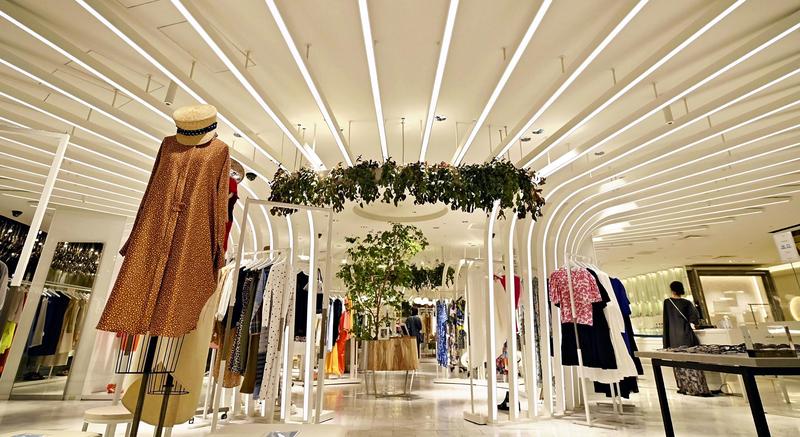
Amid a shrinking market hit hard by the novel coronavirus, some department store operators are shifting their focus to a business model that brings in income through renting out space on sales floors.
"How will we conduct business in the event of an earthquake or tsunami? If a major disaster strikes, we might not be able to open locations for as long as six months," said a senior official of a department store, stressing the pressing need to discuss a new business structure within the firm.
By renting out floor space, department stores can draw a specific amount of revenue, regardless of how well or poorly products sell, thus stabilizing their income.
J. Front Retailing Co. embarked on the business of renting floor space, pursuing an "end to the department store" policy that had been in the works even before the coronavirus pandemic.
The firm, which aims to conduct a business focused mostly on generating rental income, moved into the operation of Ginza Six in Tokyo's Ginza district and Parco stores.
Only sixty percent of the company's entire profits is generated from the department store division.
The Daimaru Shinsaibashi main store in Osaka, a J. Front subsidiary, started leasing two-thirds of its floor space to tenants when it was rebuilt in September last year. It has been successful in attracting young customers and foreign tourists as the number of visitors through January increased 11.1% over the same period in 2019.
KPMG Consulting Co. Director Shunichi Sakuma expects more department stores to take this opportunity to shift to relying on the rental business model, while reducing the number of employees in the sales force.
Takashimaya Department Store also has been earning the majority of its profits from commercial development business, drawing rent from shopping center tenants.
The commercial development business accounts for 5% of total sales, but is highly profitable, accounting for nearly 40% of operating income.
Sakuma, however, took a negative stance on department store strategies that shift the focus to income from renting floor space.
"It's a risky strategy in the medium to long term because they do not deal with consumers," he said. Sakuma is concerned that if their business partners become a tenant, they would lose the chance to improve their customer service skills.
At J. Front Retailing's Daimaru Shinsaibashi store, tenants are likely to ask for a reduction in rent once the coronavirus pandemic is under control. "Renting out space is not a department store business," a major department store official said.
Mitsukoshi Isetan Holdlings Co. has deployed "ReStyle" sales floor at the Isetan Shinjuku Main Store in Shinjuku Ward, Tokyo. It features products purchased by international buyers, each with unique tastes.
At ReStyle floor, Isetan does not employ the business practice known as "backdating payment" system in which goods on the sales floor at department stores are treated as the part of company's stock. When the items are actually sold, they are considered stock from the store.
This uniquely Japanese business practice is common because it allows department stores to avoid the risk of being left with unsold items.
As department stores can create floor spaces with their own tastes, operators can place an importance on that aspect, with each focusing on the areas as a "showroom" for a department store to show off its individuality.
Though there is a risk of being stuck with inventory without employing the backdating payment business practice, the department stores' profit margin is said to generally be 5%-10% higher.
Isetan in 1994 was the first to create a section of this kind, naming it "Kaiho-ku." It features the products of young designers and came before Mitsukoshi Ltd. and Isetan Co. merged to become Isetan Mitsukoshi Ltd.
In the late 1990s, the department store chose to go with novel brands such as Anna Sui, which attracted lots of attention.
"There are numerous brands that we carry, and our store is the only place in Japan with them in stock. Our strength is that we can create opportunities for chance encounters," said a 34-year-old Isetan buyer.
However, by filling up its stock by purchasing products – and with no returns to manufacturers – department stores have become unable to provide a wide selection of products amid the backdrop of bitter experiences from the past.
In the late 1990s, Fukuoka's long-established department store Iwataya failed in purchasing products without using Japan's common business practice and sank into financial trouble. In 2005, Iwataya came under the umbrella of Isetan before merging with Mitsukoshi.
"I was so surprised by the huge inventory. The fact that Iwataya failed is all that we now see etched in history," a senior department store official familiar with the matter said.
"Even if they are able to move 40% of the stock, they carry the remaining 60% of products as inventory. Under the backdating of payment system, apparel makers are supposed to take back that excess inventory and sell those items to another department store. As Iwataya was unable to do so, it went under," the official said.
Since then, department stores have stopped making serious efforts to purchase products without returning them to apparel makers.
According to a consultant who is well-versed in apparel makers, 85% of products are purchased via the backdating payment system, and generally only a few percent are purchased and not returned.
Isetan's ReSyle is regarded as a successful example, but its sales account for a minimal percentage of the total.
It is difficult to draw up a strategy to increase profits because of the risk of bringing in a large stock without returning goods to manufacturers.
The outbreak of the coronavirus called into question the nature of the business model of a department store, but the direction is unfocused and off course.
"The environment has changed too greatly. We should not present a simple medium- to long-term picture now," J. Front Retailing President Tatsuya Yoshimoto said.
Read more from The Japan News at https://japannews.yomiuri.co.jp/