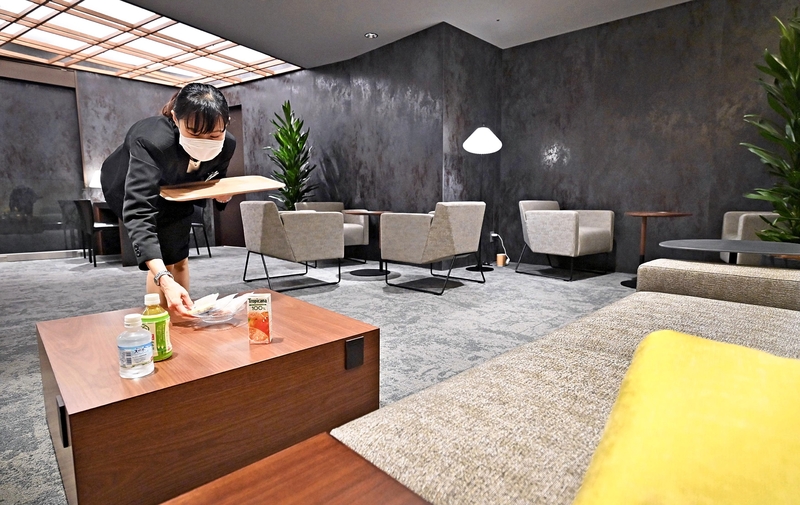
Back in late March, the Matsuya Ginza department store in Chuo Ward, Tokyo, created a spacious VIP room for foreign tourists who make large purchases of more than 1 million yen in a day.
In addition to being able to take a break during their shopping, these big spenders would receive priority handling of duty-free procedures. Its appeal was geared mostly toward Chinese tourists, who the store hoped would appreciate the increased customer services.
Foreign tourists spent a total of about 30 billion yen at department stores across the nation in December. One-fourth of Matsuya Ginza's sales come from international tourists.
Then the unexpected happened. In April, inbound tourism came to a virtual halt and the number of foreign visitors plunged to 2,900, down 99.9% year on year. Those tens of billions in sales dropped to 500 million yen.
The VIP room has been used daily for duty-free procedures by only about 10 international customers, who are in Japan for work, among other reasons.
"At any rate, the situation will continue until the end of this year," a senior official of the department store lamented.
Because Japanese department stores in general count on face-to-face sales at brick-and-mortar stores, this part of their business depends on a steady flow of foreign arrivals. They have little choice but to wait for international tourism to revive.
Cosmetics makers tend to put their sales counters on the first floor of department stores and have been a huge draw for tourist shoppers. But when the novel coronavirus infections started to spread rapidly, some did not simply sit and wait for customers.
In March, one major cosmetics company gathered 700 "social buyers" and advertised a new product to Chinese consumers via social networking sites.
These social buyers are Chinese people who are knowledgeable about Japan and have been living in the country for many years. Products that they advertised have become hot-selling products, and they have great influence on consumption among foreigners visiting Japan. These buyers have accumulated a total of 700,000 customers, with each having about 1,000 customers. The new product was sold out in three weeks, more than two months earlier than expected.
Although Japanese cosmetics are available at retail stores in China, there is a problem with counterfeit products. Therefore, the demand for "bought in Japan" is large. Products people buy via social networks are delivered to China in about a week.
"Since it will take time for the department store sales channel to recover, we need to retain buyers," a relevant official said.
Shiseido Co.'s domestic sales have increased by more than 40 billion yen to about 450 billion yen from three years ago. The sales growth is partly due to the increasing domestic demand, while international tourists greatly contributed to the overall growth. The company's management would suffer a severe blow if it just waited for the novel coronavirus crisis to be over.
One 28-year-old female Chinese social buyer living in Tokyo was approached recently by a major Japanese cosmetics company and told, "We will sell you our products at lower rates."
So far, she has purchased cosmetic products at department stores and sold them to nearly 5,000 customers. She spends more than 3 million yen every month, or sometimes 7.5 million yen, at department stores. However, she said she has never been offered any special treatment by department stores.
She liked the cosmetics company' offer, saying, "I would like to increase business with the company in the future."
More moves for direct sales like this would not bode well for department stores.
Why have the responses to this virus-caused hit to retailing been so different between department stores and cosmetics companies?
"Customers came to the store of their own volition, without us having to do anything. Because there was no system in place to attract customers, we don't know what to do," a senior department store official said wryly.
The number of international tourists had been on the rise because the second Cabinet of Prime Minister Shinzo Abe that was launched in 2012 set a goal of increasing the number of international tourists to 40 million by 2020 and implemented such measures as relaxing visa requirements.
Department stores just followed that trend. And they have been facing a slew of difficulties such as sluggish apparel sales for many years, failed overseas expansions and consumer apathy since last October's consumption tax hike. Amid such circumstances, spending by international tourists became critical to their business models.
"International tourists were like a bonus for department stores. Now, stores should look to boost domestic demand," an expert familiar with the retail industry said.
Alas, department stores seem to be sticking to their position and are waiting for the return of international tourists.
"The central government will not give up such a big market so easily," a senior official at a Tokyo-based department store said. Department stores are expecting that the government will take the lead in having international tourists come back, and such a stance indicates of laziness of depending on others.
Read more from The Japan News at https://japannews.yomiuri.co.jp/