This series presents basic information and tips for preparing washoku dishes.
"Tempura removes just the right amount of a food's water content and concentrates its flavor," said Naoyuki Yanagihara of the Yanagihara Cooking School of Traditional Japanese Cuisine in Tokyo.
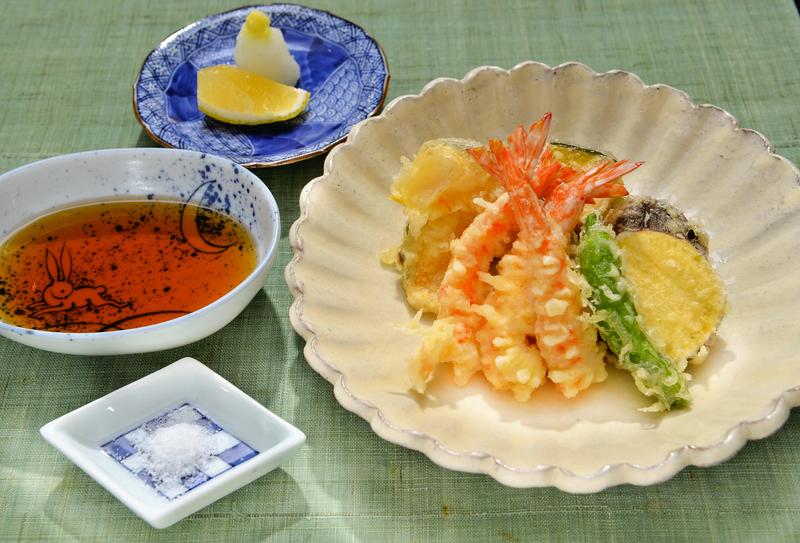
Yanagihara made tempura using shrimp, kabocha pumpkin, sweet potatoes, shiitake mushrooms and shishito peppers.
Prepare shrimp correctly
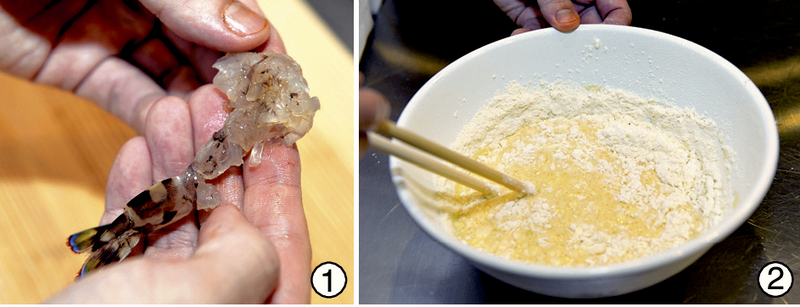
Frying shrimp tends to make it curl up into a ball and harden. To avoid this, after removing the head and shell, cut the abdomen in three places with a knife and bend it backward so it fans out (photo 1).
"Bending it back firmly makes the body straight and gives it a nice chewy texture," Yanagihara said.
Air in the tail will cause oil to splatter when frying, so cut off the very end of the tail.
Cut the kabocha into 1-centimeter-thick slices and the sweet potato into rings of the same thickness. Remove the stems of the shishito and the hard tips of the shiitake.
Don't overmix batter
Make the batter with one egg yolk, 1-1/2 cups of cold water and two cups of sifted cake flour. Mix the yolk and water, add the flour, then mix roughly with chopsticks.
Some lumps are OK (photo 2): "If you overmix it, the batter will become gluey and be too heavy. The batter will gradually combine as you go, so fry the seafood lightly first and then move onto the vegetables," Yanagihara said.
Right oil mix
Fry with a mixture of 80 percent salad oil and 20 percent sesame oil for the best aroma.
Fry seafood at 180 C and vegetables at 170 C. When batter that is dropped into the oil floats, the temperature is about right.
At 170 C, the batter will sink before rising to the surface. The shape will be round at low temperatures but long and skinny when the temperature approaches 170 C. At 180 C, it will quickly rise to the surface and start to bubble.
Get the perfect texture
When the oil is heated to 180 C, dunk the shrimp in the batter and place it in the oil head first, holding the tail. When the bits of batter floating on the surface stop bubbling, remove the shrimp with a net. All it takes is 1-1/2 minutes to 2 minutes for the perfect texture.
Lower the heat to 170 C to fry the vegetables. Mix the batter with chopsticks a bit more to make it smooth, then dip the vegetables in and put them in the oil. Kabocha and other vegetables are done when they can be pierced smoothly with a skewer.
Frying kabocha and sweet potato takes 3-1/2 minutes, while shishito and shiitake take 1-1/2 minutes.
If you are going to fry kakiage, a mixture of finely cut vegetables and seafood, do it after frying the shrimp and vegetables. Yanagihara shared a simple recipe that uses thinly sliced onion and sakuraebi small pink shrimp.
In a bowl, mix together onion, sakuraebi and batter, scoop up the mixture in a slotted spoon and place it into oil heated to 170 C.
Press it gently against the side of the pot to shape the kakiage. It will be a bit thick, so flip it over partway through.
"Tap a floating piece of kakiage with your chopsticks. When it makes a knocking sound and the edges of the onion are a bit brown, it's done," Yanagihara said.
To find out more about Japan's attractions, visit http://the-japan-news.com/news/d&d
Read more from The Japan News at https://japannews.yomiuri.co.jp/