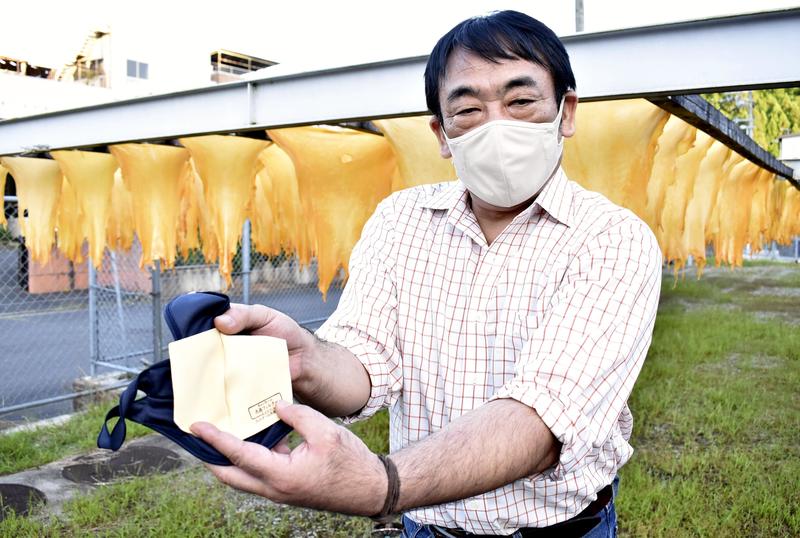
UDA, Nara --The city of Uda in Nara Prefecture is attracting attention with the sales of masks made from deerskin that boast an ultralow pass-through rate of virus particles.
Members of both the public and private sectors in the city aim to exploit the masks to serve two purposes -- preventing the spread of novel coronavirus infections and as a tool to revitalize the local economy.
Industries that specialize in fur and leather products have been prosperous in the city and deerskin products have been especially popular. The products include items such as tools used in kendo, eyeglass lens cleaners and cleaning tools for luxury vehicles. The city boasts more than 90% of the nation's production of deerskin products.
However, because of the proliferation of lower-priced artificial leathers and the aging of craftsmen, the number of those who make and sell deerskin products, which stood at about 100 in the latter half of the 1980s, has fallen to about 20.
Kasuga Corp. is one of the remaining deerskin companies, which has processed the skins of kyon, a species of deer, imported from China, and sold the products
Leathers made of kyon deerskin are well-known as high-quality goods with finely textured fiber cells that form multiple layers.
The company focused on this particular characteristic of the material and commissioned an expert organization to conduct research on it back in 2009 during an outbreak of the avian flu. The results showed that kyon deerskin had the ability to block 97.8% of airborne viruses.
Kasuga Corp. developed masks with filters made of deerskin for researchers and medical workers on frontline responders to infectious diseases.
When the mask shortage triggered by the novel coronavirus outbreak in March this year became severe, the company donated deerskin masks to the Saiseikai Arida Hospital in Yuasa, Wakayama Prefecture, where an infection cluster had been confirmed.
Requests for the masks from other hospitals and city residents skyrocketed. Once the company began selling them, its inventory of 30,000 sold out in a month.
The company then developed a new mask model for the masses, making improvements such as removing the wires that firmly fixed them to the wearer's face, so that the masks can be worn or removed more easily.
Online sales began in September via its official website, with each mask being priced at 3,600, yen plus tax.
The city government has decided to begin providing deerskin masks as thank-you gifts as part of its furusato nozei system, a tax-deductible donation program in mid-November.
"We want to put the donations we receive toward measures to cope with the novel coronavirus and the promotion of the local economy," an official of the city government said.
"We could produce masks that can make users deeply feel the high quality of deerskin products of Uda. I hope the masks will be a driving force for revitalizing Uda's leather industry," Toyohito Tsujimoto, Kasuga's managing director said.
Read more from The Japan News at https://japannews.yomiuri.co.jp/