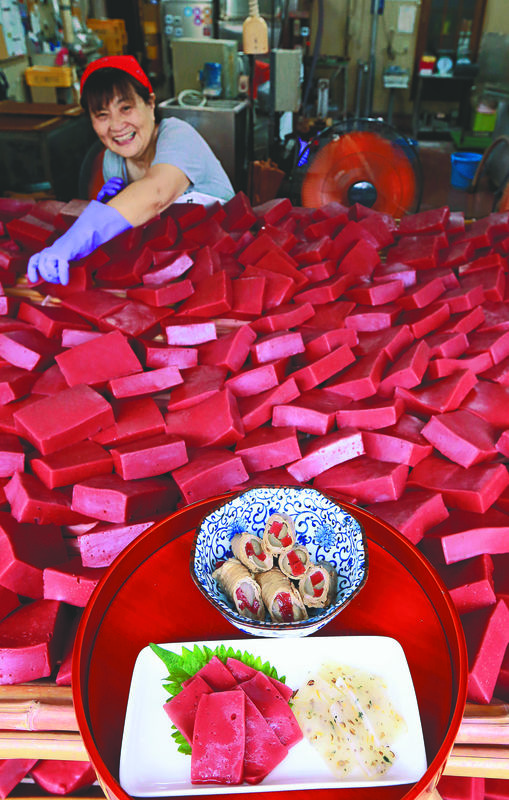
OMI-HACHIMAN, Shiga -- What color is konjak? For many in Japan, it's grayish, but for residents of this city in Shiga Prefecture it is always red.
"I learned for the first time that there are dark and light colors of konjak when I moved to Osaka at the age of 23," said Kayoko Namura, 75, who runs Kihei restaurant in the city.
Visitors to Omi-Hachiman apparently find the local konjak surprising for its vivid red hue, as witnessed by Hirotsugu Kawaharada, 49, manager of the Mt. Hachiman cable car operator that also sells skewered red konjak.
"Tourists mistake it for raw liver of some other kind of meat, or believe it must be spicy, thinking it's colored with red pepper," he said.
Konjak turns dark when it contains taro skin or seaweed, or white when it is made purely from the aroid's starch. However, in Omi-Hachiman, which faces Lake Biwa, konjak gets a different hue because it is made with an iron oxide food coloring.
One theory says that famous warlord Oda Nobunaga (1534-82), who built Azuchi Castle in what is now Omi-Hachiman, had manufacturers dye the konjak red because he liked extravagant things. However, this is merely folklore.
According to Shigeji Karasuno, who works at the municipal government office that compiles a series on local history, documents from the Edo period (1603-1867) show that konjak made in this region was popular in Kyoto and Osaka as a specialty of Omi, the traditional name for present-day Shiga Prefecture. It is unknown which color the product was at that time.
When the town of Hachiman, one of the municipalities that merged to form Omi-Hachiman, published a series on its history before World War II, documents were found that said konjak was dyed with an infusion made of corn husks during the Edo period, and it is believed that the current food coloring began being used from the Meiji era (1868-1912).
"We can assume that konjak here has been red since the days before the Meiji era," Karasuno, 50, said. "However, we don't know why it was dyed red."
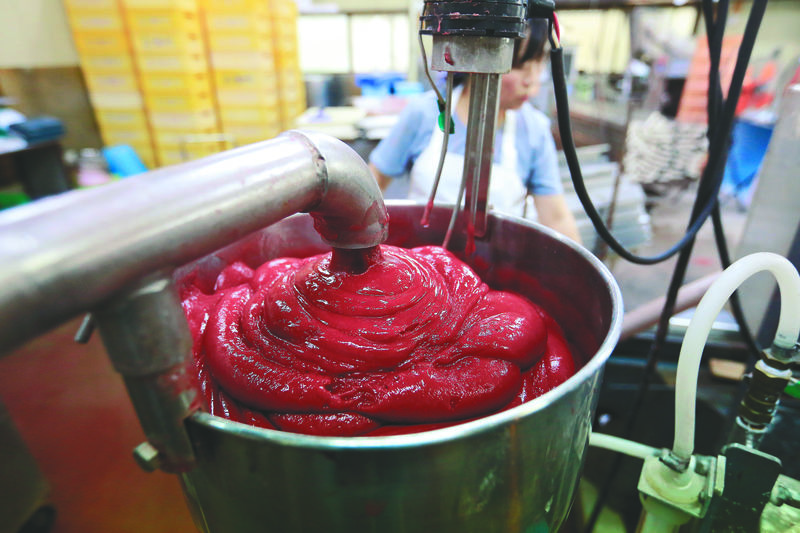
I visited Osahei Shoten, one of the two konjak manufacturers in the city. There I saw a mixture of ingredients was being poured into a gutter-shaped mold.
"We use as little lime as possible to solidify the konjak and get rid of its distinctive smell," said third-generation owner Teiichiro Umemura, 67. "We then dry it so it keeps longer."
The solid konjak was then cut into smaller pieces to be dried on a bamboo sheet, but the scene just looked like a pile of red bricks.
"Red konjak plays an indispensable part in ceremonial occasions in this region," said Teiichiro's wife, Hifumi, 65. "It requires time and steps to make, but we must preserve this tradition."
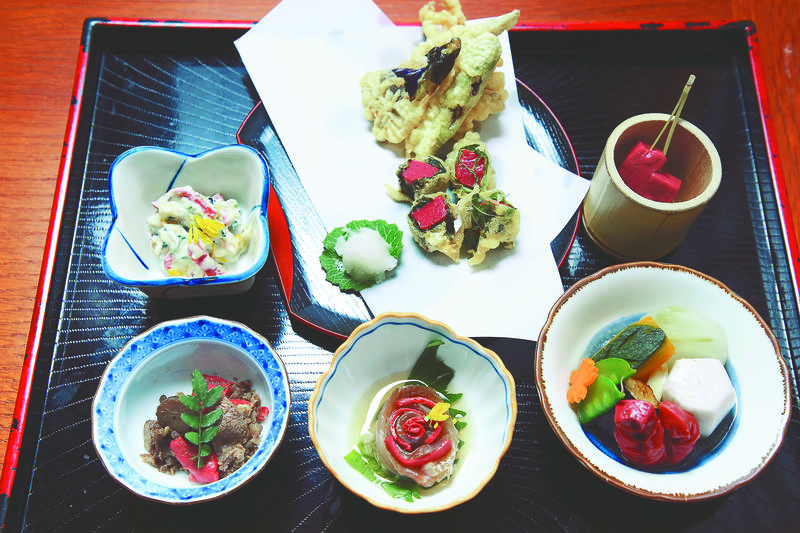
She prepared some dishes using the konjak. Slices of the specialty were served as sashimi with vinegared miso. I found the texture particularly smooth. The other dish featured the konjak wrapped in slices of pork. The konjak helped the umami of the meat stand out, while also making the dish look gorgeous.
Given how delicious it is, vivid red must have been a reasonable choice local people had made to show off their konjak.
Read more from The Japan News at https://japannews.yomiuri.co.jp/