Parks infused with local characteristics, such as restaurants that serve local specialties, are being developed across the country.
The main reason for this trend is a revised law that saw regulations eased for opening restaurants and other facilities in parks, giving more freedom for development. The change is also aimed at making parks places where not only residents can relax but tourists can also come to enjoy themselves. Ultimately, towns aim to increase their charms.
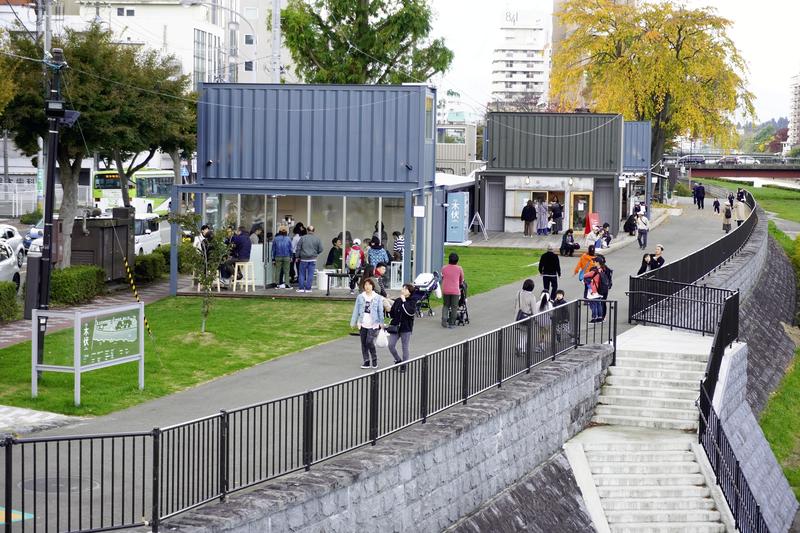
Located along a river, Kippushi Green Park is about a five-minute walk from JR Morioka Station. At the park in Morioka, brand-new blue and gray container-style buildings stand in a row. Coffee stands and restaurants opened only recently, in September.
The restaurants offer regional delicacies such as jingisukan grilled lamb, a specialty dish of Tono, Iwate Prefecture, and marine products from the Sanriku Coast. At the park, couples and families sit on the wooden deck with coffees in their hands and chat on the lawn.
The 4,000-square-meter park was built in 1985. It had an underground bicycle parking lot, but there were no restrooms. It wasn't used much except when events were held.
The city government planned to renovate the park, including installment of restrooms, to make good use of it since it is in a prime location connecting the station and the city center. A private-sector entity called 019 LLC was chosen to build and manage the park facilities under the so-called park-private finance initiative (P-PFI), and constructed 11 buildings in the park.
"I hope the park helps make the town lively," Yuki Inohara, chief executive officer of the company, said.
According to a survey by the city government, about 2,600 people have visited the park on holidays, about a sixfold increase from the figure before the park was renovated.
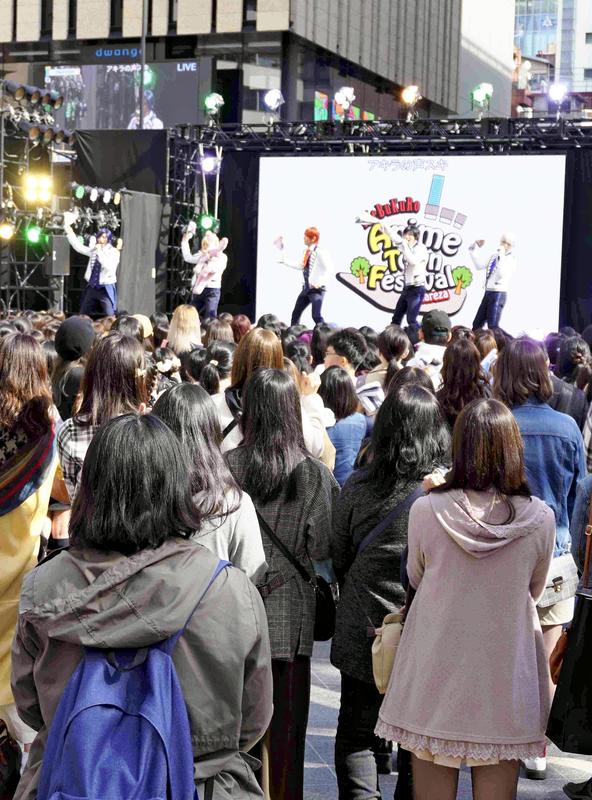
The municipality of Toshima Ward, Tokyo, is also trying to make the most of its parks to develop the ward. At Naka-Ikebukuro Park, which reopened in October after a renovation, a cafe run by Animate, an anime goods shop operator, has been set up. The area around the park, called "Otome Road," is known for the animation and comic book stores for women concentrated there. The park is designed to promote Ikebukuro as a sacred place for anime. The cafe serves food and drinks associated with anime and games.
The park has also been used for a live performance by Ichiro Mizuki, a singer known as the king of anime songs, with a temporary stage erected in the park.
In Takatsuki, Osaka Prefecture, the Ama national historic site and its surrounding area are being developed as "Ama Site Park," part of which opened this spring. As the park houses the site of a settlement in the Yayoi period (ca 300 B.C.-ca A.D. 300), it has been publicized with the catchphrase "Visit Takatsuki, origin of Japan" to stress the historic features of the city. An indoor amusement facility for families has been built, while other facilities such as one that displays excavated items from the ruins are scheduled to be set up.
Law revision positive factor
In addition to the introduction of the Park-PFI system incorporated into the Urban Park Law, which was revised in 2017, a reduction in costs for developing parks by local governments is another factor behind the progress in park development involving the private sector.
Previously, small shops were allowed to be built in parks, but the Park-PFI system has allowed park operators to build larger stores and facilities more flexibly. Like Kippushi Green Park, there have been more cases in which entities chosen through public bidding have built facilities themselves.
According to a tally by the Land, Infrastructure, Transport and Tourism Ministry, the amount spent on developing urban parks nationwide peaked at about 1.3 trillion yen in fiscal 1995, but declined to about 300 billion yen in fiscal 2015, a quarter of the peak figure, due to financial difficulties, among other reasons. To make up for this, private funds have come to be used in many places.
"With help from the private sector, regional areas can promote their new charms," said Kenzo Oguchi, a park producer who worked to revitalize Hibiya Park in Tokyo when he was a Tokyo metropolitan government official. "As competition among cities intensifies, the role of parks is likely to become more important in the future."
Read more from The Japan News at https://japannews.yomiuri.co.jp/





.png?w=600)