Many online initiatives have been launched to support shops and manufacturers as they are facing growing pressure due to business suspension requests and a number of cancellations from customers amid the novel coronavirus epidemic.
While the upscale Ginza district of Tokyo is now mostly deserted as department stores and high-end boutique shops remain closed, images of people bartering with each other signature Ginza products are frequently posted on social media.
This initiative was launched by Daichi Saito at Kobikicho Yoshiya, a wagashi traditional Japanese confectioner with a 100-year history. Yoshiya, known for its dorayaki bean-jam pancakes, has on hand a large number of branding irons to imprint certain designs on the sweets at the request of companies or shop owners. Each design reminds him of the people who order to have the irons made.
In March, Saito was shocked to hear that Kobikicho Benmatsu, a long-established shop nearby selling bento boxed meals, was going out of business due to the coronavirus crisis.
"I thought more and more stores may go under," he said.
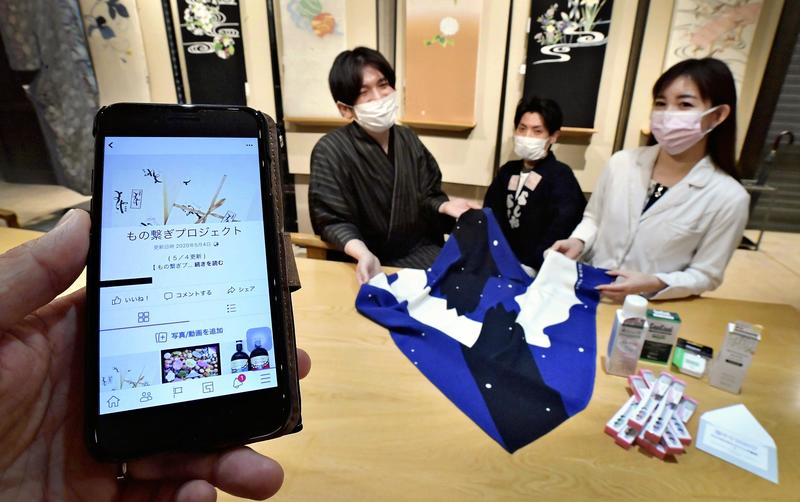
From April, Saito began posting tweets on the shop's account with the hashtag "mono-tsunagi project" (project for connecting products).
Beginning with his store's dorayaki, Saito exchanged it with another store's product, which was then bartered with another different item. Saito posted images of the items he got by barter, along with each store's characteristics and contact information.
Roughly 30 Ginza specialty items have been showcased so far, from fruit jelly, roast beef, tenugui hand towels featuring the name of a rakugo storyteller, anpan bean-jam buns to beef curry. Some viewers have left comments, saying they want to visit these shops once businesses reopen.
Sometimes "ceremonies" have been held to exchange items. On the night of May 20, one such event was held to barter a colorful furoshiki wrapping cloth from a kimono shop and a coupon for teeth whitening from a dental office.
"I'd be so glad if I could be of some help in revitalizing the Ginza district," said Saito, adding he will continue this project for the time being.
Some athletes have also played a part in getting the word out. Food Rescue Hero, an online shopping site launched in late April, aims to sell surplus produce and agricultural processed goods at a discount to assist businesses affected by business suspension requests.
The first item posted on the site was a pie made from Hokkaido apples. All 4,000 packages sold out quickly, thanks to promotional activities on social media by younger players on Hokkaido Consadole Sapporo, a team in the top division of the J.League.
"We were really in a bind because we could not sell our orchard's apples due to the voluntary closures of so many restaurants," said Takuro Nakano of Naganuma, Hokkaido, who sold the apple pie. "I really appreciate assistance coming from different fields."
On Food Rescue Hero, salmon roe marinated in soy sauce, assorted dried fish and freshly squeezed milk are also popular items.
"Even if we can't play in matches, there are things we can do," said Takuma Arano, a Consadole Sapporo player who supports the Food Rescue Hero site on his Twitter account. "There are also some athletes beyond Hokkaido who have expressed their willingness to offer a helping hand. We aim to expand this network of support nationwide."
Crowdfunding campaigns are also promising.
Hinai-jidori brand chicken, a specialty product of Akita Prefecture, has seen a 70% nosedive in consumption compared to a typical year. A crowdfunding campaign to support the chicken's producers raised its target of 1 million yen well before the end of May, the initial deadline. Donors will receive such items as a set of deli food featuring the chicken.
The Campfire website showcases a wide range of crowdfunding projects to support not just producers and restaurants, but also live music clubs and sightseeing spots. Over 3 billion yen has already been raised via crowdfunding campaigns related to the coronavirus crisis, according to the operating company of the website.
"The funds raised via crowdfunding can be provided relatively quicker than public assistance," said a public relations officer. "It is easy for people to participate because the results can be seen sooner."
Read more from The Japan News at https://japannews.yomiuri.co.jp/