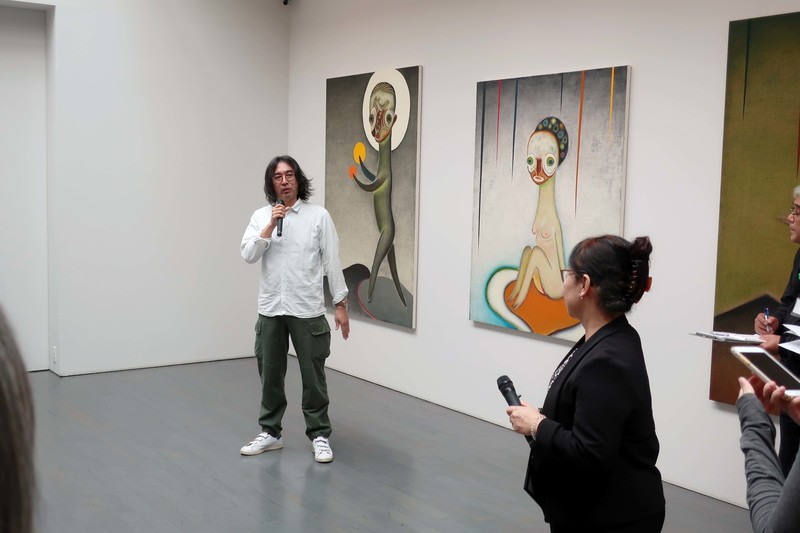
The works of Izumi Kato are often described with words like "primitivistic" and "otherwordly." Fitting, therefore, that my introduction to his art took place in the mountains far from Tokyo, amid forests hung with mist.
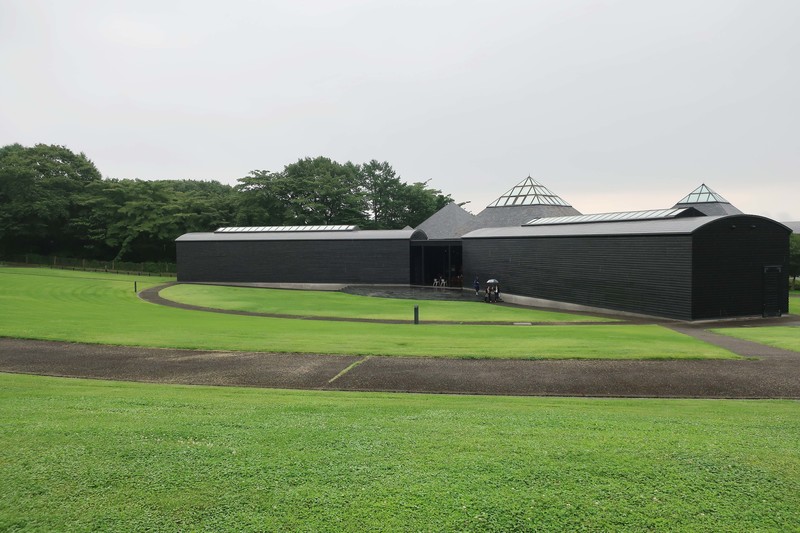
I was visiting Hara Museum ARC, which is hosting part of a massive retrospective called "Izumi Kato -- Like a Rolling Snowball." A building composed of galleries full of natural light connected by verandas, it's set among green grass and forests with a welcome silence punctuated only by the sound of sheep nearby. The highlands at the foot of Mt. Haruna in Gunma Prefecture are an unlikely locale for a contemporary art museum, but it's been going strong since being established in 1988 as the annex of the Hara Museum of Contemporary Art in Shinagawa Ward, Tokyo.
In the first gallery I entered, five enormous wooden sculptures loomed above me, their arms stretching upward with miniature heads instead of hands. The roughly chiseled wood, brightly painted faces and enormous eyes that seemed to stare beyond me all made me think of tribal totems. I felt like I'd stepped into a temple.
The feeling of connecting to something deep and ancient when looking at Kato's art is no coincidence. Based in Tokyo and Hong Kong, Kato has often acknowledged the influence of his native Shimane Prefecture -- home to Izumo Taisha grand shrine -- on his art, describing Shimane as a place of "gods and ghosts."
The human-like forms he returns to over and over -- crudely delineated bodies, faces nearly absent of features except for those fathomlessly deep eyes -- are both essentially human and eerily strange: sometimes embryonic, occasionally androgynous, reminiscent of both prehistoric art and anime characters. By creating beings that are so familiar yet hover on the edges of understanding, Kato communicates something arcane about humanity.
This may be one reason Kato is on the rise globally. Since being included in the 52nd Venice Biennale in 2007 and being taken on by French global art powerhouse Perrotin, he has held solo shows in Paris, Berlin, China, South Korea, Italy and Mexico. According to Perrotin, which has six galleries across the world, his work is especially popular among Chinese art collectors.
"The younger generation in China grew up exposed to diverse cultures around the world, so they can easily resonate with Kato's iconic spiritual beings," a representative of the gallery told The Japan News.
"People are fascinated by the uncanniness emanating from his distinctive and anthropomorphic figures. The visual impact is beyond language and culture; it is something deeply intuitive that gets at the senses."
'Boom' time
The current exhibition -- which will run through January 2020 at both Hara Museum locations -- is a significant moment in Kato's career. In addition to being his first solo show in Tokyo, it's monumental: A total of about 130 pieces were originally planned, but ultimately more than 200 are on display.
Kato began to work as an artist in his late 20s, after graduating from art school. This year he turns 50. "For me," he explained at a press conference on July 11, days before the show opened, "'Like a Rolling Snowball' is like, somehow I survived for 25 years, so I want to keep living as an artist and as a human."
One gallery room groups Kato's early paintings from the mid- to late-1990s. They're moody, ephemeral approximations of human forms, the simple lines of their bodies dripping toward the edge of the canvas, their faces blurred, the colors washed out as though they've been rained on.
In another room, enormous heads with luminescent edges float on solid black canvases in a series of paintings from 2006-07. The ever-present hypnotic eyes, usually painted a single color, are speckled. Kato said the way he paints the eyes changes depending on his current "boom," meaning whatever he's really into at a particular time.
He's reluctant to attach motivations to his works, explaining that he experiments rather than makes something for this or that reason.
"The triggers are all over the place, but I have no idea what they are," he said. "When something rings my bell, without checking it at all, I start creating and something I don't control enters the work … When the 'boom' ends and I'm able to digest it, the work ends up being something within my realm."
Kato has increasingly incorporated a wider variety of materials into his work, collecting rocks from reclaimed land near his Hong Kong studio, printing lithographs at Idem workshop in Paris, attaching soft vinyl figurines to wooden sculptures and sewing canvas with embroidery thread.
The trend is evident in his works at the Tokyo museum, which were all created between 2017 and 2019. The Western-style building was a private residence built by Meiji-era industrialist Kunizo Hara in 1938 -- but the airy front room with its elegant fireplace is currently home to a gigantic canvas and leather humanoid figure.
Later, looking out from what used to be the sunroom, I spied two small rock figures in the garden, one tucked into the trunk of a tree like a tiny god. Decisions like these were made by Kato during a three-day period he spent at the museum placing the objects, Associate Curator Mariko Ogata said.
The last room I visited holds nearly a dozen individual works in display cases that, Ogata pointed out, are akin to those in natural history museums. They hold unique humanoid forms, each made with entirely different materials, demonstrating how Kato's practice has evolved.
Yet despite the obvious differences, there are commonalities that thread these specimens together. It seems like a metaphor for the human race, and an example of how a deeply Japanese artist like Izumi Kato can transcend boundaries.
-- ARC to become sole Hara Museum location
Hara Museum of Contemporary Art in Tokyo opened in 1979, but due to the building's age and historical status it will be closed at the end of 2020. From 2021, Hara Museum ARC will be the sole exhibition space.
The ARC annex warrants a day or weekend trip. Located near Ikaho Onsen, long a popular escape for Tokyoites, it's also next door to Ikaho Green Bokujo, a farm and campsite. Mizusawa udon, said to be one of the "three great udon of Japan," comes from this region and can be enjoyed at a number of restaurants a short drive from the museum in Ikahomachi Mizusawa.
-- Exhibition information:
"Izumi Kato -- Like a Rolling Snowball" runs until Jan. 13, 2020, at both locations:
Hara Museum of Contemporary Art, Shinagawa Ward, Tokyo, 11 a.m. to 5 p.m., closed Mondays (except national holidays).
Hara Museum ARC, Shibukawa, Gunma Prefecture, 9:30 a.m. to 4:30 p.m., closed Thursdays.
Check website for specific opening dates: www.haramuseum.or.jp
Read more from The Japan News at https://japannews.yomiuri.co.jp/