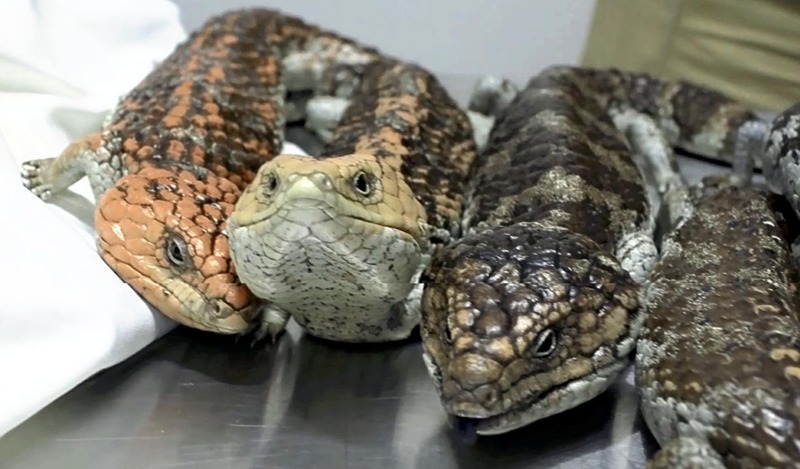
JAKARTA -- The smuggling of bobtail lizards (also known as shingleback lizards), which are popular as pets in Asian countries, is rampant and several Japanese involved in such cases have been caught. As there is no law that restricts distribution and other actions once they are brought into Japan, the lizards are believed to be sold through pet shops and other conventional distribution channels.
The bobtail lizard is indigenous to Australia and has scales that look like those of pine cones. In recent years, the lizard has attracted attention as a pet and is sometimes sold in Japan for more than 1 million yen.
Relevant Australian authorities are investigating the smuggling cases in cooperation with international organizations, on the assumption that smuggling syndicates may be involved.
Australia restricts the export of its wild animals. Cases of bobtail lizards being smuggled have been on the rise since 2018. In the April-May period, crackdowns by the International Criminal Police Organization along with investigative authorities from 22 countries including Australia found more than 200 people involved in reptile smuggling.
Australian authorities have caught Japanese nationals in four cases since November 2018. During the April-May crackdowns, a 27-year-old Japanese woman was arrested for trying to take 19 lizards, including bobtail lizards, out of Australia.
At the end of July, two Japanese men in their 50s and 20s respectively were sentenced to five months in prison for violating the Bio-diversity Conservation Law. The two men were spotted in early June trying to transport 13 lizards in a suitcase at Perth Airport, in the country's southwest.
Both cases involved live lizards. An official said that a common criminal organization must be involved in these cases.
According to the World Wide Fund for Nature, more than 190,000 live reptiles are imported into Japan every year.
Japan imports about 430 million yen worth of reptiles each year and is the world's fourth-largest such importer, following Hong Kong, the United States and China.
Japan's Welfare and Management of Animals Law does not require pet shops to prove means of acquisition of animals. Therefore, it is believed that not a few smuggled animals are distributed along with animals that are imported formally or bred in Japan.
A WWF Japan official said, "Consumers can't spot smuggled pets" and urged that countermeasures be strengthened.
Read more from The Japan News at https://japannews.yomiuri.co.jp/