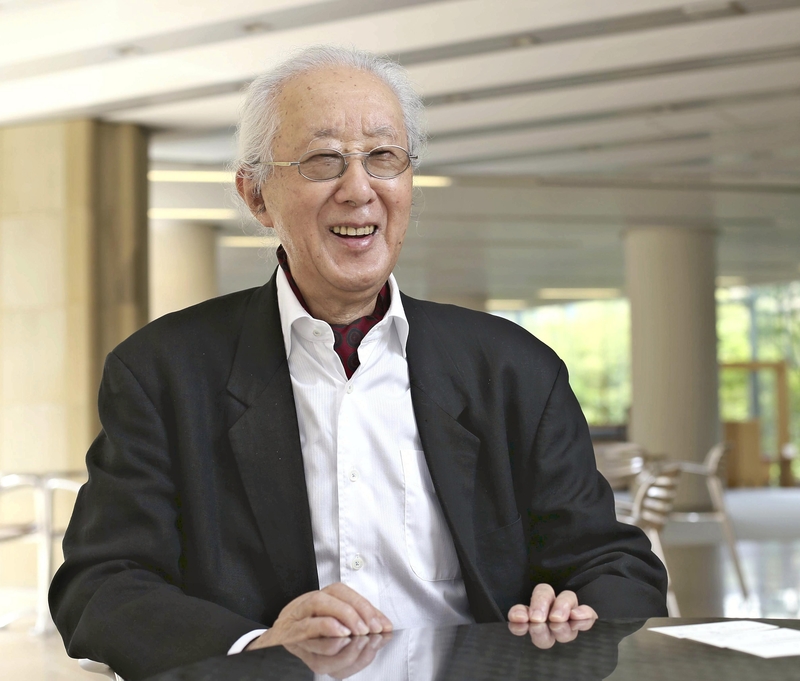
OITA -- An exhibition showcasing the work of world-renowned architect Arata Isozaki explores the core tenets of a man who has constantly questioned just what architecture should be. "I want people to see the exhibition with their eyes, listen to it, walk through it and, in particular, feel it in their back," said Isozaki, 88.
Titled "Isozaki Arata no Nazo" (Arata Isozaki: Third Space IKI+SHIMA), the exhibition runs until Nov. 24 at the Oita Art Museum in Isozaki's hometown of Oita. It features 30 projects he has worked on, beginning in the 1960s, including building design, installations and urban planning projects.
The exhibition has two sections, named "iki" (breath) and "shima" (isle). The iki section represents the concept of ma, or the space that lies in between things.
The installation "Michiyuki" (1978-79) has 15 stones placed on the floor, much like stepping stones found in a traditional Japanese garden. Placing the stones at uneven intervals creates "ma" in the spaces between them, and these spaces also are transformed depending on where they're viewed from. This piece displays Isozaki's ideological background as a standard-bearer for postmodern architecture, which defied the functionalism of the 1970s and '80s.
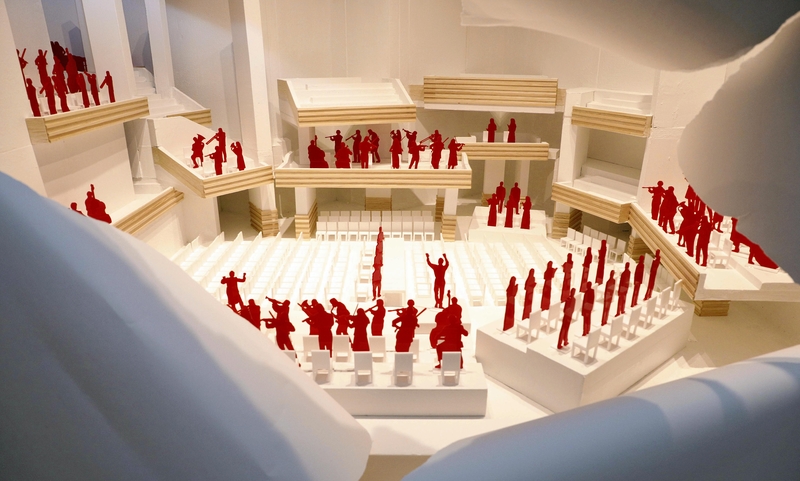
Such thinking took on tangible form in the auditorium at Akiyoshidai International Art Village (1995-98) in Mine, Yamaguchi Prefecture. As well as including a model of the venue, video footage is played of the contemporary opera actually being performed in the hall.
The hall's seats are movable, so audience members can freely change their position in relation to the stage and experience different sounds depending on their location. This broadens the possibilities of what can be heard, and creates a space in which the audience can be actively involved.
Shima is a concept that depicts precisely what cities mean to Isozaki. His urban planning and large-scale projects reveal his approach of bringing up problems that society needs to address.
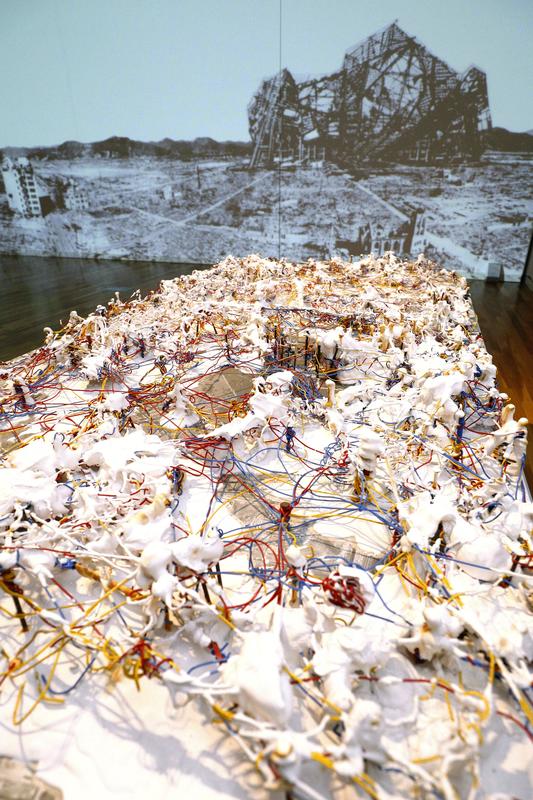
"Fuka Katei" (Incubation Process), a 1962 Isozaki work that was adapted in 1997, features spikes driven into a city map with wires tied in no particular pattern, then covered with plaster. Visitors helped create this work at a previous exhibition. This piece symbolizes that no matter how "planned" development might be, modern-day cities go through a recurring cycle of natural growth and collapse, and therefore cannot escape becoming uncontrollable.
Isozaki's urban planning ideas are on a huge scale, building cities from scratch. This applies to works including "Kuchu Toshi -- Shibuya Keikaku" (City in the Air -- Shibuya Project, 1960-62) and "Kaishi Plan, Zhuhai, China" (1994-97,) his plan for an artificial island to be constructed off the coast of Macao, China.
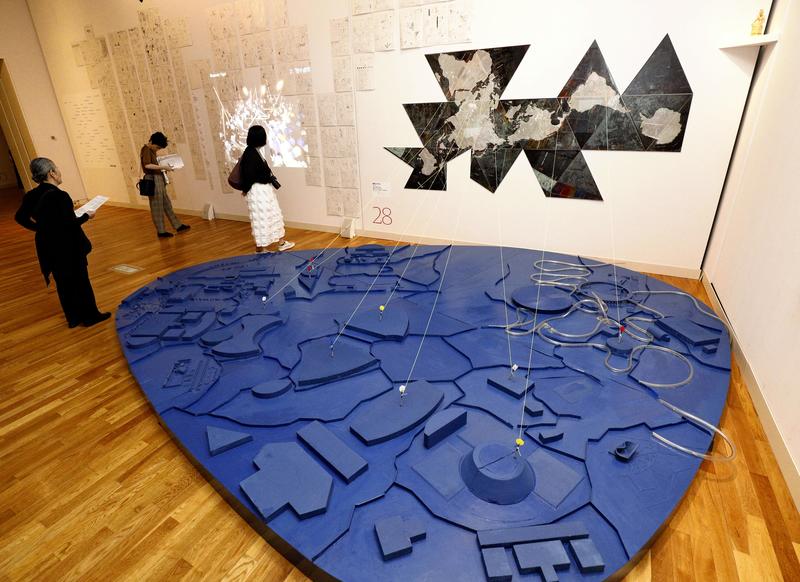
Most of Isozaki's plans were considered difficult to realize when they were announced, so they remained little more than concepts on paper. However, the concept of an island off Macao and a city of information and space seen in "Computer Aided City" (1972), which imagined a model for Makuhari, Chiba Prefecture, still resonate today.
"Many years ago, I thought a utopia could be expressed only in science fiction, but now we can start making this in real life," Isozaki said.
Isozaki's depictions of cities have expanded in scope to a global scale. His 2019 installation for a project portraying the holding of a conference to consider solutions to global problems, suggests assembling representatives of the world's languages -- not nation states -- on a manmade island. Just before this exhibition opened, young people from around the world had a chance to speak at a U.N. climate action summit meeting. "That was very well-timed," Isozaki said.
In recent years, Isozaki has keenly felt that the English word "architecture" has taken on a broader meaning.
"When I read English-language newspapers, I see that people who design and develop cities, and even politicians who decide policies and theorists also are starting to be called architects. It isn't just a term reserved for [conventional] architects," Isozaki said. "Architects no longer just draw up artistic buildings like they did years ago. Now they truly can do architecture in a broader sense."
Read more from The Japan News at https://japannews.yomiuri.co.jp/