NARA -- Kisshosoji temple in Nara Prefecture has enshrined a "moe" girl character based on the patriarch of Shugendo, a form of asceticism incorporating ancient mountain worship, Buddhism and other religious beliefs.
It is extremely rare to worship moe characters -- usually cute, endearing female anime or comic characters beloved by fans -- as an object of faith, although it has become common for temples and shrines to use them to bring in visitors.
The temple is located in the city of Gose, and has a history of about 1,300 years. It said to be the birthplace of Shugendo founder En no Ozunu, also known as En no Gyoja.
The temple hopes to have the character "serve as an impetus for many people to learn about Shugendo practice."
Despite being a historic temple associated with the Shugendo founder, Kisshosoji has very few parishioners and struggled to raise funds to renovate its main hall in 2007.
The temple therefore adopted last year as its official moe character a girl created by local illustrator Hideki Sumino, in the hope of drawing many people to Kisshosoji.
The character is named En no Ozuna, and its kanji characters come from the founder's name and the first letter of the word "Nara."
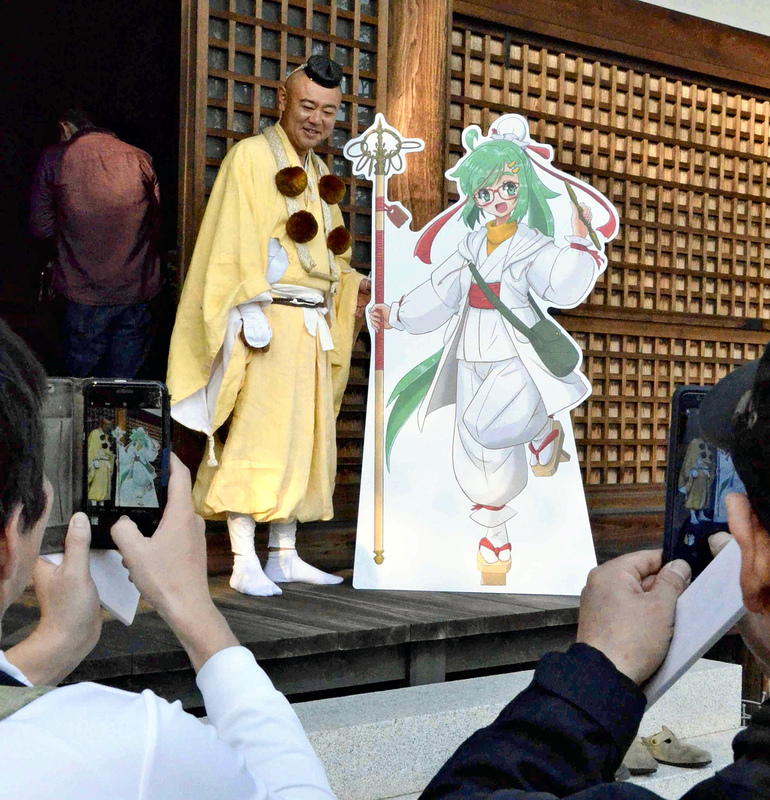
She wears a mountain ascetic costume of white clothing and geta wooden clogs, and holds a crosier in her right hand and a vajra mystical weapon in the left.
In October last year, the temple invited ascetics from the Shogoin head temple of the Shugen sect in Kyoto to hold a consecration ceremony for Ozuna to make her a deity who practices under the Buddhist deity Fudo-myoo, the temple's principal diety.
A 40-centimeter-tall figure of Ozuna is enshrined in the main hall along with the temple's principal deity.
The "moe-character deity" became news on social media, and now has more than 4,000 Twitter followers.
The temple began attracting young visitors from all over the country and sells ema wooden plaques with an illustration of Ozuna as well as a key chain among other goods.
The temple's goshuin red ink stamp to record a visit to the temple has also become popular. A panel of the character is set in the main hall, and visitors can take pictures with it.
On Oct. 21, the temple held a ceremony to commemorate the first anniversary of Ozuna's consecration. About 50 people participated.
"I now feel close to Shugendo, which has a solemn image," said Kazuki Maeda, a 31-year-old company employee who attended the event from Kita Ward, Osaka.
Yoko Matsumoto, 34, from Katsuragi, Nara Prefecture, said she became interested in the temple through its moe-character deity. "The temple may become popular among foreigners who admire Japanese anime culture," she said.
On Nov. 11, the 17-year-old second daughter of the temple's chief priest, Tekkan Yamada, will dress up as Ozuna and lead about 100 mountain ascetics in a parade at the Gose festival.
"The new deity is accepted by Shugendo followers without any problem. I want to make Shugendo better known through Ozuna and form a connection with many people," Yamada said.
Temples seek young visitors
Temples and shrines across the nation are utilizing "moe" characters of gods and other figures to promote their areas.
In 2009, Ryohoji temple in Hachioji, Tokyo, put up a large signboard featuring characters modeled after the Buddhist deity Benzaiten and others so "anyone can casually visit the temple." Such efforts made the temple famous as a "moe dera."
Now the Ryohoji characters have a theme song and stickers for use on the message app LINE, attracting many young people to the temple.
A citizen group based in Katsuragi, Nara Prefecture, began creating characters featuring deities from shrines in the city in November last year. The city government plans to soon issue a map of the characters.
One factor behind these efforts is said to be a decline in the number of parishioners and financial supporters, called danka in the case of temples and ujiko for shrines.
More than 30 percent of the about 100,000 temples across the nation are believed to be on the verge of closure, according to the Japan Tourism Association for Shrines and Temples.
"More temples and shrines in rural Japan, which face grave financial difficulties, are likely to create moe characters to increase the number of young visitors," said Shingo Ito, a visiting associate professor at the International Research Center for Japanese Studies.
Ito, who specializes in religion, said: "Promoting temples and shrines through the internet and moe characters is effective for attracting young people. However, such promotions are hard to accept for people who aren't interested in characters like that."
Read more from The Japan News at https://japannews.yomiuri.co.jp/