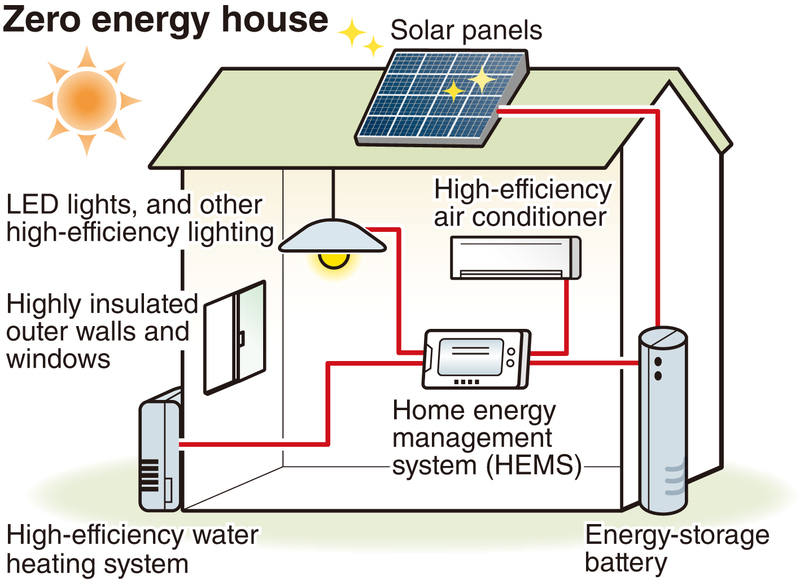
Houses combining energy-saving and energy-generating facilities, such as solar power generation, to achieve a zero-net energy balance are increasingly gaining attention. Net zero energy houses (sometimes abbreviated as ZEH) are often environment- and budget-friendly, and because of their ability to maintain a fairly constant internal temperature, they are also expected to have positive health effects. The central government is promoting the spread of zero-energy homes, citing that they will help reduce greenhouse gas emissions and enable self-supply of electricity during disasters.
Hironori Ishige, 35, a company employee in Choshi, Chiba Prefecture, built a wooden one-story zero-energy home in March this year. Ishige, his wife and his daughters had been living at his parents' house with his mother and father, but when his two daughters became older, he felt that the house was too small for all of them.
"For me and my wife, a house is a once-in-a-lifetime purchase. If we were going to build a house, we wanted to build a comfortable, high-quality house that was energy-efficient, among other things" Ishige said.
Thick, high-density, thermal insulation materials and highly insulated windows with multiple panes of glass were used in the house's construction so that the temperature outside has minimal impact on the temperature inside. Furthermore, they tried to make the house more energy efficient by installing high-efficiency air conditioners and LED lights, among other things.
Surplus electricity produced by the solar panels installed on the roof can be sold to energy providers. The amount of electricity generated and the amount of electricity consumed can be checked on their home energy management system (HEMS).
Cool in summer, warm in winter
Ishige made full use of his large roof area by having 62 solar panels installed, over four times as many as the average. About 10 kilowatts of electricity are generated during the day, even on overcast days, while only about 1 kilowatt of electricity is consumed. After subtracting charges for electricity consumed from the money earned from the sale of surplus electricity, they have been making about 40,000 yen a month, according to Ishige.
"Thanks to [the building's] high thermal insulation properties, it's comfortable inside, even on extremely hot days. I'm satisfied because the house even earns money," he said.
"We offer houses that are cool in summer, warm in winter and comfortable to live in," said an official from Tokyo-based Aqurahome Co., which built the house.
The central government has set a goal of increasing the percentage of zero-energy homes built to over 50 percent of detached new-builds by 2020. Because the construction cost of zero-energy homes is about 2 yen to 3 million higher than an ordinary house, the central government has introduced a subsidy program to provide 700,000 yen toward the construction costs of such homes in fiscal 2018.
Toshiharu Ikaga, an architectural environment engineering professor at Keio University, said: "The minimal temperature variation in highly insulated houses helps to prevent heat shock and thus lowers the risk of cardiac disorders and cerebral stroke. In addition, a study has shown that such houses help to extend healthy life expectancy by four years. As a health promotion measure for the super-aging society, it is important to promote ZEHs."
Home builders are also getting behind the push toward zero-energy homes. Seventy-six percent of new detached houses constructed by Sekisui House Ltd. in fiscal 2017 were zero-energy buildings. Apartment blocks generally have less space per unit for the installation of solar panels, but the company has started to use materials with higher thermal insulation properties to meet zero-energy standards. Misawa Homes Co. is also making efforts to develop a construction method to take advantage of the solar-energy generating capacity of even small roofs.
Read more from The Japan News at https://japannews.yomiuri.co.jp/