With the signing of a new free trade pact between Japan and Britain, a sharp rise in tariffs and other negative impacts are expected to be avoided in regard to trade between the two countries.
Tokyo and London aim to put the agreement into effect on Jan. 1 after going through parliamentary procedures. The current trade agreement expires at the end of this year as a result of Britain's withdrawal from the European Union.
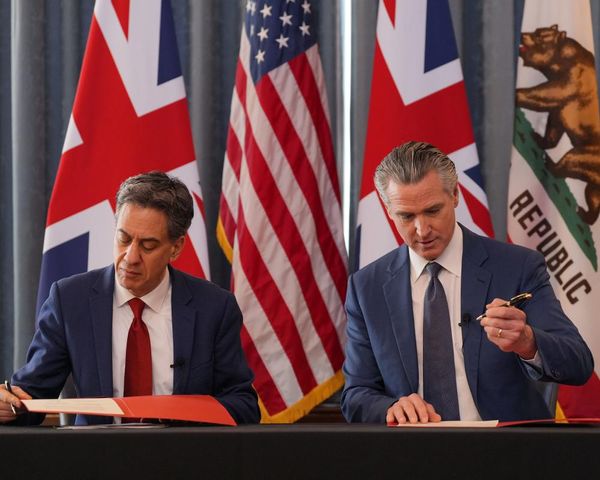
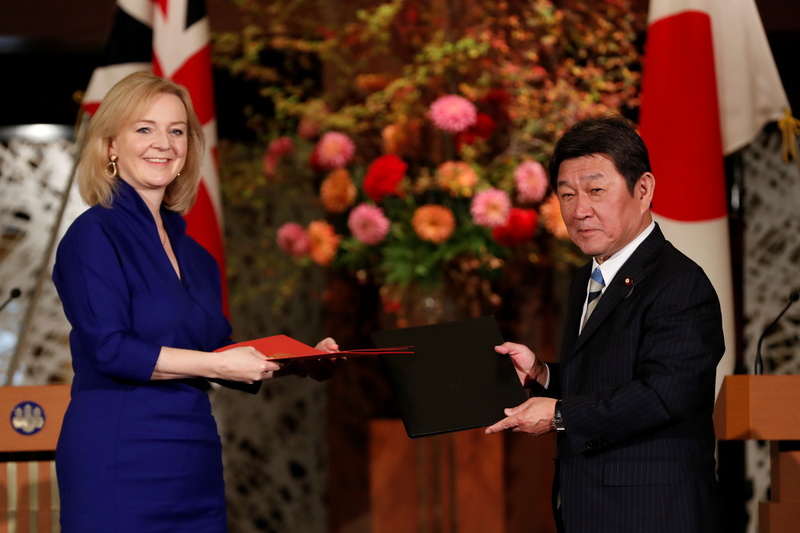
Foreign Minister Toshimitsu Motegi and British Secretary of State for International Trade Elizabeth Truss signed the economic partnership agreement in a signing ceremony at the Iikura Guest House in Tokyo on Friday.
"In addition to further promoting trade and investment between Japan and Britain, we would like to make this agreement serve as an important foundation to strengthen and promote the bilateral relationship," Motegi said at a press conference after the signing ceremony.
The deal with Japan is Britain's first trade agreement with a major economy since leaving the European Union in January this year. "How fitting it is to be in the Land of the Rising Sun to welcome in the dawn of a new era of free trade," Truss said. The deal will bring great benefits for both countries, she said.
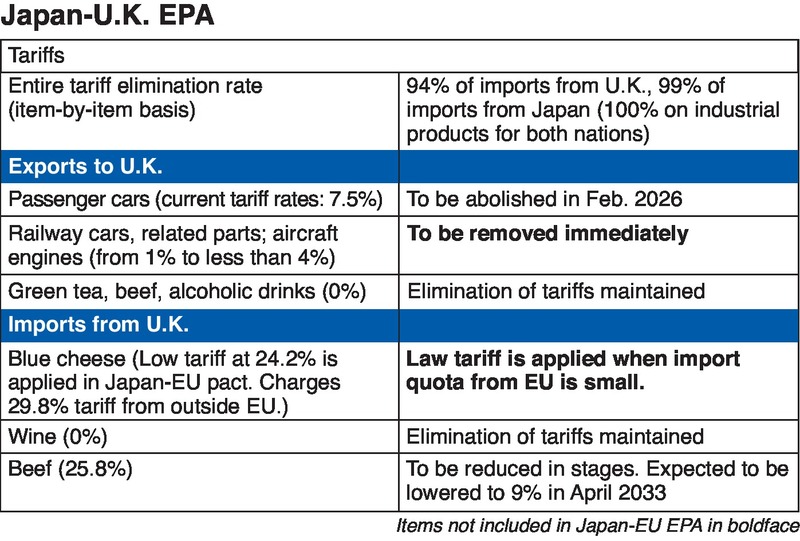
In terms of tariffs, the bilateral trade pact largely followed the EU-Japan EPA.
On an item-by-item basis, tariffs on about 94% of imports from Britain, and tariffs on about 99% of imports from Japan will be eliminated, including items subject to the future abolition of tariffs. They agreed on these terms because any major change in tariff rates could affect the economic activities of both countries.
The two nations agreed to maintain the existing arrangement under which tariffs on cars -- Japan's key industry -- exported from Japan to Britain will be abolished in February 2026.
Meanwhile, additional tariffs on railway cars and related parts exported from Japan to Britain will be removed immediately.
Another important feature of the agreement is that it enhances digital trade rules, something other trade agreements are not yet doing. The agreement prohibits both governments asking businesses to disclose confidential business information, such as algorithms and codes, or to install core computer equipment in their countries.
The excessive collection of information by governments is also subject to regulation under the agreement. It is believed that the ban aims to discourage the Chinese government from collecting data.
The agreement also includes cooperation between the two countries to prevent consumers from being harmed by cartels and other unfair transactions by companies.
Britain has also shown interest in joining the Trans-Pacific Partnership (TPP). The Japanese government has been negotiating the bilateral EPA based on the TPP rules as well.
Yasutoshi Nishimura, minister in charge of economic revitalization and TPP affairs, who met with Truss after the signing ceremony, said "Japan would work closely with Britain, which shares our values."
Read more from The Japan News at https://japannews.yomiuri.co.jp/