The transport ministry is investigating how much flights and other factors affect pilots' levels of fatigue, in a bid to improve the management of Japanese pilots' fatigue to match levels in the United States and Europe.
A shortage of pilots is feared in Japan, and the Land, Infrastructure, Transport and Tourism Ministry's fact-finding survey is aimed at preventing excessive work burdens on pilots from leading to dangerous situations.
The ministry plans to compile a draft of standards regarding pilots' degree of fatigue by the end of this fiscal year, based on the survey's findings.
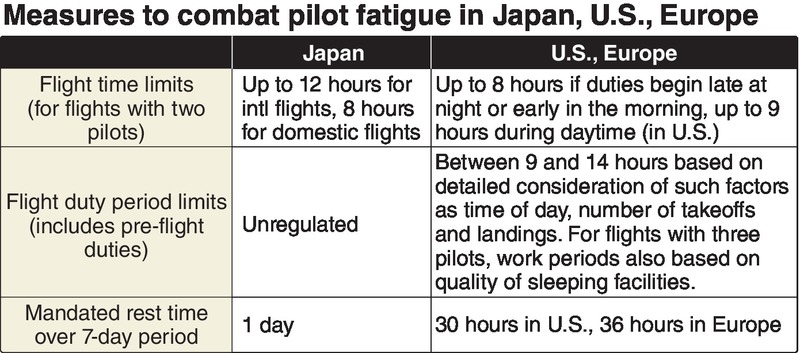
Current Japanese standards for managing pilots' fatigue have been in place since 1992. Among other rules, they stipulate that pairs of pilots cannot work more than eight consecutive hours on domestic flights, or more than 12 hours on international flights.
However, the current standards do not take into account the frequency of takeoffs and landings, or the time of day.
In the United States and Europe, measures to manage pilots' fatigue were made stricter following the crash of a Colgan Air plane in the United States in 2009. All 49 passengers and crew onboard were killed, as well as a local resident.
There were records that the pilot had repeatedly yawned before the crash. Experts pointed out the possibility that pilot fatigue had been a significant cause of the accident, which led to tougher standards.
The revised standards are detailed -- for example, airlines must shorten pilots' work hours on flights if pilots begin flight operations late at night or early in the morning, and if planes' facilities for sleep breaks are in bad condition.
Given that airlines across the globe are forming business tie-ups, the ministry judged that Japan needed to manage pilots' fatigue to the same degree as in the United States and Europe.
The fact-finding survey has been conducted through Japanese airlines since late July. Pilots analyze their own physical condition before and after flights by choosing one answer from among seven options, ranging from "I'm completely awake and don't feel sleepy" to "I'm exhausted and it's impossible for my body to function effectively."
Tests to measure pilots' responses to lights are also conducted. Statistics are then compiled in accordance with the pilots' number of takeoffs and landings and the times of day that they fly.
The ministry will analyze the results while also hearing from experts in aeronautical engineering and medicine. It then plans to draft new standards for management of pilot fatigue.
According to the ministry, there were about 6,400 pilots at Japanese airlines as of January last year. More than half were veterans aged 45 or older.
Along with the retirement of many pilots in the coming years and increased demand for flight services, about 430 newly hired pilots are expected to be needed in 2030, or 1.4 times current annual hiring levels.
Some flights are already being canceled due to an insufficient number of pilots, mainly by low-cost carriers.
"Because of irregular flight duty periods and time-zone differences, it's difficult to manage pilots' physical condition," said Sadao Tamura, a former captain with All Nippon Airways and a former member of the ministry's Japan Transport Safety Board.
"At some airlines, mainly LCCs, the burden on pilots may increase. It's important to establish standards for pilots' fatigue as soon as possible, so they don't work too much."
Read more from The Japan News at https://japannews.yomiuri.co.jp/